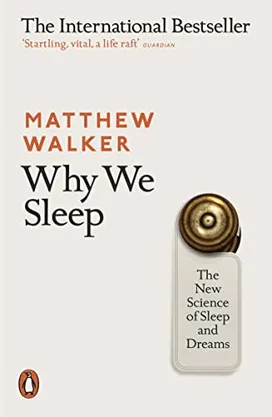
Why We Sleep
by Matthew Walker
Started 20 April 2020 · 368 pages
A neuroscientist explains what sleep does for the brain and body, why we need it, and how lack of sleep harms memory, health and longevity.
About the book, from Open Library. Get the book.
46 highlights · Kindle location in the margin
- 88
More than a third of adults in many developed nations fail to obtain the recommended seven to nine hours of nightly sleep.
- 91
Routinely sleeping less than six hours a night weakens your immune system, substantially increasing your risk of certain forms of cancer.
- 95
Fitting Charlotte Brontë’s prophetic wisdom that “a ruffled mind makes a restless pillow,” sleep disruption further contributes to all major psychiatric conditions, including depression, anxiety, and suicidality.
- 97
Too little sleep swells concentrations of a hormone that makes you feel hungry while suppressing a companion hormone that otherwise signals food satisfaction. Despite being full, you still want to eat more. It’s a proven recipe for weight gain in sleep-deficient adults and children alike. Worse, should you attempt to diet but don’t get enough sleep while doing so, it is futile, since most of the weight you lose will come from lean body mass, not fat.
- 130
Consider that we have known the functions of the three other basic drives in life—to eat, to drink, and to reproduce—for many tens if not hundreds of years now. Yet the fourth main biological drive, common across the animal kingdom—the drive to sleep—has continued to elude science for millennia.
- 139
As one sleep scientist has said, “If sleep does not serve an absolutely vital function, then it is the biggest mistake the evolutionary process has ever made.”
- 169
sleep is the single most effective thing we can do to reset our brain and body health each day—Mother Nature’s best effort yet at contra-death.
- 188
My hypothesis: there was a unique and specific electrical brain signature that could forecast which dementia subtype each individual was progressing toward.
- 190
in the nighttime ocean of sleeping brainwaves did the recordings speak out a clear labeling of my patients’ saddening disease fate. The discovery proved that sleep could potentially be used as a new early diagnostic litmus test to understand which type of dementia an individual would develop.
- 254
It is no coincidence that the likelihood of breaking an Olympic record has been clearly tied to time of day, being maximal at the natural peak of the human circadian rhythm in the early afternoon.
- 258
It was in 1729 when French geophysicist Jean-Jacques d’Ortous de Mairan discovered the very first evidence that plants generate their own internal time.
- 270
De Mairan placed the plant in a sealed box for the next twenty-four-hour period, plunging it into total dark for both day and night. During these twenty-four hours of blackness, he would occasionally take a peek at the plant in controlled darkness, observing the state of the leaves. Despite being cut off from the influence of light during the day, the plant still behaved as though it were being bathed in sunlight; its leaves were proudly expanded.
- 274
de Mairan had shown that a living organism kept its own time, and was not, in fact, slave to the sun’s rhythmic commands.
- 276
The plant didn’t just have a circadian rhythm, it had an “endogenous,” or self-generated, rhythm.
- 318
So long as they are reliably repeating, the brain can also use other external cues, such as food, exercise, temperature fluctuations, and even regularly timed social interaction. All of these events have the ability to reset the biological clock, allowing it to strike a precise twenty-four-hour note.
- 321
Any signal that the brain uses for the purpose of clock resetting is termed a zeitgeber, from the German “time giver” or “synchronizer.”
- 354
These are “morning types,” and make up about 40 percent of the populace.
- 355
Others are “evening types,” and account for approximately 30 percent of the population.
- 356
The remaining 30 percent of people lie somewhere in between morning and evening types, with a slight leaning toward eveningness,
- 357
You may colloquially know these two types of people as “morning larks” and “night owls,”
- 362
The prefrontal cortex controls high-level thought and logical reasoning, and helps keep our emotions in check.
- 365
An adult’s owlness or larkness, also known as their chronotype, is strongly determined by genetics. If you are a night owl, it’s likely that one (or both) of your parents is a night owl.
- 369
night owls are not owls by choice. They are bound to a delayed schedule by unavoidable DNA hardwiring. It is not their conscious fault, but rather their genetic fate.
- 389
Your suprachiasmatic nucleus communicates its repeating signal of night and day to your brain and body using a circulating messenger called melatonin.
- 391
melatonin is released at night.
- 395
melatonin helps regulate the timing of when sleep occurs by systemically signaling darkness throughout the organism. But melatonin has little influence on the generation of sleep itself:
- 403
there is a significant sleep placebo effect of melatonin, which should not be underestimated: the placebo effect is, after all, the most reliable effect in all of pharmacology.
- 434
For every day you are in a different time zone, your suprachiasmatic nucleus can only readjust by about one hour.
- 448
Scientists have studied airplane cabin crews who frequently fly on long-haul routes and have little chance to recover. Two alarming results have emerged. First, parts of their brains—specifically those related to learning and memory—had physically shrunk, suggesting the destruction of brain cells caused by the biological stress of time-zone travel. Second, their short-term memory was significantly impaired. They were considerably more forgetful than individuals of similar age and background who did not frequently travel through time zones. Other studies of pilots, cabin crew members, and shift workers have reported additionally disquieting consequences, including far higher rates of cancer and type 2 diabetes than the general population—or even carefully controlled match individuals who do not travel as much.
- 455
Often, they choose to take melatonin pills in an attempt to help with the problem.
- 461
It will still be a struggle to generate the event of sleep itself at this irregular time (for me), but the timing signal does significantly increase the likelihood of sleep in this jet-lagged context.
- 464
At this very moment, a chemical called adenosine is building up in your brain. It will continue to increase in concentration with every waking minute that elapses. The longer you are awake, the more adenosine will accumulate.
- 467
One consequence of increasing adenosine in the brain is an increasing desire to sleep. This is known as sleep pressure, and it is the second force that will determine when you feel sleepy, and thus should go to bed.
- 469
As a result of that chemical sleep pressure, when adenosine concentrations peak, an irresistible urge for slumber will take hold.
- 472
You can, however, artificially mute the sleep signal of adenosine by using a chemical that makes you feel more alert and awake: caffeine.
- 473
caffeine is the most widely used (and abused) psychoactive stimulant in the world. It is the second most traded commodity on the planet, after oil.
- 476
Caffeine works by successfully battling with adenosine for the privilege of latching on to adenosine welcome sites—or receptors—in the brain.
- 479
By hijacking and occupying these receptors, caffeine blocks the sleepiness signal normally communicated to the brain by adenosine. The upshot: caffeine tricks you into feeling alert and awake, despite the high levels of adenosine that would otherwise seduce you into sleep.
- 481
Levels of circulating caffeine peak approximately thirty minutes after oral administration.
- 483
Caffeine has an average half-life of five to seven hours. Let’s say that you have a cup of coffee after your evening dinner, around 7:30 p.m. This means that by 1:30 a.m., 50 percent of that caffeine may still be active and circulating throughout your brain tissue. In other words, by 1:30 a.m., you’re only halfway to completing the job of cleansing your brain of the caffeine you drank after dinner.
- 488
Most people do not realize how long it takes to overcome a single dose of caffeine, and therefore fail to make the link between the bad night of sleep we wake from in the morning and the cup of coffee we had ten hours earlier with dinner.
- 493
Also be aware that de-caffeinated does not mean non-caffeinated. Depending on the decaffeination method and the bean that is used, one cup of decaf can have between 3 to as high as 10 percent of the dose of a regular cup of coffee.
- 501
Aging also alters the speed of caffeine clearance: the older we are, the longer it takes our brain and body to remove caffeine, and thus the more sensitive we become in later life to caffeine’s sleep-disrupting influence.
- 520
It is worth pointing out that caffeine is a stimulant drug. Caffeine is also the only addictive substance that we readily give to our children and teens—the consequences of which we will return to later in the book.
- 537
This combination of strong activating output from the circadian rhythm together with low levels of adenosine result in a delightful sensation of being wide awake.
- 538
at least it should, so long as your sleep was of good quality and sufficient length the night before. If you feel as though you could fall asleep easily midmorning, you are very likely not getting enough sleep, or the quality of your sleep is insufficient.)