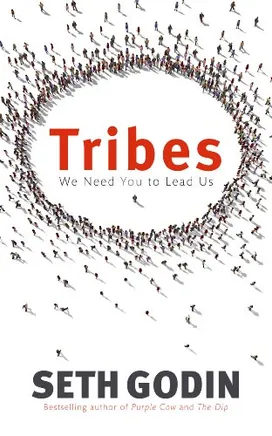
Tribes
by Seth Godin
Started 29 July 2020 · 160 pages
Godin argues that the internet makes it easy to lead a tribe, a group connected by an idea and a leader, and that anyone can and should lead one.
About the book, from Open Library. Get the book.
202 highlights · Kindle location in the margin
- 36
A tribe is a group of people connected to one another, connected to a leader, and connected to an idea. For millions of years, human beings have been part of one tribe or another. A group needs only two things to be a tribe: a shared interest and a way to communicate.
- 43
You can’t have a tribe without a leader—and you can’t be a leader without a tribe.
- 49
Human beings can’t help it: we need to belong. One of the most powerful of our survival mechanisms is to be part of a tribe, to contribute to (and take from) a group of like-minded people.
- 53
We want to belong not to just one tribe, it turns out, but to many. And if you give us tools and make it easy, we’ll keep joining.
- 57
Jacqueline is inspiring entrepreneurs in the developing world to create enterprises that enrich the people around them. She’s helping create organizations that deliver clean water, ambulances, and reading glasses and … doing it in a scalable way that challenges expectations.
- 61
Geography used to be important. A tribe might be everyone in a certain village, or it might be model-car enthusiasts in Sacramento, or it might be the Democrats in Springfield. Corporations and other organizations have always created their own tribes around their offices or their markets—tribes of employees or customers or parishioners. Now, the Internet eliminates geography.
- 72
Many tribes. Many tools. I’m writing to you about both. The market needs you (we need you) and the tools are there, just waiting. All that’s missing is you, and your vision and your passion.
- 74
Some tribes are stuck. They embrace the status quo and drown out any tribe member who dares to question authority and the accepted order. Big charities, tiny clubs, struggling corporations—they’re tribes and they’re stuck.
- 87
the Internet is just a tool, an easy way to enable some tactics. The real power of tribes has nothing to do with the Internet and everything to do with people. You don’t need a keyboard to lead … you only need the desire to make something happen.
- 108
The question isn’t, Is it possible for me to do that? Now, the question is, Will I choose to do it?
- 116
Tribes are about faith—about belief in an idea and in a community.
- 118
Do you believe in what you do? Every day? It turns out that belief happens to be a brilliant strategy.
- 120
Many people are starting to realize that they work a lot and that working on stuff they believe in (and making things happen) is much more satisfying than just getting a paycheck and waiting to get fired (or die).
- 144
Heretics are the new leaders. The ones who challenge the status quo, who get out in front of their tribes, who create movements.
- 147
Suddenly, heretics, troublemakers, and change agents aren’t merely thorns in our side—they are the keys to our success. Tribes give you leverage. And each of us has more leverage than ever before.
- 168
Management is about manipulating resources to get a known job done.
- 170
Leadership, on the other hand, is about creating change that you believe in.
- 173
Leaders have followers. Managers have employees. Managers make widgets. Leaders make change.
- 183
Corporations are traditionally built around the CEO, with all his perks and power. The closer you get to being king/CEO, the more influence and power you have. The goal of the corporation is to enrich the king and to keep him in power.
- 186
Marketing changed everything. Marketing created leverage. Marketing certainly changed the status quo. Most of all, marketing freed and energized the tribe.
- 190
Marketing is the act of telling stories about the things we make—stories that sell and stories that spread. Marketing elects presidents, and marketing raises money for charity. Marketing also determines if the CEO stays or goes (Carly Fiorina learned this the hard way). Most of all, marketing influences markets.
- 192
Marketing used to be about advertising, and advertising is expensive. Today, marketing is about engaging with the tribe and delivering products and services with stories that spread.
- 196
Marketing changed the idea of stability. It’s human nature—we still assume the world is stable, still assume that Google will be number one in five years, that we’ll type on keyboards and fly on airplanes, that China will keep growing, and that the polar ice cap won’t really be melted in six years.
- 210
It’s a criticism when you throw that word at a politician, but all tribes are made up of partisans, the more partisan the better. If you’re a middle-of-the-roader, you don’t bother joining a tribe.
- 211
Partisans want to make a difference. Partisans want something to happen (and something else not to happen). Leaders lead when they take positions, when they connect with their tribes, and when they help the tribe connect to itself.
- 223
New rule: If you want to grow, you need to find customers who are willing to join you or believe in you or donate to you or support you. And guess what? The only customers willing to do that are looking for something new. The growth comes from change and light and noise.
- 249
In Permission Marketing, years ago, I wrote about how marketers must earn the right to deliver anticipated, personal, and relevant messages to people who want to get them. And that’s still correct, as far as it goes.
- 254
I just heard about Jack, an “occasional restaurant” run by Danielle Sucher and Dave Turner in Brooklyn. They open the restaurant only about twenty times a year, on Saturday nights. By appointment. Go online and you can see the menu in advance. Then, you book and pay if you want to go.
- 266
Leaders, on the other hand, don’t care very much for organizational structure or the official blessing of whatever factory they work for. They use passion and ideas to lead people, as opposed to using threats and bureaucracy to manage them. Leaders must become aware of how the organization works, because this awareness allows them to change it.
- 278
Great leaders create movements by empowering the tribe to communicate. They establish the foundation for people to make connections, as opposed to commanding people to follow them.
- 280
This is how Skype spread around the world. Cofounder Niklas Zennström understood that overthrowing the tyranny of the phone companies was too big a project for a small company. But if he could empower the tribe to do it themselves, to connect to one another and to spread the word, he would be able to incite a movement.
- 282
Malcolm Gladwell wrote about the fall of the Berlin Wall, and it involved much the same dynamic. The collapse of East Germany wasn’t the work of one hardworking activist. Instead, it was the gradual but inexorable growth of the tribe, a loosely coordinated movement of activists that gained in force until it couldn’t be stopped.
- 289
The communication can be one of four kinds: • Leader to tribe • Tribe to leader • Tribe member to tribe member • Tribe member to outsider
- 294
So a leader can help increase the effectiveness of the tribe and its members by • transforming the shared interest into a passionate goal and desire for change; • providing tools to allow members to tighten their communications; and • leveraging the tribe to allow it to grow and gain new members.
- 302
The National Rifle Association has a huge impact on the political culture of the United States, far in excess of the organization’s actual size. That’s because the tribe is extraordinarily well connected, communicating up, down, and sideways, and because they have a passionate mission, not just a common idea.
- 310
Tribes, though, aren’t about stuff. They’re about connection.
- 314
unlike the residue of stuff, the tribal connections you can create with leadership grow; they don’t fade. As the organization matures and touches more people, those connections lead to more connections. The tribe thrives; it delivers value and it spreads. Internet folks call this viral activity, or a virtuous cycle. The better you do, the better you do. Connections lead to connections. Great ideas spread.
- 346
Did engineers switch because of the newsletter? Of course not. They switched for the journey. They wanted to be part of something that mattered. Twenty years later, people on that team still talk about what we built.
- 355
Most organizations spend their time marketing to the crowd. Smart organizations assemble the tribe.
- 359
the market has demonstrated that ideas that spread win, and the ideas that are spreading are the remarkable ones.
- 367
Management often works to maintain the status quo, to deliver average products to average people. In a stable environment, this is exactly the right strategy. Build reliability and predictability, cut costs, and make a profit.
- 371
Life’s too short to fight the forces of change. Life’s too short to hate what you do all day. Life’s way too short to make mediocre stuff. And almost everything that’s standard is now viewed as mediocre.
- 378
In an article posted on his Technium Web site, Kevin Kelly brilliantly described the world of “1,000 True Fans.”
- 383
A true fan brings three friends with him to a John Mayer concert or to the opening of a Chuck Close exhibit. A true fan pays extra to own the first edition, or buys the hardcover, instead of just browsing around on the Web site. Most important, a true fan connects with other true fans and amplifies the noise the artist makes.
- 397
The difference between an instant message and twits, though, is that your instant message goes to one person and a twit goes to anyone who has chosen to follow you.
- 407
Organizations that destroy the status quo win.
- 411
Whatever the status quo is, changing it gives you the opportunity to be remarkable.
- 416
Products and services like those require initiative to produce. You can’t manage your way to initiative.
- 418
creating products and services that are remarkable is fun. Doing work that’s fun is engaging. So not surprisingly, making things that are successful is a great way to spend your time. There you go: initiative = happiness.
- 445
By “factory,” I don’t necessarily mean a place with heavy machinery, greasy floors, and a din. I mean any organization that cranks out a product or a service, does it with measurable output, and tries to reduce costs as it goes. I mean any job where your boss tells you what to do and how to do it.
- 447
The second reason we have factories has nothing to do with efficiency and a lot to do with human nature. Part of us wants stability. We want the absence of responsibility that a factory job can give us. The idea of “I’m doing what you told me to” is very compelling, especially if the alternative is foraging for food or begging on the streets.
- 451
On a recent trip I took to India, this mind-set was made crystal clear. Ask almost anyone there what the perfect job would be, and the answer is: working as a government bureaucrat. Not only do you have air-conditioning, but you aren’t even asked to take initiative. The job is steady, the pay is good, and there are no surprises.
- 453
The factory is part of the fabric of our lives. It’s there because it pays, and it’s there because it’s steady, and it’s there because we want it. What you won’t find in a factory is a motivated tribe making a difference. And what you won’t find waiting outside the factory is a tribe of customers, excited about what’s to come.
- 465
when we envision our dream jobs, we’re imagining someone who reaps huge rewards as a result of her insight. Or someone who has control over what he does all day, creating products or services that he’s actually proud of. It certainly involves having authority over your time and your effort and having input into what you do.
- 470
The author Dan Pink coined the term Free Agent Nation to describe a movement of smart people leaving organizations to go out on their own.
- 477
In unstable times, growth comes from leaders who create change and engage their organizations, instead of from managers who push their employees to do more for less.
- 481
I’ve encountered thousands (it might be tens of thousands) of people walking around with great ideas. Some of the ideas really are great; some are merely pretty good. There doesn’t seem to be a shortage of ideas. Ordinary folks can dream up remarkable stuff fairly easily. What’s missing is the will to make the ideas happen.
- 484
In a battle between two ideas, the best one doesn’t necessarily win. No, the idea that wins is the one with the most fearless heretic behind it.
- 489
Fear’s an emotion, no doubt about it. One of the strongest, oldest, and most hardwired.
- 493
What’s interesting about the folks I meet who are engaged and are clearly heretics is that they’ve actively talked themselves out of the fear. I mean, the fear is still there, but it’s drowned out by a different story.
- 495
It’s the story of success, of drive, of doing something that matters. It’s an intellectual story about what the world (or your industry or your project) needs and how your insight can help make a difference.
- 502
the levers are here. The proof is here. The power is here. The only thing holding you back is your own fear.
- 505
Dr. Laurence Peter is famous for proposing that “in a hierarchy every employee tends to rise to his level of incompetence.”
- 507
I think what actually happens is that “in every organization everyone rises to the level at which they become paralyzed with fear.”
- 509
The essence of leadership is being aware of your fear (and seeing it in the people you wish to lead). No, it won’t go away, but awareness is the key to making progress.
- 524
Even worse, working for an organization that is busy fighting off change is horrible.
- 529
What people are afraid of isn’t failure. It’s blame. Criticism.
- 530
We choose not to be remarkable because we’re worried about criticism. We hesitate to create innovative movies, launch new human resource initiatives, design a menu that makes diners take notice, or give an audacious sermon because we’re worried, deep down, that someone will hate it and call us on it.
- 536
Fear of criticism is a powerful deterrent because the criticism doesn’t actually have to occur for the fear to set in. Watch a few people get criticized for being innovative, and it’s pretty easy to convince yourself that the very same thing will happen to you if you’re not careful.
- 538
Constructive criticism, of course, is a terrific tool. If a critic tells you, “I don’t like it” or “This is disappointing,” he’s done no good at all. In fact, quite the opposite is true. He’s used his power to injure without giving you any information to help you do better next time. Worse, he hasn’t given those listening any data with which to make a thoughtful decision on their own. Not only that, but by refusing to reveal the basis for his criticism, he’s being a coward, because there’s no way to challenge his opinion.
- 546
One bad review doesn’t ruin my day because I realize what a badge of honor it is to get a bit of criticism at all. It means that I confounded expectations—that I didn’t deliver the sequel or the simple, practical guide that some expected. It means that, in fact, I did something worth remarking on.
- 553
“If I get criticized for this, will I suffer any measurable impact? Will I lose my job, get hit upside the head with a softball bat, or lose important friendships?” If the only side effect of the criticism is that you will feel bad about the criticism, then you have to compare that bad feeling with the benefits you’ll get from actually doing something worth doing. Being remarkable is exciting, fun, profitable, and great for your career. Feeling bad wears off.
- 558
How can I create something that critics will criticize?
- 575
Which is true of all great leaders, from David Chang in his New York City kitchen to Nancy Pearl, Seattle’s favorite librarian. They’re generous. They exist to help the tribe find something, to enable the tribe to thrive. But they understand that the most powerful way to enable is to be statueworthy: by getting out front, by making a point, by challenging convention, and by speaking up. Those are brave acts, and bravery begets statues.
- 582
When a CEO takes the spoils of royalty and starts acting like a selfish monarch, he’s no longer leading. He’s taking.
- 610
second kind of marketing, the act of tightening your organization and spreading the word within the tribe.
- 620
With Twitter, tiny driplike updates reach the thousands of people who are waiting to hear from you and follow your lead.
- 629
Leadership is scarce because few people are willing to go through the discomfort required to lead. This scarcity makes leadership valuable. If everyone tries to lead all the time, not much happens. It’s discomfort that creates the leverage that makes leadership worthwhile.
- 632
It’s uncomfortable to stand up in front of strangers. It’s uncomfortable to propose an idea that might fail. It’s uncomfortable to challenge the status quo. It’s uncomfortable to resist the urge to settle. When you identify the discomfort, you’ve found the place where a leader is needed.
- 636
If you’re not uncomfortable in your work as a leader, it’s almost certain you’re not reaching your potential as a leader.
- 639
it’s a mistake to believe that your best tribe recruits are blind sheep. Folks who do nothing but mindlessly follow instructions let you down in two ways.
- 641
First, they’re not going to do the local leadership required when tribe members interact. They’re going to be so busy following the playbook that they’ll hesitate about engaging in the interactions that make a tight tribe such a vibrant organization.
- 644
Second, they’re not going to do a very good job of recruiting new members to your tribe. That’s because evangelism requires leadership. Leading someone toward giving up one worldview and embracing yours isn’t easy and it’s not always comfortable. Consider any vibrant group—political activists, nonprofit volunteers, or brand fanatics. In each case, it’s the microleaders in the trenches and their enthusiastic followers who make the difference, not the honcho who is ostensibly running the group.
- 652
Leaders figure out how to step into those vacuums and create motion. They work hard to generate movement—the sort of movement that can transform a group into a tribe.
- 657
This posture of leaning in is rare and valuable.
- 657
In the spring of 2008, I announced a paid summer internship for students. More than 130 well-educated students from all over the world applied. As an experiment, I set up a private Facebook group for the applicants and invited each one to participate. Sixty of them joined immediately. No tribe existed yet—just sixty strangers in an online forum. Within hours, a few had taken the lead, posting topics, starting discussions, leaning in and leading. They called on their peers to contribute and participate. And the rest? They lurked. They sat and they watched. They were hiding, afraid of something that wasn’t likely to happen. Whom would you hire?
- 670
The one path that never works is the most common one: doing nothing at all.
- 720
Others will scoff and move on, wondering what the obsession is all about. That’s what makes it a tribe, of course. There are insiders and outsiders.
- 723
As opposed to a curious person who explores first and then considers whether or not he wants to accept the ramifications.
- 726
Curious is the key word. It has nothing to do with income, nothing to do with education, and certainly nothing to do with organized religion. It has to do with a desire to understand, a desire to try, a desire to push whatever envelope is interesting. Leaders are curious because they can’t wait to find out what the group is going to do next. The changes in the tribe are what are interesting, and curiosity drives them.
- 731
It’s easy to underestimate how difficult it is for someone to become curious. For seven, ten, or even fifteen years of school, you are required to not be curious. Over and over and over again, the curious are punished.
- 734
It’s more about a five- or ten- or fifteen-year process where you start finding your voice, and finally you begin to realize that the safest thing you can do feels risky and the riskiest thing you can do is play it safe.
- 736
Once recognized, the quiet yet persistent voice of curiosity doesn’t go away. Ever. And perhaps it’s such curiosity that will lead us to distinguish our own greatness from the mediocrity that stares us in the face.
- 753
Ultimately, people are most easily led where they wanted to go all along. While that may seem as if it limits your originality or influence, it’s true.
- 763
So great leaders don’t try to please everyone. Great leaders don’t water down their message in order to make the tribe a bit bigger. Instead, they realize that a motivated, connected tribe in the midst of a movement is far more powerful than a larger group could ever be.
- 781
You’re not going to be able to grow your career or your business or feed the tribe by going after most people.
- 807
Change isn’t made by asking permission. Change is made by asking forgiveness, later.
- 815
There are heretics everywhere you look. It’s so asymmetrical that burning heretics isn’t particularly effective any longer. As a result, more and more people—good people, people on a mission, people with ideas that matter—are stepping forward and making a difference.
- 842
As the ability to lead a tribe becomes open to more people, it’s interesting to note that those who take that opportunity (and those who succeed most often) are doing it because of what they can do for the tribe, not because of what the tribe can do for them.
- 895
Settling is no fun. It’s a malignant habit, a slippery slope that takes you to mediocrity.
- 896
Managers settle all the time. They don’t really have a choice because there are too many competing priorities. Heretics don’t settle. They’re not good at that. Managers who are stuck, who compromise to keep things quiet, who battle the bureaucracy every day—they’re the ones who settle.
- 904
Faith is the unstated component in the work of a leader and I think faith is underrated.
- 905
Paradoxically, religion is vastly overrated.
- 905
Faith goes back a long way. Faith leads to hope, and it overcomes fear.
- 913
Faith is critical to all innovation. Without faith, it’s suicidal to be a leader, to act like a heretic.
- 914
Religion, on the other hand, represents a strict set of rules that our fellow humans have overlaid on top of our faith. Religion supports the status quo and encourages us to fit in, not to stand out.
- 921
That’s why human beings invented religion. It’s why we have spiritual religions and cultural religions and corporate religions. Religion gives our faith a little support when it needs it, and it makes it easy for your peers to encourage you to embrace your faith. Religion at its best is a sort of mantra, a subtle but consistent reminder that belief is okay, and that faith is the way to get where you’re going.
- 925
Religion at its worst reinforces the status quo, often at the expense of our faith.
- 935
Heretics challenge a given religion, but do it from a very strong foundation of faith. In order to lead, you must challenge the status quo of the religion you’re living under.
- 944
You can do this on purpose. You can recognize the need for faith in your idea, you can find the tribe you need to support you, and yes, you can create a new religion around your faith. Steve Jobs did it on purpose at Apple and Phil Knight is famous for doing it at Nike.
- 949
When you fall in love with the system, you lose the ability to grow.
- 952
When you lead without compensation, when you sacrifice without guarantees, when you take risks because you believe, then you are demonstrating your faith in the tribe and its mission.
- 968
Leadership almost always involves thinking and acting like the underdog. That’s because leaders work to change things, and the people who are winning rarely do.
- 971
Changing things—pushing the envelope and creating a future that doesn’t exist yet (at the same time you’re criticized by everyone else)—requires bravery.
- 972
Ordinary thinking and ordinary effort are almost never enough to generate leadership. That’s because our inclination is to do barely enough. It takes something extraordinary, a call to action that is irresistible, and a cause worth fighting for to make people actually join in.
- 977
The easiest thing is to react. The second easiest thing is to respond. But the hardest thing is to initiate.
- 980
Responding is a much better alternative.
- 982
But both pale in comparison to initiative. Initiating is really and truly difficult, and that’s what leaders do.
- 986
Sometimes, though, it may make more sense to take the follow. Leading when you don’t know where to go, when you don’t have the commitment or the passion, or worst of all, when you can’t overcome your fear—that sort of leading is worse than none at all.
- 990
In the old model, things happened to you at work. Factories opened, people were hired. Bosses gave instructions. You got transferred. There were layoffs. You got promoted. Factories closed.
- 992
Leaders, on the other hand, don’t have things happen to them. They do things.
- 1001
soldiers realize that it’s war that makes generals,
- 1009
Art Kleiner’s deeply researched classic, The Age of Heretics, tells stories, one after another, of corporate heretics who ended up demoted, fired, disgraced, and unhappy.
- 1019
Top management now wants leaders. It wants heretics who will create change before change happens to them. Top management understands that they need followers, that they have to engage the tribe with change and remarkable initiative.
- 1022
We hesitate because we’ve seen what’s happened before. We’re afraid of failure, of criticism, of making a mistake, and of getting caught. We worry that we’ll lose our jobs if we stop managing and start leading.
- 1032
The status quo is persistent and resistant. It exists because everyone wants it to.
- 1034
Everyone in the developing world believes that things are going to be the way they were. So when entrepreneurship and technology show up in a village in Kenya, everyone resists.
- 1041
Over and over, everyone is wrong—unless you believe that innovation can change things, that heretics can break the rules, and that remarkable products and services spread.
- 1050
The first rule the music business failed to understand is that, at least at first, the new thing is rarely as good as the old thing was. If you need the alternative to be better than the status quo from the very start, you’ll never begin.
- 1052
Soon enough, the new thing will be better than the old thing. But if you wait until then, it’s going to be too late.
- 1054
The second rule they missed is that past performance is no guarantee of future success.
- 1062
The music business was built around five pillars: • Free radio promotion • A limited number of competing music labels • The high cost of production, requiring musicians to get financing from labels • The Top 40 hits–based focus of the baby boomer generation • A high-margin, nonreproducible medium (the LP) Notice that none of these five pillars has anything to do with tribes or leadership.
- 1070
The innovation: use digital distribution and the Internet like radio, but do it better. Be in the services/souvenir business, instead of suing customers and yearning for the old days. Find thousands of tribes for thousands of musicians and lead them where they want to go.
- 1074
It’s not so easy for an unknown artist to start from scratch and build a career self-publishing. Not so easy for her to find fans, one at a time, and build an audience. Very, very easy for a record label or a top artist to do so.
- 1091
define sheepwalking as the outcome of hiring people who have been raised to be obedient and giving them brain-dead jobs and enough fear to keep them in line.
- 1102
Training a student to be a sheep is a lot easier than the alternative. Teaching to the test, ensuring compliant behavior, and using fear as a motivator are the easiest and fastest ways to get a kid through school. So why does it surprise us that we graduate so many sheep?
- 1113
Then, over and over, we see something happen. When you hire amazing people and give them freedom, they do amazing stuff. And the sheepwalkers and their bosses watch and shake their heads, certain that this is an exception and that it is way too risky for their industry or their customer base.
- 1138
I think the real question—the one they probably wouldn’t want to answer—was, “Isn’t it sad that we have a job where we spend two weeks avoiding the stuff we have to do fifty weeks a year?”
- 1146
“Life’s too short” is repeated often enough to be a cliché, but this time it’s true. You don’t have enough time to be both unhappy and mediocre. It’s not just pointless, it’s painful. Instead of wondering when your next vacation is, maybe you ought to set up a life you don’t need to escape from.
- 1151
A thermostat is far more valuable than a thermometer.
- 1152
The thermometer reveals that something is broken. The thermometer is an indicator, our canary in the coal mine.
- 1154
The thermostat, on the other hand, manages to change the environment in sync with the outside world. Every organization needs at least one thermostat.
- 1162
The Web connects people. That’s what it does. And movements take connected people and make change.
- 1165
The key elements in creating a micromovement consist of five things to do and six principles:
- 1166
Publish a manifesto.
- 1169
Make it easy for your followers to connect with you.
- 1171
Make it easy for your followers to connect with one another.
- 1174
Realize that money is not the point of a movement.
- 1176
Track your progress.
- 1178
Principles:
- 1178
Transparency really is your only option.
- 1181
Your movement needs to be bigger than you.
- 1183
Movements that grow, thrive.
- 1184
Movements are made most clear when compared to the status quo or to movements that work to push the other direction.
- 1187
Exclude outsiders.
- 1189
Tearing others down is never as helpful to a movement as building your followers up.
- 1208
Tribes are the most effective media channels ever, but they’re not for sale or for rent. Tribes don’t do what you want; they do what they want. Which is why joining and leading a tribe is such a powerful marketing investment.
- 1213
Isaac Newton was totally, fantastically wrong about alchemy, the branch of science he spent most of his career on.
- 1215
Steve Jobs was wrong about the Apple III, wrong about the NeXT computer, wrong about the Newton. Insanely wrong.
- 1217
The secret of being wrong isn’t to avoid being wrong! The secret is being willing to be wrong. The secret is realizing that wrong isn’t fatal.
- 1226
The secret of leadership is simple: Do what you believe in. Paint a picture of the future. Go there. People will follow.
- 1249
it’s a certainty that there’s risk. The safer you play your plans for the future, the riskier it actually is. That’s because the world is certainly, definitely, and more than possibly changing.
- 1254
There are a number of transaction costs to using the market; the cost of obtaining a good or service via the market is actually more than just the price of the good. Other costs, including search and information costs, bargaining costs, keeping trade secrets, and policing and enforcement costs, can all potentially add to the cost of procuring something with a firm. This suggests that firms will arise when they can arrange to produce what they need internally and somehow avoid these costs.
- 1258
In other words, we start formal organizations when it’s cheaper than leading a tribe instead.
- 1260
The Internet changes this because you can build a bigger, faster, cheaper tribe than you used to be able to.
- 1268
That’s why initiative is such an astonishingly successful tool: because it’s rare. Even a little bit of action, a few new ideas, or a tiny bit of initiative can fill the vacuum.
- 1307
The big win is in turning donors into patrons and activists and participants. The biggest donors are the ones who not only give, but also do the work. The ones who make the soup or feed the hungry or hang the art.
- 1312
It means opening yourself up to volunteers and encouraging them to network, to connect with one another, and, yes, even to mutiny.
- 1326
What’s helpful is to realize that you have a choice when you communicate. You can design your products to be easy to use. You can write so your audience hears you. You can present in a place and in a way that guarantees that the people you want to listen will hear you. Most of all, you get to choose who will understand (and who won’t).
- 1340
If you’re trying to persuade the tribe at work to switch from one strategy to the other, don’t start with the leader of the opposition. Begin instead with the passionate individuals who haven’t been embraced by other tribes yet. As you add more and more people like these, your option becomes safer and more powerful—then you’ll see the others join you.
- 1344
The largest enemy of change and leadership isn’t a “no.” It’s a “not yet.”
- 1358
it has nothing to do with knowing how the trick is done, and everything to do with the art of doing it. The tactics of leadership are easy. The art is the diffcult part.
- 1383
I have no doubt that her original idea was met with resistance or even derision. Too many sacred cows, too much status in the status quo. Even as she persisted, her initial efforts were unlikely to have met with universal acclaim, with worldwide publicity and huge applause. Only her focus and drive and commitment made it work.
- 1389
They were perfect, except for the fact with a female illiteracy rate exceeding 70 percent, words written in perfect Kinyarwandan made little difference.”
- 1390
Jacqueline noticed that the way messages spread in Rwanda was by song.
- 1393
The challenge for the leader is to help your tribe sing, whatever form that song takes.
- 1400
Peter told me that when he first broached the idea, everyone thought it was stupid. He had no instant support, no one applauding or eager to sign up at first blush. It was his leadership and commitment that made it occur, not the idea itself (which was nothing but an update of the prize that Lindbergh won more than half a century earlier). The idea wasn’t the point. Organizing the tribe was.
- 1422
Being charismatic doesn’t make you a leader. Being a leader makes you charismatic.
- 1423
There are leaders with speech impediments and a fear of public speaking. Leaders way down the corporate ladder and leaders with no money or obvious trappings of power. There are ugly leaders too, so charisma certainly isn’t about being attractive.
- 1425
Mostly, people give up when they get to the charisma part of the checklist. “I wasn’t born charismatic, not like those other guys, so I guess I’ll just settle for following.”
- 1427
The flaw in this reasoning is that those other guys weren’t born charismatic either. It’s a choice, not a gift.
- 1429
What most people want in a leader is something that’s very difficult to find: we want someone who listens.
- 1443
Remarkable visions and genuine insight are always met with resistance. And when you start to make progress, your efforts are met with even more resistance. Products, services, career paths—whatever it is, the forces for mediocrity will align to stop you, forgiving no errors and never backing down until it’s over.
- 1447
The yin and yang are clear: without people pushing against your quest to do something worth talking about, it’s unlikely to be worth the journey. Persist.
- 1450
Find one person who trusts you and sell him a copy. Does he love it? Is he excited about it? Excited enough to tell ten friends because it helps them, not because it helps you?
- 1452
Tribes grow when people recruit other people. That’s how ideas spread as well. The tribe doesn’t do it for you, of course. They do it for each other. Leadership is the art of giving people a platform for spreading ideas that work.
- 1472
It’s a myth that change happens overnight, that right answers succeed in the marketplace right away, or that big ideas happen in a flash.
- 1473
They don’t. It’s always (almost always, anyway) a matter of accretion. Drip, drip, drip. Improvements happen a bit at a time, not as grand-slam home runs that are easy to get.
- 1477
If your organization requires success before commitment, it will never have either.
- 1481
Given that leaders can appear anywhere in an organization, it seems to me that the job of senior management is to find them and support them. Leaders have tribes of their own, and someone needs to lead those tribes.
- 1486
Managers stamp out deviants. That’s what they do. Leaders understand a different calculus. Leaders understand that change is not only omnipresent, but the key to success.
- 1500
find leaders (the heretics who are doing things differently and making change), and then amplify their work, give them a platform, and help them find followers—and things get better. They always get better.
- 1508
A little farther away, hours by plane, are people unable to reach their goals because they live in a community that just doesn’t have the infrastructure to support them.
- 1531
The BIG YES, on the other hand, is about leadership and apparent risk. Mostly, it’s about leverage. Today, more than ever, the BIG YES is available to every person lucky enough take it.
- 1542
People don’t believe what you tell them. They rarely believe what you show them. They often believe what their friends tell them. They always believe what they tell themselves.
- 1547
The barriers to leadership have fallen. There are tribes everywhere, many in search of leaders.
- 1557
In my experience, leaders don’t need to wait. There’s no correlation between money, power, or education and successful leadership. None. John McCain was fifth in his class (from the bottom) at the United States Naval Academy. Howard Schultz sold kitchen gadgets and ended up at an underfunded three-store coffee bean chain before he turned it into Starbucks. Ghandi was a lawyer in South Africa. Waiting doesn’t pay. Saying yes
- 1561
Quality is not only not necessary, for many items it’s undesirable.
- 1564
Perfect is an illusion, one that was created to maintain the status quo. The Six Sigma charade is largely about hiding from change, because change is never perfect. Change means reinvention, and until something is reinvented, we have no idea what the spec is.
- 1630
Actually, they do have one thing in common. Every tribe leader I’ve ever met shares one thing: the decision to lead.
- 1643
Once you choose to lead, you’ll be under huge pressure to reconsider your choice, to compromise, to dumb it down, or to give up. Of course you will. That’s the world’s job: to get you to be quiet and follow. The status quo is the status quo for a reason.
- 1645
But once you choose to lead, you’ll also discover that it’s not so difficult. That the options available to you seem really clear, and that yes, in fact, you can get from here to there.