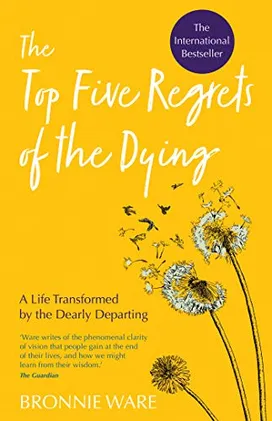
Top Five Regrets of the Dying
by Bronnie Ware
Started 22 July 2020 · 320 pages
A palliative care nurse shares what dying patients told her they regretted most, and what their stories taught her about living.
About the book, from Open Library. Get the book.
12 highlights · Kindle location in the margin
- 72
As I set about creating my own regret-free life while still caring for dying people and afterwards, I came to understand just how difficult it is to let go of all that stops us being our absolute best self. Living regret-free is not something achievable in a flash. It is created by an ongoing day-to-day process of conscious decisions, loving actions to ourselves, and a whole bucket full of courage.
- 81
Finding the courage to act or surrender will never be as painful as lying on a deathbed with regrets.
- 181
Routine works for a lot of people. I thrive on change. But routine has its place and certainly works best for many people, particularly as they are getting older.
- 268
Creative expression was starting to flow from me. Now living in Western Australia, I sat by the Swan River in Perth and made two lists. On one list was what I was good at; on the other one, what I loved to do.
- 350
the society I was living in, the modern society of Western culture, was not one that exposed its people to dying bodies on a regular basis. It wasn’t like some other cultures, where human death is out in the open and a very visible part of everyday life.
- 352
Our society has shut death out, almost as a denial of its existence. This denial leaves both the dying person and the family or friends totally unprepared for something that is inevitable. We are all going to die. But rather than acknowledge the existence of death, we try to hide it. It is as if we are trying to convince ourselves that ‘out of sight, out of mind’ really works. But it doesn’t, because we carry on trying to validate ourselves through our material life and associated fearful behaviour instead.
- 358
Once we acknowledge that limited time is remaining, although we don’t know if that is years, weeks or hours, we are less driven by ego or by what other people think. Instead, we are more driven by what our hearts truly want. Acknowledging our inevitable, approaching death offers us the opportunity to find greater purpose and satisfaction in the time we have remaining.
- 391
They say that everything comes down to love or fear: every emotion, every action, and every thought.
- 530
Unhealthy patterns surfaced in my mind, as a result of past conditioning and society telling me I couldn’t live this way. Fear started rearing its ugly head, as I wondered how on earth it was all going to come together, yet again. Bringing myself back to the present moment was the only thing that had saved me before, and was the only thing that would save me now. And there is no better place to face your fears than in nature, where you can get back into the true rhythm of life.
- 565
I hated this part of my life, this compulsion to always throw caution to the wind and create such challenging situations for myself, time and time again. Yet it was also addictive. Each time I did this, I challenged my fears head-on and somehow I always, always landed on my feet again. In some ways each leap of faith became harder, as it brought me closer to the core of my deepest fears. Yet each leap also became easier. I had tested my faith to the limit on numerous occasions previously and had gained wisdom and a stronger faith in myself through the process. Life also made more sense to me this way, regardless of how hard it was at times. I just didn’t fit in with the way conventional society works.
- 576
Surrender is not giving up, far from it. Surrender takes an enormous amount of courage. Often we are only capable of doing so when the pain of trying to control the outcome becomes too much to bear. Reaching that point is actually liberating, even if it is not fun. Being able to accept that there is absolutely nothing more you can do, other than hand it over to the greater force, is the catalyst that finally opens the flow.
- 695
Of all of the regrets and lessons shared with me as I sat beside their beds, the regret of not having lived a life true to themselves was the most common of all. It was also the one that caused the most frustration, as the client’s realisation came too late.