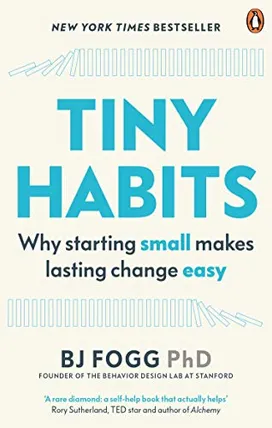
Tiny Habits
by BJ Fogg
Started 15 January 2020 · finished 15 April 2020 · 320 pages
A Stanford behaviour scientist’s method for building habits by starting tiny, anchoring each new habit to an existing routine and celebrating each small win.
About the book, from Open Library. Get the book.
95 highlights · Kindle location in the margin
- 214
The disconnect between want and do has been blamed on a lot of things — but people blame it on themselves for the most part.
- 222
When our results fall short of our expectations, the inner critic finds an opening and steps on stage. Many of us believe that if we fail to be more productive, lose weight, or exercise regularly then something must be wrong with us. If only we were better people, we wouldn’t have failed.
- 227
Our approach to change is. It’s a design flaw — not a personal flaw.
- 232
In order to design successful habits and change your behaviors, you should do three things. + Stop judging yourself. + Take your aspirations and break them down into tiny behaviors. + Embrace mistakes as discoveries and use them to move forward.
- 257
I did silly things that turned out to be wildly successful, like doing two push-ups after every time I pee.
- 276
there are only three things we can do that will create lasting change: Have an epiphany, change our environment, or change our habits in tiny ways.
- 283
The essence of Tiny Habits is this: Take a behavior you want, make it tiny, find where it fits naturally in your life, and nurture its growth.
- 290
With the Tiny Habits method, you focus on small actions that you can do in less than thirty seconds.
- 302
After you put your feet on the floor in the morning, immediately say this phrase, “It’s going to be a great day.” As you say these seven words, try to feel optimistic and positive.
- 318
it will help you learn the single most important skill in behavior change — feeling successful.
- 331
With Tiny Habits, risk doesn’t have to factor into the equation. Tiny can also be undercover. You can start to change without making a big scene. No one will sabotage you. This reduces the pressure on you.
- 342
the pervasive idea that you’ve got to go big or go home. We live in an aspiration-driven culture that is rooted in instant gratification. We find it difficult to enact or even accept incremental progress. Which is exactly what you need to cultivate meaningful long-term change.
- 344
People get frustrated and demoralized when things don’t happen quickly. It’s natural. It’s normal. But it’s another way we’re set up to fail.
- 356
motivation and willpower get a lot of airtime. People are always looking for ways to ramp them up and sustain them over time. The problem is that both motivation and willpower are shape-shifters by nature, which makes them unreliable.
- 373
a key maxim of Behavior Design — simplicity changes behavior
- 377
Juni also discovered that her unresolved grief was prompting many of her sugar-bingeing behaviors
- 382
Keeping changes small and expectations low is how you design around fair-weather friends like motivation and willpower. When something is tiny, it’s easy to do — which means you don’t need to rely on the unreliable nature of motivation.
- 387
With Tiny Habits, you also learn how to feel good in your life. The ability to pat yourself on the back instead of beat yourself up grows solid, life-changing roots.
- 538
Each person’s motivation, ability, and prompt will be different in any given situation. The specifics of motivation or ability may differ by culture or age.
- 550
Behaviors that ultimately become habits will reliably fall above the Action Line.
- 562
The more motivated you are to do a behavior, the more likely you are to do the behavior
- 568
The harder a behavior is to do, the less likely you are to do it
- 574
The easier a behavior is to do, the more likely the behavior will become habit.
- 577
Motivation and ability work together like teammates
- 594
You can disrupt a behavior you don’t want by removing the prompt. This isn’t always easy, but removing the prompt is your best first move to stop a behavior from happening.
- 738
It was a narrative running on repeat — “You can’t do what you used to; what’s wrong with you?”
- 745
the Behavior Model doesn’t have a “lazy” axis or a “weak” axis. It didn’t fit her blame narrative. It’s a model, not a referendum on character. Once Jennifer realized that she was not her behavior, everything changed.
- 748
I want you to look at your behavior the way a scientist looks at what’s growing in a petri dish — with curiosity and objective distance. This is going to be a different mindset than the ones in many of the change books you might have read.
- 750
I want you to treat your life as your own personal “change lab” — a place to experiment with the person you want to be. A place where you not only feel safe but also feel like anything is possible.
- 758
The Motivation Monkey tricks us into setting unreasonable goals. He can sometimes help us reach amazing heights, but he will often abandon us when we need him most.
- 801
Here’s the unfortunate thing — most people believe motivation is the true engine of behavior change.
- 805
Motivation is like a party-animal friend. Great for a night out, but not someone you would rely on to pick you up from the airport. You must understand its role and its limitations, then pick behaviors that don’t rely on such a fickle friend.
- 811
Some psychologists talk about extrinsic and intrinsic motivation. No offense to all those psychologists, but I’ve found this to be a weak distinction that is not very helpful in the real world.
- 837
Big spikes of motivation are awesome for doing really hard things — once.
- 841
high levels of motivation are both scattershot and unsustainable.
- 924
Aspirations are abstract desires, like wanting your kids to succeed in school. Outcomes are more measurable, like getting straight As second semester. Both of these are great places to start the process of Behavior Design.
- 926
A behavior is something you can do right now or at another specific point in time.
- 928
In contrast, you can’t achieve an aspiration or outcome at any given moment.
- 929
You can only achieve aspirations and outcomes over time if you execute the right specific behaviors.
- 930
I’ve found that people don’t naturally think in terms of specific behaviors, and this tendency trips up almost everyone.
- 931
People use the word “goal” when they are talking about aspirations or outcomes. If someone says “goal,” you can’t be sure what they are talking about since the word is ambiguous. For that reason, “goal” is not part of the vocabulary in Behavior Design. Use either “aspiration” or “outcome” for precision.
- 955
The first step in Behavior Design is to get clear on your aspirations (or outcomes). What do you want? What is your dream? What result do you want to achieve?
- 1041
No matter what kind of change you want to make, matching yourself with the right behaviors is the key to changing your life for good. In Behavior Design we have a name for the best matches: Golden Behaviors.
- 1043
A Golden Behavior has three criteria. + The behavior is effective in realizing your aspiration (impact) + You want to do the behavior (motivation) + You can do the behavior (ability)
- 1093
Behavior Design recognizes this reality: A key to lasting change is matching yourself with behaviors that you want to do.
- 1371
Ask the Discovery Question and identify the weak links in your Ability Chain. Then zero in on the right problem to solve.
- 1952
predict that Context Prompts will be less and less effective over time. Businesses will pay more to get in front of their customers, but they will get a lot less in return. Why? In the future, Context Prompts won’t reach customers at the right moment, or they will be filtered out and not noticed. And if Context Prompts do reach people, they will increasingly be able to skip them, much like we fast-forwarded through commercials on TiVo.
- 1955
For your business to succeed, I predict that you will need to find a better way to prompt your customer since Context Prompts are losing their effectiveness. The good news is that there are Action Prompts. Businesses rarely employ Action Prompts today, but I believe they will be the gold standard in the future. Many products and services will succeed by helping customers create Action Prompts.
- 1999
After I feel insulted, I will think of something nice to do for myself was her winning Habit Recipe.
- 2087
In my research, I’ve found that adults have many ways to tell themselves, “I did a bad job,” and very few ways of saying, “I did a good job.” We rarely recognize our successes and feel good about what we’ve done.
- 2165
Whether you’re trying to train your dog to sit or getting students to arrive on time by offering snacks at the start of the first few class periods, treats can both motivate behavior and reinforce a habit.
- 2202
There is a direct connection between what you feel when you do a behavior and the likelihood that you will repeat the behavior in the future.
- 2207
habits can form very quickly, often in just a few days, as long as people have a strong positive emotion connected to the behavior.
- 2211
Emotions create habits. Not repetition. Not frequency. Not fairy dust. Emotions.
- 2280
Fogg Maxim #2: Help people feel successful. Just four words. But so important. Note that this maxim doesn’t say, “Help people be successful.” It’s about feeling successful instead. Every product or service that is growing and thriving today does this well. They help us feel successful.
- 2303
Some people are naturally more inclined to celebrate their successes. If you are an enthusiastic and optimistic person, you might find celebrations easy to do — even fun. In fact, you may already be celebrating; you just don’t have a name for it. However, if you tend toward self-criticism or have a bit of a pessimistic outlook, celebration may not be as natural.
- 2324
I believe my celebration technique is a breakthrough in habit formation. I hope you can see why. By skillfully celebrating, you create a feeling of Shine, which in turn causes your brain to encode the new habit.
- 2412
If celebrating the small stuff is hard for you, the go-big-or-go-home mentality is probably sneaking up on you. Shut it down. It’s a trap. Celebrating a win — no matter how tiny — will quickly lead to more wins.
- 2432
you can’t succeed with starting small if you’re looking down your nose at it. Why do we clap for a baby when she is taking her first step? Not because she is doing it perfectly, or because she “earned it,” or because she did it bigger and better than the baby next door. We clap because we know it is the first small step that she is taking toward a lifetime of walking and running — and that is hugely important.
- 2528
If you learn just one thing from my entire book, I hope it’s this: Celebrate your tiny successes. This one small shift in your life can have a massive impact even when you feel there is no way up or out of your situation. Celebration can be your lifeline.
- 2549
What she used to notice was all the annoying stuff — the red lights and the cashier who shuts down the lane she’d been waiting in for five minutes. But now the little wins popped out at her. And she started celebrating them.
- 2552
our brains want to feel good. Celebrating small wins gives them something to repattern our life around. Linda told me that she has “retrained her brain to think positively as opposed to negatively.”
- 2721
The size of the success doesn’t seem to matter very much. When you feel successful at something, even if it’s tiny, your confidence grows quickly, and your motivation increases to do that habit again and perform related behaviors. I call this success momentum. Surprisingly enough, this gets created by the frequency of your successes, not by the size. So with Tiny Habits you are shooting for a bunch of tiny successes done quickly. Not a big one that takes a long time.
- 2768
When people feel successful, even with small things, their overall level of motivation goes up dramatically, and with higher levels of motivation, people can do harder behaviors.
- 2927
Context Skill, which I describe in this way: The skill of redesigning your environment to make your habits easier to do
- 3003
While celebration is the most important Mindset Skill, this next one ranks right up there with it. The skill of embracing a new identity When you can let go of old identities and embrace new ones, you will soar in your ability to go from tiny to transformative.
- 3078
Some of your tiny changes will grow; others will multiply. Along the way, as you feel successful, your identity will shift. And this is how you will go from tiny to transformative.
- 3224
bad habits are not fundamentally different from good habits when it comes to basic components. Behavior is behavior; it’s always a result of motivation, ability, and a prompt coming together at the same moment.
- 3348
You can make a habit less likely if you change the environment so the bad habit requires more time.
- 3359
The next factor in the Ability Chain is money, and the question then becomes: How can I make this habit more expensive?
- 3369
To make a habit harder to do, you can change how much physical effort it requires.
- 3382
Of all the factors in the Ability Chain, physical effort is my favorite one to leverage in stopping a bad habit. You can redesign at a time when your motivation is high and you’re not tempted to do the habit. Then, when your mood changes and you want ice cream or TV or wine, you realize that your habit is harder to do and maybe not worth doing at all.
- 3385
For some habits, the best solution is to require more mental effort. This factor exploits our human tendency to be lazy, which is a crass way of saying we’ve evolved to conserve our energies when we can.
- 3387
If you reset your password to something complicated like 1Lik3be1ng0uT51de (translation: I like being outside) and don’t allow your system to save it, you’d need to enter this crazy string of characters each time you want to access your feed or post something.
- 3390
When people count calories or track points, as they do in Weight Watchers, they eat less in part because they have added an extra step that requires thinking.
- 3394
The final factor in the Ability Chain is routine. This is the subtlest of the bunch, and it is one of the hardest to apply. But it’s worth considering. Look for ways to make your unwanted habit conflict with an important habit, a routine you value more than the habit you want to stop.
- 3396
Surfing at daybreak became an important habit for me, and it’s part of my identity now. My new surfing routine made some of my old habits harder to do in the evening because I had to be alert and ready to face the waves early in the morning. I started eating dinner earlier. I avoided blue light from screens, and I went to bed early. These were all good changes that came from creating a morning routine that conflicted with my unhealthy evening habits.
- 3461
you need to get specific about the habit you want to stop and the new habit that will replace it, and it’s vital that you choose the new habit wisely.
- 3470
instead of reading news that raises my blood pressure, I could watch surfing videos. I would be motivated to do this because I love surfing and want to get more skilled. And watching videos is easier than reading. So I’ve found a new habit that will replace my old one. Success!
- 3478
Remapping the prompt means doing the new habit instead of the old one when you are prompted.
- 3512
There is no single technique that works for stopping all habits. But now there is a process, and you can start using my Behavior Design Masterplan immediately. And you will get better with practice. You will become more proficient at pinpointing pivotal issues and resolving problems.
- 3616
Chris did predictably well in school. All he had to do was show up, which ultimately worked against him in other areas. Because what Chris didn’t learn was a set of skills as necessary as math and English. Mike had tried to tell Chris that life was about more than grades, that it was about interacting with others, having a work ethic, showing up reliably, and being accountable — all things that Chris struggled with mightily. Chris’s intellectual capacity had always outstripped his emotional capability. It took several years of family therapy for Mike to realize that Chris felt things deeply and didn’t have the right tools to deal with that.
- 3636
Mike was one of those people who “gets it” immediately. He was one of those systems thinkers who are fast at plugging in new knowledge to solve old challenges. I assumed Mike’s eagerness to learn the intricacies of Behavior Design was about increasing his professional excellence. But I found out later that the excited energy I’d felt from him was the realization that he could finally help Chris. The Behavior Model made total sense to Mike — many behaviors of Chris’s were suddenly explicable, and he saw exactly why his own interventions hadn’t been working. Mike realized that he needed to shift his focus from motivation to ability. Motivation, especially in a teenager, is not dependable. He also saw that giving his son a memorable, immediate prompt would be far more effective than the abstract nagging he’d been using.
- 3707
Before Mike helped Chris gain traction in his daily habits, he did a good job of changing his own behavior. Mike modified what he asked Chris to do and how he asked him to do it, changing his tone and posture from one of frustration and preordained defeat to one of empowerment and support. The success he found had an outsize effect not only on Chris’s behavior but also on his own.
- 3724
Remember this truth: Change leads to change. You start people on the path to change from the place they want to begin. As they build confidence and skills, they will open up to other types of changes,
- 3839
I want to offer you my special chapter on Tiny Habits for Business Success, which you can get by going to TinyHabits.com/business.
- 3875
Feedback from authority figures is powerful, and approval from authority figures can open the door to transformation.
- 3882
you can be the source of Shine for your group. This happens naturally for parents helping babies walk, and it’s natural for good teachers. You’ll also find examples of this in everyday life even when you don’t expect it. At a spot on Maui where people learn to surf, the spectators (mostly friends and parents) will cheer for the newbies when they catch their first waves.
- 3885
Most of us can up our game in this area. We can be more prolific and immediate with positive feedback. If we wait until someone reaches a big milestone, we have missed many opportunities to help people feel Shine.
- 3898
Some people will feel more Shine from the first approach; other people will feel more Shine from being better than others.
- 3920
One of my personal themes for the last year has been to “strengthen others in all my interactions.”
- 4026
One habit that they created in fourth grade helped Rachel manage time and get things done. The recipe was After I get home from school (trailing edge: taking off my backpack), I will check my homework list and write down a guess of how long it will take me. Her celebration was built in — once Rachel had guessed how much time her homework would take, she could get excited about all the things she could do with the rest of her time that evening. This was only a number written on the top of a list, but it helped her learn time management. Rachel got better at understanding how long certain academic tasks took and prioritizing her to-dos accordingly.
- 4104
If someone is stressed out, if they are pressed for time, if they feel overwhelmed, they cannot make big changes. And they aren’t likely to even try. I saw that Tiny Habits was the only realistic path that would work for people in that situation. And it may be the only realistic option for you and the people around you.
- 4293
Where much is given, much is expected.
- 4303
You now have a system for change, which means you don’t have to guess. You can design for whatever aspiration or outcome you want.