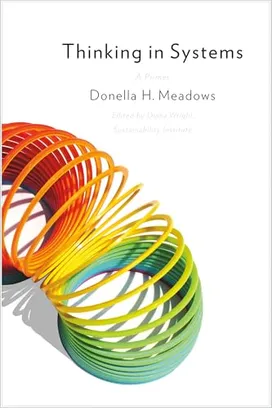
Thinking in Systems
by Donella H. Meadows
Started 26 November 2020 · 240 pages
A short, clear introduction to systems thinking: stocks, flows, feedback loops, and the leverage points where small changes shift how a system behaves.
About the book, from Open Library. Get the book.
32 highlights · Kindle location in the margin
- 160
The answer clearly lies within the Slinky itself. The hands that manipulate it suppress or release some behavior that is latent within the structure of the spring.
- 162
Once we see the relationship between structure and behavior, we can begin to understand how systems work, what makes them produce poor results, and how to shift them into better behavior patterns.
- 163
As our world continues to change rapidly and become more complex, systems thinking will help us manage, adapt, and see the wide range of choices we have before us. It is a way of thinking that gives us the freedom to identify root causes of problems and see new opportunities.
- 165
system is a set of things—people, cells, molecules, or whatever—interconnected in such a way that they produce their own pattern of behavior over time.
- 202
Psychologically and politically we would much rather assume that the cause of a problem is “out there,” rather than “in here.” It’s almost irresistible to blame something or someone else, to shift responsibility away from ourselves, and to look for the control knob, the product, the pill, the technical fix that will make a problem go away.
- 260
Beyond Ghor, there was a city. All its inhabitants were blind. A king with his entourage arrived nearby; he brought his army and camped in the desert. He had a mighty elephant, which he used to increase the people’s awe. The populace became anxious to see the elephant, and some sightless from among this blind community ran like fools to find it. As they did not even know the form or shape of the elephant, they groped sightlessly, gathering information by touching some part of it. Each thought that he knew something, because he could feel a part.… The man whose hand had reached an ear … said: “It is a large, rough thing, wide and broad, like a rug.” And the one who had felt the trunk said: “I have the real facts about it. It is like a straight and hollow pipe, awful and destructive.” The one who had felt its feet and legs said: “It is mighty and firm, like a pillar.” Each had felt one part out of many. Each had perceived it wrongly.…
- 270
The behavior of a system cannot be known just by knowing the elements of which the system is made.
- 280
A system* is an interconnected set of elements that is coherently organized in a way that achieves something. If you look at that definition closely for a minute, you can see that a system must consist of three kinds of things: elements, interconnections, and a function or purpose.
- 296
an old city neighborhood where people know each other and communicate regularly is a social system, and that a new apartment block full of strangers is not—not until new relationships arise and a system forms.
- 298
A system is more than the sum of its parts. It may exhibit adaptive, dynamic, goal-seeking, self-preserving, and sometimes evolutionary behavior.
- 302
Systems can be self-organizing, and often are self-repairing over at least some range of disruptions. They are resilient, and many of them are evolutionary.
- 332
Many of the interconnections in systems operate through the flow of information. Information holds systems together and plays a great role in determining how they operate.
- 336
Students may use informal information about the probability of getting a good grade to decide what courses to take.
- 342
A system’s function or purpose is not necessarily spoken, written, or expressed explicitly, except through the operation of the system. The best way to deduce the system’s purpose is to watch for a while to see how the system behaves.
- 346
Purposes are deduced from behavior, not from rhetoric or stated goals.
- 352
An important function of almost every system is to ensure its own perpetuation.
- 354
one of the most frustrating aspects of systems is that the purposes of subunits may add up to an overall behavior that no one wants.
- 367
Keeping sub-purposes and overall system purposes in harmony is an essential function of successful systems.
- 377
The least obvious part of the system, its function or purpose, is often the most crucial determinant of the system’s behavior.
- 380
If you change the interconnections in the tree—say that instead of taking in carbon dioxide and emitting oxygen, it does the reverse—it would no longer be a tree. (It would be an animal.)
- 386
People have imagined many purposes for a university besides disseminating knowledge—making money, indoctrinating people, winning football games.
- 389
the least obvious part of the system, its function or purpose, is often the most crucial determinant of the system’s behavior. Interconnections are also critically important. Changing relationships usually changes system behavior.
- 390
The elements, the parts of systems we are most likely to notice, are often (not always) least important in defining the unique characteristics of the system—unless changing an element also results in changing relationships or purpose.
- 407
A stock is the memory of the history of changing flows within the system.
- 437
Systems thinkers use graphs of system behavior to understand trends over time, rather than focusing attention on individual events.
- 475
Stocks generally change slowly, even when the flows into or out of them change suddenly. Therefore, stocks act as delays or buffers or shock absorbers in systems.
- 479
An economy cannot build up a large stock of functioning factories and highways and electric plants overnight, even if a lot of money is available.
- 482
Industrialization cannot proceed faster than the rate at which factories and machines can be constructed and the rate at which human beings can be educated to run and maintain them.
- 485
The time lags that come from slowly changing stocks can cause problems in systems, but they also can be sources of stability.
- 488
The time lags imposed by stocks allow room to maneuver, to experiment, and to revise policies that aren’t working.
- 489
If you have a sense of the rates of change of stocks, you don’t expect things to happen faster than they can happen. You don’t give up too soon. You can use the opportunities presented by a system’s momentum to guide it toward a good outcome—much
- 494
Stocks allow inflows and outflows to be decoupled and to be independent and temporarily out of balance with each other.