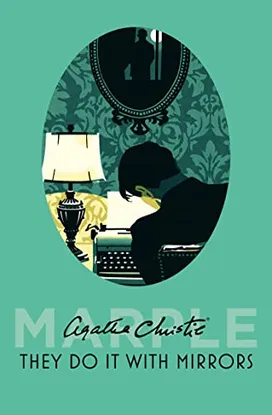
They Do It With Mirrors
by Agatha Christie
Started 16 December 2018 · 207 pages
Miss Marple visits an old friend at a country house that has become a home for delinquent boys, and finds a household where a murder is waiting to happen.
About the book, from Open Library. Get the book.
23 highlights · page in the margin
- p. 3
Everyone’s life has a tempo. Ruth’s was presto whereas Miss Marple’s was content to be adagio.
- p. 4
Odd, but quite natural, because when one lives in the same country there is no need to arrange meetings with old friends. One assumes that, sooner or later, one will see them without contrivance. Only, if you move in different spheres, that does not happen. The paths of Jane Marple and Carrie Louise did not cross. It was as simple as that.
- p. 7
he’s bitten by that same bug of wanting to improve everybody’s lives for them. And really, you know, nobody can do that but yourself.’
- p. 9
The things that go on in a pure peaceful village would probably surprise you.’
- p. 12
‘Human nature, dear, is very much the same everywhere. It is more difficult to observe it closely in a city, that is all.’
- p. 16
Soon, I expect, the fashionable thing to do will be not to educate your children, preserve their illiteracy carefully until they’re eighteen.
- p. 21
To youth it seems very odd to think that age was once young and pigtailed and struggled with decimals and English literature.
- p. 31
Lewis Serrocold was a short man, not particularly impressive in appearance, but with a personality that immediately marked him out.
- p. 54
except a lot of whining boys and young men who want to live easily and dishonestly and don’t care about the idea of doing a little hard work. What about the decent boys from decent homes? Why isn’t something done for them? Honesty just isn’t interesting to cranks like Mr Serrocold and Dr Maverick and all the bunch of half-baked sentimentalists we’ve got here. I and my brothers were brought up the hard way, Miss Marple, and we weren’t encouraged to whine. Soft, that’s what the world is nowadays!’
- p. 55
‘We’re all mad, dear lady,’ he said as he ushered her in through the door. ‘That’s the secret of existence. We’re all a little mad.’
- p. 58
But people don’t really need a cause for feeling what they do feel. They’re just made that way.
- p. 58
Miss Marple thought briefly of Miss Moncrieff, a slave to a tyrannical invalid mother. Poor Miss Moncrieff who longed for travel and to see the world. And of how St Mary Mead in a decorous way had rejoiced when Mrs Moncrieff was laid in the churchyard and Miss Moncrieff, with a nice little income, was free at last. And of how Miss Moncrieff, starting on her travels, had got no farther than Hyères where, calling to see one of ‘mother’s oldest friends’, she had been so moved by the plight of an elderly hypochondriac that she had cancelled her travel reservations and taken up her abode in the villa to be bullied, over-worked, and to long wistfully, once more, for the joys of a wider horizon.
- p. 110
Modesty forbade Miss Marple to reply that she was, by now, quite at home with murder.
- p. 115
he comes from a country where a man is esteemed by the success he makes of life.’
- p. 115
‘Whilst here we are so very fond of failures,’ said Miss Marple.
- p. 115
English are rather odd that way. Even in war, so much prouder of their defeats and their retreats than of their victories. Foreigners never can understand why we’re so proud of Dunkirk. It’s the sort of thing they’d prefer not to mention themselves. But we always seem to be almost embarrassed by a victory—and treat it as though it weren’t quite nice to boast about it. And look at all our poets! The Charge of the Light Brigade, and the little Revenge went down in the Spanish Main. It’s really a very odd characteristic when you come to think of it!’
- p. 118
there are plenty of good decent lads about, lads who could do with a start in life. But there, honesty has to be its own reward—millionaires don’t leave trust funds to help the worthwhile.
- p. 151
Mildred Strete likes money … She mayn’t spend it, but she likes it. I’m not sure why … She may be a miser—with a miser’s passion. Or she may like the power that money gives.
- p. 188
‘They do it with mirrors is, I believe, the slang phrase.’
- p. 196
But the old man was very miserable about it, and moped, said he was no good for anything any more, and Leonard who was very soft-hearted and rather foolish, began to pretend he drank more than he should. He always smelt of whisky and he used to sham being rather fuddled when his patients came. His idea was that they’d go back to the father again and say the younger man was no good.’
- p. 196
So many people with good hearts have no sense.
- p. 216
People who can be very good can be very bad, too.
- p. 216
I do see that if you’re—good, you have to be humble as well.’