The War of Art
by Steven Pressfield
· 4 min read
The main take away
Are you a writer who can’t write because of writer’s block? Or an artist or painter or sculptor or photographer who can’t create because of that voice in your head that keeps saying to you, ‘You are not good enough’ or ‘You can’t create today as it’s not ideal for <put your reason here>’? Then you are already familiar with what writer Steven Pressfield terms as ‘Resistance’. Read the book here.
My High-level Review
It’s a good book if you are having a creativity block and want to find out how to overcome it. This book is a primer and a must-read for creative people who want to improve their productivity or deal with procrastination. The second part of the book delves into angels and God, you can skip that part unless you are inclined that way.
Book Summary
What is Resistance and how it harms us
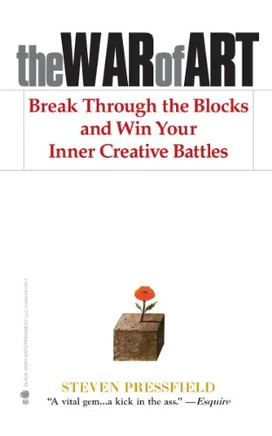
In his book ‘The War of Art’, the author Steven Pressfield talks about creator’s block, which he terms as ‘Resistance’ and how any wannabe creator can beat it.
Steven advocates that all of us have two lives, one we live and another ‘unlived’ life, and the difference between the two is Resistance. He offers various situations where Resistance arises, but essentially it is part of any creative pursuit. So you are dealing with Resistance if you are a writer, musician, painter, film maker, dancer, entrepreneur, gym rat, dieter…you get the idea. It is internal and self-generated, not external and not imposed upon us creators from outside. It is powerful and will keep you from doing whatever you are pursuing.
It is also impersonal and infallible. And like the North Star, it will always stop you from doing what you endeavour to do the most. It is also unidirectional, so it will stop you from being an entrepreneur when you are working as a barista but not the other way around.
Resistance feeds on our fear. Our fear of being judged or harshly criticised for publicly putting out our creation. And finally our fear of failure and rejection by those whose opinions we value.
Procrastination is the most common manifestation of Resistance because it is the easiest to rationalise. We can always say to ourselves, ‘We will do it later instead of now’ and thus comfort our minds that we are not abandoning the project, just postponing it. It is another matter that the ‘later’ never comes. And then this becomes a habit. We don’t just put off the project for now, we put it off till we are on our deathbed and suddenly filled with regret of living an ‘unlived’ life.
Resistance makes us unhappy. And beyond that, it becomes clinical. It causes depression, aggression and dysfunction. And the consumer economy that we live in makes it worse by using its profit-seeking artillery in full force to this sudden opportunity of making money from our unhappiness by selling us a product, a drug, a distraction.
Rationalisation is Resistance’s right-hand man. It keeps us from feeling the shame that we should have felt otherwise if we truly faced what cowards we are for not doing our work.
How to overcome resistance?
There is only one difference between the aspiring creators who are defeated by Resistance vs. the ones who beat Resistance successfully. They are amateurs vs. pros.
The amateur plays for fun. The professional plays for keeps. To the amateur, the game is his avocation. To the professional, the game is his vocation.
Resistance hates it when we turn pro.
Here’s a nice quote of Somerset Maugham from the book that I really liked.
Someone once asked Somerset Maugham if he wrote on a schedule or only when struck by inspiration. “I write only when inspiration strikes,” he replied. “Fortunately it strikes every morning at nine o’clock sharp.”
Now that’s a pro.
Steven says we are a pro if
- We show up every day regardless of mood or our feelings
- We stay on the job and are committed over the long haul
- The stakes for us are high and real and we are ready to accept remuneration for our work
- We do not overidentify with our jobs
- We master the technique of the job and have a sense of humour about it
- We are ready to show our work and receive praise or blame for it
On the other hand, one is an amateur if
- He overidentifies with his jobs - The amateur defines himself by it.
- He doesn’t show up every day
- He doesn’t stay on the job all day and is not committed over the long haul
- The stakes are illusory and fake for him and he doesn’t earn any money doing it
- He doesn’t have any sense of humour about his job
- He is not ready to show his work to the public
Steven says a professional is patient. While Resistance makes us jump into a project with an overambitious and unrealistic timeline, the professional accepts delayed gratification. The pro views her work as craft and not art.
A professional does not hesitate to ask for help. And a professional does not take failure personally.
While an amateur lets the negative opinion of others stop him from creating his work of art, a professional self-validates. The pro blows critics off, he doesn’t even hear them. He knows that the critic’s criticism is the supreme compliment, the critic hates the most which he himself would have done if only he had the guts.
The professional has learned that success, like happiness, comes as a by-product of work. So the professional concentrates on the work, irrespective of whether the rewards come or not.