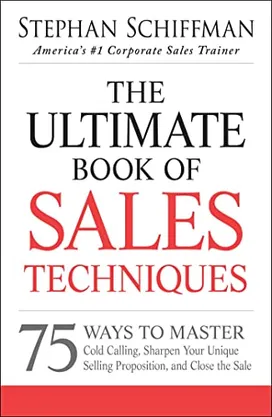
The Ultimate Book of Sales Techniques
by Stephan Schiffman
Started 4 July 2020
Seventy-five short, practical techniques for every stage of selling, from cold calling and getting appointments to presenting and closing.
About the book, from Open Library. Get the book.
12 highlights · page in the margin
- p. 13
The prospect to whom you’re talking during your sales appointment or your cold call is happy with what he’s got. He has no defined need. If he did, if he wasn’t happy, he’d have called you.
- p. 14
To spark that creativity, you’ve got to have insight into the customer: what they do, how they do it, when they do it, whom they do it with, and perhaps most importantly, why they do it that way. Once you understand that, you can find innovative ways of showing them how you can help them do it better.
- p. 14
People buy because they believe that what you’re selling is better than what they currently have. Your challenge is to demonstrate that fact to them. And how can you possibly do that unless you understand what they’re doing with the product or service they’re currently using? The answer is, you can’t. Hence the value of insight.
- p. 14
Keep these words in mind as you read through the chapters that follow: insight … creativity … innovation … different.
- p. 15
Reinvention means examining what you do, how you do it, when you do it, and why you do it.
- p. 16
You have to ask questions. You have to let the prospect talk. The object of the cold call is to get the appointment. You have to keep track of your numbers. An objection is an opportunity. You must know the personality type of the person with whom you’re dealing.
- p. 16
success depends on your ability to fail early and often.
- p. 16
I’ve always said that sales, when it comes down to it, is about helping the client. That’s never been more true than today.
- p. 19
As a salesperson, your job is to help the client do things better. The only way to do that is by finding out how and why the client is doing things now. That means you’ve got to ask the client questions. And listen to the answers.
- p. 20
In today’s selling environment, there is no excuse for “cluelessness” about the company’s products and services. Take a few minutes to pull up the target company’s website. Ask yourself: Who are this company’s customers? Which of our success stories would be most relevant to this company?
- p. 20
It’s just as important to know what kind of next step you plan to ask for at the conclusion of the meeting. In other words, what is the Next Step you want to get to from this meeting? Specifically: What are you planning to ask for at the conclusion of the meeting? Another meeting to review a preliminary proposal? Another meeting to connect with the president of the company? A phone conference at a specific date and time to review technical details? A formal commitment to work together?
- p. 20
the Next Step must be helpful, logical, and easy for the prospect to agree to. It must also be connected to a specific date and time. And you must ask for it directly before you leave the meeting. Be sure you plan a primary Next Step—and a backup Next Step, just in case the first one doesn’t work out.