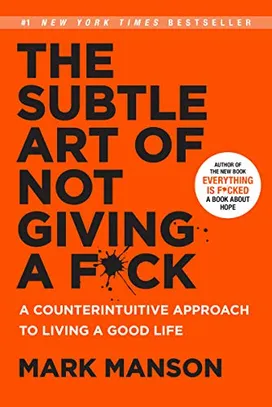
The Subtle Art of Not Giving a F*ck
by Mark Manson
Started 20 March 2019 · 224 pages
Manson argues for caring about fewer things: choose what’s worth struggling for, take responsibility, and accept that life involves suffering and failure.
About the book, from Open Library. Get the book.
39 highlights · Kindle location in the margin
- 112
You get anxious about confronting somebody in your life. That anxiety cripples you and you start wondering why you’re so anxious. Now you’re becoming anxious about being anxious. Oh no! Doubly anxious! Now you’re anxious about your anxiety, which is causing more anxiety. Quick, where’s the whiskey? Or let’s say you have an anger problem. You get pissed off at the stupidest, most inane stuff, and you have no idea why. And the fact that you get pissed off so easily starts to piss you off even more. And then, in your petty rage, you realize that being angry all the time makes you a shallow and mean person, and you hate this; you hate it so much that you get angry at yourself. Now look at you: you’re angry at yourself getting angry about being angry. Fuck you, wall. Here, have a fist. Or you’re so worried about doing the right thing all the time that you become worried about how much you’re worrying. Or you feel so guilty for every mistake you make that you begin to feel guilty about how guilty you’re feeling. Or you get sad and alone so often that it makes you feel even more sad and alone just thinking about it.
- 152
The desire for more positive experience is itself a negative experience. And, paradoxically, the acceptance of one’s negative experience is itself a positive experience.
- 156
the idea that the more you pursue feeling better all the time, the less satisfied you become, as pursuing something only reinforces the fact that you lack it in the first place.
- 163
“You will never be happy if you continue to search for what happiness consists of. You will never live if you are looking for the meaning of life.”
- 168
don’t want that to happen, do I?”
- 174
Being open with your insecurities paradoxically makes you more confident and charismatic around others. The pain of honest confrontation is what generates the greatest trust and respect in your relationships. Suffering through your fears and anxieties is what allows you to build courage and perseverance.
- 176
Everything worthwhile in life is won through surmounting the associated negative experience.
- 206
This is a sickness. And it will eat you alive. You will see every adversity as an injustice, every challenge as a failure, every inconvenience as a personal slight, every disagreement as a betrayal.
- 214
Subtlety #1: Not giving a fuck does not mean being indifferent; it means being comfortable with being different.
- 245
Subtlety #2: To not give a fuck about adversity, you must first give a fuck about something more important than adversity.
- 259
I once heard an artist say that when a person has no problems, the mind automatically finds a way to invent some.
- 264
Subtlety #3: Whether you realize it or not, you are always choosing what to give a fuck about.
- 335
One of those realizations was this: that life itself is a form of suffering. The rich suffer because of their riches. The poor suffer because of their poverty. People without a family suffer because they have no family. People with a family suffer because of their family. People who pursue worldly pleasures suffer because of their worldly pleasures. People who abstain from worldly pleasures suffer because of their abstention.
- 340
that pain and loss are inevitable and we should let go of trying to resist them.
- 342
The premise is that happiness is algorithmic, that it can be worked for and earned and achieved as if it were getting accepted to law school or building a really complicated Lego set. If I achieve X, then I can be happy. If I look like Y, then I can be happy. If I can be with a person like Z, then I can be happy.
- 389
“Life is essentially an endless series of problems, Mark,” the panda told me. He sipped his drink and adjusted the little pink umbrella. “The solution to one problem is merely the creation of the next one.”
- 408
True happiness occurs only when you find the problems you enjoy having and enjoy solving.
- 432
Emotions are simply biological signals designed to nudge you in the direction of beneficial change.
- 464
A more interesting question, a question that most people never consider, is, “What pain do you want in your life? What are you willing to struggle for?” Because that seems to be a greater determinant of how our lives turn out.
- 510
our struggles determine our successes. Our problems birth our happiness, along with slightly better, slightly upgraded problems.
- 512
Because the joy is in the climb itself.
- 677
I’m awesome and the rest of you all suck, so I deserve special treatment.
- 677
2. I suck and the rest of you are all awesome, so I deserve special treatment.
- 710
We’re all, for the most part, pretty average people. But it’s the extremes that get all of the publicity. We kind of know this already, but we rarely think and/or talk about it, and we certainly never discuss why this could be a problem.
- 740
The fact that this statement is inherently contradictory—after all, if everyone were extraordinary, then by definition no one would be extraordinary—is missed by most people.
- 763
You will have a growing appreciation for life’s basic experiences: the pleasures of simple friendship, creating something, helping a person in need, reading a good book, laughing with someone you care about.
- 859
We all have emotional blind spots. Often they have to do with the emotions that we were taught were inappropriate growing up. It takes years of practice and effort to get good at identifying blind spots in ourselves and then expressing the affected emotions appropriately. But this task is hugely important, and worth the effort.
- 876
People may perceive that they feel lonely. But when they ask themselves why they feel lonely, they tend to come up with a way to blame others—everyone else is mean, or no one is cool or smart enough to understand them—and thus they further avoid their problem instead of seeking to solve it.
- 940
The question is not whether we evaluate ourselves against others; rather, the question is by what standard do we measure ourselves?
- 955
If you want to change how you see your problems, you have to change what you value and/or how you measure failure/success.
- 986
Pleasure. Pleasure is great, but it’s a horrible value to prioritize your life around.
- 995
Research shows that once one is able to provide for basic physical needs (food, shelter, and so on), the correlation between happiness and worldly success quickly approaches zero. So if you’re starving and living on the street in the middle of India, an extra ten thousand dollars a year would affect your happiness a lot. But if you’re sitting pretty in the middle class in a developed country, an extra ten thousand dollars per year won’t affect anything much—meaning that you’re killing yourself working overtime and weekends for basically nothing.
- 1002
Always Being Right. Our brains are inefficient machines. We consistently make poor assumptions, misjudge probabilities, misremember facts, give in to cognitive biases, and make decisions based on our emotional whims. As humans, we’re wrong pretty much constantly, so if your metric for life success is to be right—well, you’re going to have a difficult time rationalizing all of the bullshit to yourself.
- 1012
While there is something to be said for “staying on the sunny side of life,” the truth is, sometimes life sucks, and the healthiest thing you can do is admit it.
- 1019
But the anger is not the problem. Anger is natural. Anger is a part of life. Anger is arguably quite healthy in many
- 1021
situations. (Remember, emotions are just feedback.)
- 1030
As Freud once said, “One day, in retrospect, the years of struggle will strike you as the most beautiful.”
- 1041
(Side Note: As a rule, people who are terrified of what others think about them are actually terrified of all the shitty things they think about themselves being reflected back at them.)
- 1064
When we have poor values—that is, poor standards we set for ourselves and others—we are essentially giving fucks about the things that don’t matter, things that in fact make our life worse. But when we choose better values, we are able to divert our fucks to something better—toward things that matter, things that improve the state of our well-being and that generate happiness, pleasure, and success as side effects.