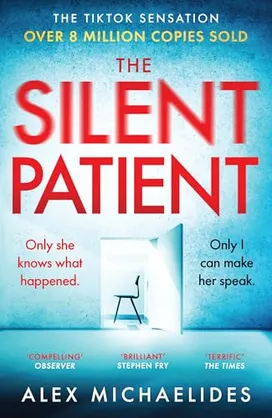
The Silent Patient
by Alex Michaelides
Started 25 October 2020 · 352 pages
A painter shoots her husband and then never speaks again, and a psychotherapist becomes obsessed with uncovering why, in a psychological thriller with a twist.
About the book, from Open Library. Get the book.
17 highlights · Kindle location in the margin
- 241
The real motivation was purely selfish. I was on a quest to help myself. I believe the same is true for most people who go into mental health. We are drawn to this particular profession because we are damaged – we study psychology to heal ourselves. Whether we are prepared to admit this or not is another question.
- 247
As the psychoanalyst Donald Winnicott put it: ‘There is no such thing as a baby.’ The development of our personalities doesn’t take place in isolation, but in relationship with another – we are shaped and completed by unseen, unremembered forces; namely our parents.
- 252
My father’s unpredictable and arbitrary rages made any situation, no matter how benign, into a potential minefield. An innocuous remark or a dissenting voice would trigger his anger and set off a series of explosions from which there was no refuge.
- 272
Somehow grasping at vanishing snowflakes is like grasping at happiness; an act of possession which instantly gives way to nothing.
- 275
My only hope of survival, I realised, was to retreat – physically as well as psychically. I had to get away, far away. Only then would I be safe.
- 278
I didn’t know it then, but it was too late – I had internalised my father, introjected him, buried him deep in my unconscious. No matter how far I ran, I carried him with me wherever I went. I was pursued by an infernal, relentless chorus of furies, all with his voice – shrieking that I was worthless, shameful, a failure.
- 290
I didn’t want to die. Not yet; not when I hadn’t lived.
- 301
I internalised a new kind of relationship with another human being: one based on mutual respect, honesty and kindness – not recrimination, anger, and violence. I slowly started to feel differently inside about myself – less empty, more capable of feeling, less afraid. The hateful internal chorus never entirely left me – but I now had Ruth’s voice to counter it, and I paid less attention. As a result, the voices in my head grew quieter and would temporarily vanish. I’d feel peaceful – even happy, sometimes.
- 315
We’re all crazy, I believe, just in different ways.
- 518
I tried to silence the negative voices in my head – my father’s voice – telling me I wasn’t up to the job, I was useless, a fraud.
- 539
we are made up of different parts, some good, some bad; and that a healthy mind can tolerate this ambivalence and juggle both good and bad at the same time. Mental illness is precisely about a lack of this kind of integration – we end up losing contact with the unacceptable parts of ourselves.
- 577
I tore off a sheet of paper from a pad, and reached for my pen. An old habit, formed at university – something about the process of putting pen to paper helps me organise my mind. I’ve always had difficulty formulating an opinion until I’ve written it down.
- 587
Murderous rage, homicidal rage, is not born in the present. It originates in the land before memory, in the world of early childhood, with abuse and mistreatment at a young age, which builds up a charge over the years, until it explodes – often at the wrong target.
- 774
Unexpressed emotions will never die. They are buried alive, and will come forth later, in uglier ways. Sigmund Freud
- 1151
Someone who has never learned to contain himself is plagued by anxious feelings for the rest of his life; feelings that Bion aptly titled ‘nameless dread’. And such a person endlessly seeks this unquenchable containment from external sources – he needs a drink or a joint to ‘take the edge off’ this endless anxiety – hence my addiction to marijuana.
- 1155
Ruth said that enforcement and constraint never produced anything good, and that, rather than force myself to live without weed, a better starting place might be to acknowledge that I was now dependent on it, and unwilling or unable to abandon it. Whatever marijuana did for me was still working, Ruth argued – until the day it would outlive its usefulness, when I would probably relinquish it with ease.
- 1161
as Ruth had predicted – once I was secure and happy, the habit fell away from me quite naturally, like dry caked mud from a boot.