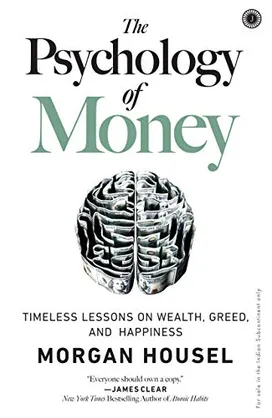
The Psychology of Money
by Morgan Housel
Started 30 September 2020 · 288 pages
Short chapters on how people actually behave with money: luck and risk, compounding, knowing when you have enough, and why temperament matters more than intelligence in building wealth.
About the book, from Open Library. Get the book.
294 highlights · Kindle location in the margin
- 52
The premise of this book is that doing well with money has a little to do with how smart you are and a lot to do with how you behave. And behavior is hard to teach, even to really smart people.
- 53
A genius who loses control of their emotions can be a financial disaster. The opposite is also true. Ordinary folks with no financial education can be wealthy if they have a handful of behavioral skills that have nothing to do with formal measures of intelligence.
- 56
My favorite Wikipedia entry begins: “Ronald James Read was an American philanthropist, investor, janitor, and gas station attendant.”
- 66
It turned out there was no secret. There was no lottery win and no inheritance. Read saved what little he could and invested it in blue chip stocks. Then he waited, for decades on end, as tiny savings compounded into more than $8 million.
- 91
One, financial outcomes are driven by luck, independent of intelligence and effort. That’s true to some extent, and this book will discuss it in further detail. Or, two (and I think more common), that financial success is not a hard science. It’s a soft skill, where how you behave is more important than what you know.
- 97
Finance is overwhelmingly taught as a math-based field, where you put data into a formula and the formula tells you what to do, and it’s assumed that you’ll just go do it.
- 102
It’s that knowing what to do tells you nothing about what happens in your head when you try to do it.
- 130
Voltaire’s observation that “History never repeats itself; man always does.”
- 145
People from different generations, raised by different parents who earned different incomes and held different values, in different parts of the world, born into different economies, experiencing different job markets with different incentives and different degrees of luck, learn very different lessons.
- 147
Everyone has their own unique experience with how the world works.
- 157
Your personal experiences with money make up maybe 0.00000001% of what’s happened in the world, but maybe 80% of how you think the world works. So equally smart people can disagree about how and why recessions happen, how you should invest your money, what you should prioritize, how much risk you should take, and so on.
- 176
We all think we know how the world works. But we’ve all only experienced a tiny sliver of it.
- 177
As investor Michael Batnick says, “some lessons have to be experienced before they can be understood.” We are all victims, in different ways, to that truth.
- 207
Local stock markets in Germany and Japan were wiped out during World War II. Entire regions were bombed out. At the end of the war German farms only produced enough food to provide the country’s citizens with 1,000 calories a day. Compare that to the U.S., where the stock market more than doubled from 1941 through the end of 1945, and the economy was the strongest it had been in almost two decades.
- 227
I don’t know what to make of this. Part of me wants to argue, fiercely. Part of me wants to understand. But mostly it’s an example of how different experiences can lead to vastly different views within topics that one side intuitively thinks should be black and white.
- 250
“What you’re doing seems crazy but I kind of understand why you’re doing it.”—uncovers the root of many of our financial decisions.
- 259
But the entire concept of being entitled to retirement is, at most, two generations old.
- 260
Before World War II most Americans worked until they died. That was the expectation and the reality.
- 271
It was not until the 1980s that the idea that everyone deserves, and should have, a dignified retirement took hold. And the way to get that dignified retirement ever since has been an expectation that everyone will save and invest their own money.
- 292
LUCK AND RISK are siblings. They are both the reality that every outcome in life is guided by forces other than individual effort.
- 294
NYU professor Scott Galloway has a related idea that is so important to remember when judging success—both your own and others’: “Nothing is as good or as bad as it seems.”
- 315
One in a million high-school-age students attended the high school that had the combination of cash and foresight to buy a computer. Bill Gates happened to be one of them.
- 318
Gates is staggeringly smart, even more hardworking, and as a teenager had a vision for computers that even most seasoned computer executives couldn’t grasp. He also had a one in a million head start by going to school at Lakeside.
- 337
Bill Gates experienced one in a million luck by ending up at Lakeside. Kent Evans experienced one in a million risk by never getting to finish what he and Gates set out to achieve. The same force, the same magnitude, working in opposite directions.
- 339
Luck and risk are both the reality that every outcome in life is guided by forces other than individual effort. They are so similar that you can’t believe in one without equally respecting the other. They both happen because the world is too complex to allow 100% of your actions to dictate 100% of your outcomes. They are driven by the same thing: You are one person in a game with seven billion other people and infinite moving parts. The accidental impact of actions outside of your control can be more consequential than the ones you consciously take.
- 346
Years ago I asked economist Robert Shiller, who won the Nobel Prize in economics, “What do you want to know about investing that we can’t know?” “The exact role of luck in successful outcomes,” he answered.
- 349
no one actually thinks luck doesn’t play a role in financial success. But since it’s hard to quantify luck and rude to suggest people’s success is owed to it, the default stance is often to implicitly ignore luck as a factor of success.
- 355
Economist Bhashkar Mazumder has shown that incomes among brothers are more correlated than height or weight. If you are rich and tall, your brother is more likely to also be rich than he is tall. I think most of us intuitively know this is true—the quality of your education and the doors that open for you are heavily linked to your parents’ socioeconomic status.
- 358
Failure—which can be anything from bankruptcy to not meeting a personal goal—is equally abused.
- 359
Did failed businesses not try hard enough? Were bad investments not thought through well enough? Are wayward careers due to laziness? Sometimes, yes. Of course.
- 361
Everything worth pursuing has less than 100% odds of succeeding, and risk is just what happens when you end up on the unfortunate side of that equation. Just as with luck, the story gets too hard, too messy, too complex if we try to pick apart how much of an outcome was a conscious decision versus a risk.
- 369
someone else’s failure is usually attributed to bad decisions, while your own failures are usually chalked up to the dark side of risk. When judging your failures I’m likely to prefer a clean and simple story of cause and effect, because I don’t know what’s going on inside your head. “You had a bad outcome so it must have been caused by a bad decision” is the story that makes the most sense to me. But when judging myself I can make up a wild narrative justifying my past decisions and attributing bad outcomes to risk.
- 386
“My God, John,” said Vanderbilt, “You don’t suppose you can run a railroad in accordance with the statutes of the State of New York, do you?”
- 419
Be careful who you praise and admire. Be careful who you look down upon and wish to avoid becoming.
- 422
Some people are born into families that encourage education; others are against it. Some are born into flourishing economies encouraging of entrepreneurship; others are born into war and destitution. I want you to be successful, and I want you to earn it. But realize that not all success is due to hard work, and not all poverty is due to laziness. Keep this in mind when judging people, including yourself.
- 425
Therefore, focus less on specific individuals and case studies and more on broad patterns.
- 426
Studying a specific person can be dangerous because we tend to study extreme examples—the billionaires, the CEOs, or the massive failures that dominate the news—and extreme examples are often the least applicable to other situations, given their complexity. The more extreme the outcome, the less likely you can apply its lessons to your own life, because the more likely the outcome was influenced by extreme ends of luck or risk.
- 429
You’ll get closer to actionable takeaways by looking for broad patterns of success and failure. The more common the pattern, the more applicable it might be to your life.
- 433
people who have control over their time tend to be happier in life is a broad and common enough observation that you can do something with it.
- 434
My favorite historian, Frederick Lewis Allen, spent his career depicting the life of the average, median American—how they lived, how they changed, what they did for work, what they ate for dinner, etc.
- 437
Bill Gates once said, “Success is a lousy teacher. It seduces smart people into thinking they can’t lose.”
- 438
When things are going extremely well, realize it’s not as good as you think. You are not invincible, and if you acknowledge that luck brought you success then you have to believe in luck’s cousin, risk, which can turn your story around just as quickly.
- 441
Failure can be a lousy teacher, because it seduces smart people into thinking their decisions were terrible when sometimes they just reflect the unforgiving realities of risk. The trick when dealing with failure is arranging your financial life in a way that a bad investment here and a missed financial goal there won’t wipe you out so you can keep playing until the odds fall in your favor.
- 444
as much as we recognize the role of luck in success, the role of risk means we should forgive ourselves and leave room for understanding when judging failures.
- 445
Nothing is as good or as bad as it seems.
- 452
At a party given by a billionaire on Shelter Island, Kurt Vonnegut informs his pal, Joseph Heller, that their host, a hedge fund manager, had made more money in a single day than Heller had earned from his wildly popular novel Catch-22 over its whole history. Heller responds, “Yes, but I have something he will never have … enough.”
- 499
What Gupta and Madoff did is something different. They already had everything: unimaginable wealth, prestige, power, freedom. And they threw it all away because they wanted more. They had no sense of enough.
- 508
There is no reason to risk what you have and need for what you don’t have and don’t need.
- 512
1. The hardest financial skill is getting the goalpost to stop moving.
- 517
Modern capitalism is a pro at two things: generating wealth and generating envy. Perhaps they go hand in hand; wanting to surpass your peers can be the fuel of hard work. But life isn’t any fun without a sense of enough. Happiness, as it’s said, is just results minus expectations.
- 520
Social comparison is the problem here.
- 528
the ceiling of social comparison is so high that virtually no one will ever hit it. Which means it’s a battle that can never be won, or that the only way to win is to not fight to begin with—to accept that you might have enough, even if it’s less than those around you.
- 532
“The only way to win in a Las Vegas casino is to exit as soon as you enter.”
- 534
“Enough” is not too little.
- 543
There are many things never worth risking, no matter the potential gain.
- 580
Moderately cool summers, not cold winters, were the icy culprit.
- 581
It begins when a summer never gets warm enough to melt the previous winter’s snow. The leftover ice base makes it easier for snow to accumulate the following winter, which increases the odds of snow sticking around in the following summer, which attracts even more accumulation the following winter. Perpetual snow reflects more of the sun’s rays, which exacerbates cooling, which brings more snowfall, and on and on. Within a few hundred years a seasonal snowpack grows into a continental ice sheet, and you’re off to the races. The same thing happens in reverse. An orbital tilt letting more sunlight in melts more of the winter snowpack, which reflects less light the following years, which increases temperatures, which prevents more snow the next year, and so on. That’s the cycle.
- 596
Warren Buffett’s net worth is $84.5 billion. Of that, $84.2 billion was accumulated after his 50th birthday. $81.5 billion came after he qualified for Social Security, in his mid-60s.
- 612
Jim Simons, head of the hedge fund Renaissance Technologies, has compounded money at 66% annually since 1988. No one comes close to this record. As we just saw, Buffett has compounded at roughly 22% annually, a third as much.
- 614
Simons’ net worth, as I write, is $21 billion. He is—and I know how ridiculous this sounds given the numbers we’re dealing with—75% less rich than Buffett.
- 624
Linear thinking is so much more intuitive than exponential thinking.
- 640
The danger here is that when compounding isn’t intuitive we often ignore its potential and focus on solving problems through other means. Not because we’re overthinking, but because we rarely stop to consider compounding potential.
- 646
The practical takeaway is that the counterintuitiveness of compounding may be responsible for the majority of disappointing trades, bad strategies, and successful investing attempts.
- 649
good investing isn’t necessarily about earning the highest returns, because the highest returns tend to be one-off hits that can’t be repeated. It’s about earning pretty good returns that you can stick with and which can be repeated for the longest period of time. That’s when compounding runs wild.
- 658
there’s only one way to stay wealthy: some combination of frugality and paranoia.
- 701
Getting money requires taking risks, being optimistic, and putting yourself out there.
- 702
But keeping money requires the opposite of taking risk. It requires humility, and fear that what you’ve made can be taken away from you just as fast. It requires frugality and an acceptance that at least some of what you’ve made is attributable to luck, so past success can’t be relied upon to repeat indefinitely.
- 712
The ability to stick around for a long time, without wiping out or being forced to give up, is what makes the biggest difference. This should be the cornerstone of your strategy, whether it’s in investing or your career or a business you own.
- 740
Nassim Taleb put it this way: “Having an ‘edge’ and surviving are two different things: the first requires the second. You need to avoid ruin. At all costs.”
- 743
More than I want big returns, I want to be financially unbreakable. And if I’m unbreakable I actually think I’ll get the biggest returns, because I’ll be able to stick around long enough for compounding to work wonders.
- 752
Planning is important, but the most important part of every plan is to plan on the plan not going according to plan.
- 760
A good plan doesn’t pretend this weren’t true; it embraces it and emphasizes room for error. The more you need specific elements of a plan to be true, the more fragile your financial life becomes.
- 763
Many bets fail not because they were wrong, but because they were mostly right in a situation that required things to be exactly right. Room for error—often called margin of safety—is one of the most underappreciated forces in finance. It comes in many forms: A frugal budget, flexible thinking, and a loose timeline— anything that lets you live happily with a range of outcomes.
- 769
A barbelled personality—optimistic about the future, but paranoid about what will prevent you from getting to the future—is vital.
- 773
You can be optimistic that the long-term growth trajectory is up and to the right, but equally sure that the road between now and then is filled with landmines, and always will be. Those two things are not mutually exclusive.
- 793
A mindset that can be paranoid and optimistic at the same time is hard to maintain, because seeing things as black or white takes less effort than accepting nuance. But you need short-term paranoia to keep you alive long enough to exploit long-term optimism.
- 823
A lot of things in business and investing work this way. Long tails—the farthest ends of a distribution of outcomes—have tremendous influence in finance, where a small number of events can account for the majority of outcomes.
- 826
we underestimate how normal it is for a lot of things to fail. Which causes us to overreact when they do.
- 835
Anything that is huge, profitable, famous, or influential is the result of a tail event—an outlying one-in-thousands or millions event. And most of our attention goes to things that are huge, profitable, famous, or influential. When most of what we pay attention to is the result of a tail, it’s easy to underestimate how rare and powerful they are.
- 839
Investment firm Correlation Ventures once crunched the numbers.20 Out of more than 21,000 venture financings from 2004 to 2014: 65% lost money. Two and a half percent of investments made 10x–20x. One percent made more than a 20x return. Half a percent—about 100 companies out of 21,000—earned 50x or more. That’s where the majority of the industry’s returns come from.
- 846
tails drive everything.
- 847
The distribution of success among large public stocks over time is not much different than it is in venture capital.
- 849
J.P. Morgan Asset Management once published the distribution of returns for the Russell 3000 Index—a big, broad, collection of public companies—since 1980.21 Forty percent of all Russell 3000 stock components lost at least 70% of their value and never recovered over this period. Effectively all of the index’s overall returns came from 7% of component companies that outperformed by at least two standard deviations.
- 876
Google’s hiring acceptance rate is 0.2%.22 Facebook’s is 0.1%.23 Apple’s is about 2%.24 So the people working on these tail projects that drive tail returns have tail careers.
- 880
Napoleon’s definition of a military genius was, “The man who can do the average thing when all those around him are going crazy.”
- 900
There is the old pilot quip that their jobs are “hours and hours of boredom punctuated by moments of sheer terror.”
- 902
A good definition of an investing genius is the man or woman who can do the average thing when all those around them are going crazy.
- 908
If you’re a good worker you’ll find the right company in the right field after several attempts and trials.
- 939
At the Berkshire Hathaway shareholder meeting in 2013 Warren Buffett said he’s owned 400 to 500 stocks during his life and made most of his money on 10 of them. Charlie Munger followed up: “If you remove just a few of Berkshire’s top investments, its long-term track record is pretty average.”
- 941
When we pay special attention to a role model’s successes we overlook that their gains came from a small percent of their actions. That makes our own failures, losses, and setbacks feel like we’re doing something wrong. But it’s possible we are wrong, or just sort of right, just as often as the masters are. They may have been more right when they were right, but they could have been wrong just as often as you.
- 953
THE HIGHEST FORM of wealth is the ability to wake up every morning and say, “I can do whatever I want today.”
- 957
The ability to do what you want, when you want, with who you want, for as long as you want, is priceless. It is the highest dividend money pays.
- 958
Angus Campbell was a psychologist at the University of Michigan. Born in 1910, his research took place during an age when psychology was overwhelmingly focused on disorders that brought people down—things like depression, anxiety, schizophrenia.
- 960
Campbell wanted to know what made people happy. His 1981 book, The Sense of Wellbeing in America,
- 964
Having a strong sense of controlling one’s life is a more dependable predictor of positive feelings of wellbeing than any of the objective conditions of life we have considered.
- 966
More than your salary. More than the size of your house. More than the prestige of your job. Control over doing what you want, when you want to, with the people you want to, is the broadest lifestyle variable that makes people happy.
- 968
Money’s greatest intrinsic value—and this can’t be overstated— is its ability to give you control over your time. To obtain, bit by bit, a level of independence and autonomy that comes from unspent assets that give you greater control over what you can do and when you can do it.
- 977
Using your money to buy time and options has a lifestyle benefit few luxury goods can compete with.
- 985
The hardest thing about this was that I loved the work. And I wanted to work hard. But doing something you love on a schedule you can’t control can feel the same as doing something you hate.
- 987
There is a name for this feeling. Psychologists call it reactance.
- 988
Jonah Berger, a marketing professor at the University of Pennsylvania, summed it up well: People like to feel like they’re in control—in the drivers’ seat. When we try to get them to do something, they feel disempowered. Rather than feeling like they made the choice, they feel like we made it for them. So they say no or do something else, even when they might have originally been happy to go along.25
- 992
When you accept how true that statement is, you realize that aligning money towards a life that lets you do what you want, when you want, with who you want, where you want, for as long as you want, has incredible return.
- 1015
John D. Rockefeller was one of the most successful businessmen of all time. He was also a recluse, spending most of his time by himself. He rarely spoke, deliberately making himself inaccessible and staying quiet when you caught his attention.
- 1031
More of us have jobs that look closer to Rockefeller than a typical 1950s manufacturing worker, which means our days don’t end when we clock out and leave the factory. We’re constantly working in our heads, which means it feels like work never ends.
- 1035
your tool is your head, which never leaves you.
- 1042
Compared to generations prior, control over your time has diminished. And since controlling your time is such a key happiness influencer, we shouldn’t be surprised that people don’t feel much happier even though we are, on average, richer than ever.
- 1046
30 Lessons for Living, gerontologist Karl Pillemer
- 1053
What they did value were things like quality friendships, being part of something bigger than themselves, and spending quality, unstructured time with their children. “Your kids don’t want your money (or what your money buys) anywhere near as much as they want you. Specifically, they want you with them,” Pillemer writes.
- 1056
Controlling your time is the highest dividend money pays.
- 1069
The letter I wrote after my son was born said, “You might think you want an expensive car, a fancy watch, and a huge house. But I’m telling you, you don’t. What you want is respect and admiration from other people, and you think having expensive stuff will bring it. It almost never does—especially from the people you want to respect and admire you.”
- 1079
It’s a subtle recognition that people generally aspire to be respected and admired by others, and using money to buy fancy things may bring less of it than you imagine. If respect and admiration are your goal, be careful how you seek it. Humility, kindness, and empathy will bring you more respect than horsepower ever will.
- 1100
Modern capitalism makes helping people fake it until they make it a cherished industry.
- 1101
Wealth is the nice cars not purchased. The diamonds not bought. The watches not worn, the clothes forgone and the first-class upgrade declined. Wealth is financial assets that haven’t yet been converted into the stuff you see.
- 1107
You can laugh, and please do. But the answer is, yes, people do need to be told that. When most people say they want to be a millionaire, what they might actually mean is “I’d like to spend a million dollars.” And that is literally the opposite of being a millionaire.
- 1109
Investor Bill Mann once wrote: “There is no faster way to feel rich than to spend lots of money on really nice things. But the way to be rich is to spend money you have, and to not spend money you don’t have. It’s really that simple.”31
- 1111
It is excellent advice, but it may not go far enough. The only way to be wealthy is to not spend the money that you do have. It’s not just the only way to accumulate wealth; it’s the very definition of wealth.
- 1115
Rich is a current income.
- 1117
But wealth is hidden. It’s income not spent. Wealth is an option not yet taken to buy something later. Its value lies in offering you options, flexibility, and growth to one day purchase more stuff than you could right now.
- 1124
Wealth is turning down that treat meal and actually burning net calories. It’s hard, and requires self-control. But it creates a gap between what you could do and what you choose to do that accrues to you over time.
- 1136
Imagine how hard it would be to learn how to write if you couldn’t read the works of great authors. Who would be your inspiration? Who would you admire? Whose nuanced tricks and tips would you follow? It would make something that is already hard even harder. It’s difficult to learn from what you can’t see. Which helps explain why it’s so hard for many to build wealth.
- 1139
The world is filled with people who look modest but are actually wealthy and people who look rich who live at the razor’s edge of insolvency. Keep this in mind when quickly judging others’ success and setting your own goals.
- 1149
Past a certain level of income people fall into three groups: Those who save, those who don’t think they can save, and those who don’t think they need to save.
- 1152
The first idea—simple, but easy to overlook—is that building wealth has little to do with your income or investment returns, and lots to do with your savings rate.
- 1173
Wealth is just the accumulated leftovers after you spend what you take in. And since you can build wealth without a high income, but have no chance of building wealth without a high savings rate, it’s clear which one matters more.
- 1180
Learning to be happy with less money creates a gap between what you have and what you want—similar to the gap you get from growing your paycheck, but easier and more in your control.
- 1182
A high savings rate means having lower expenses than you otherwise could, and having lower expenses means your savings go farther than they would if you spent more.
- 1190
Past a certain level of income, what you need is just what sits below your ego.
- 1195
When you define savings as the gap between your ego and your income you realize why many people with decent incomes save so little.
- 1197
People with enduring personal finance success—not necessarily those with high incomes—tend to have a propensity to not give a damn what others think about them.
- 1199
So people’s ability to save is more in their control than they might think.
- 1206
You can save just for saving’s sake. And indeed you should. Everyone should.
- 1212
Savings without a spending goal gives you options and flexibility, the ability to wait and the opportunity to pounce. It gives you time to think. It lets you change course on your own terms.
- 1213
Every bit of savings is like taking a point in the future that would have been owned by someone else and giving it back to yourself.
- 1215
That flexibility and control over your time is an unseen return on wealth.
- 1220
When you don’t have control over your time, you’re forced to accept whatever bad luck is thrown your way. But if you have flexibility you have the time to wait for no-brainer opportunities to fall in your lap. This is a hidden return on your savings.
- 1222
Savings in the bank that earn 0% interest might actually generate an extraordinary return if they give you the flexibility to take a job with a lower salary but more purpose, or wait for investment opportunities that come when those without flexibility turn desperate.
- 1224
And that hidden return is becoming more important.
- 1225
The world used to be hyper-local.
- 1228
A hyper-connected world means the talent pool you compete in has gone from hundreds or thousands spanning your town to millions or billions spanning the globe. This is especially true for jobs that rely on working with your head versus your muscles: teaching, marketing, analysis, consulting, accounting, programming, journalism, and even medicine increasingly compete in global talent pools. More fields will fall into this category as digitization erases global boundaries
- 1232
A question you should ask as the range of your competition expands is, “How do I stand out?”
- 1236
Intelligence is not a reliable advantage in a world that’s become as connected as ours has.
- 1237
But flexibility is.
- 1237
In a world where intelligence is hyper-competitive and many previous technical skills have become automated, competitive advantages tilt toward nuanced and soft skills—like communication, empathy, and, perhaps most of all, flexibility.
- 1239
If you have flexibility you can wait for good opportunities, both in your career and for your investments. You’ll have a better chance of being able to learn a new skill when it’s necessary. You’ll feel less urgency to chase competitors who can do things you can’t, and have more leeway to find your passion and your niche at your own pace. You can find a new routine, a slower pace, and think about life with a different set of assumptions. The ability to do those things when most others can’t is one of the few things that will set you apart in a world where intelligence is no longer a sustainable advantage.
- 1250
YOU’RE NOT a spreadsheet. You’re a person. A screwed up, emotional person.
- 1253
Do not aim to be coldly rational when making financial decisions. Aim to just be pretty reasonable. Reasonable is more realistic and you have a better chance of sticking with it for the long run, which is what matters most when managing money.
- 1273
We now have better, more scientific evidence of fever’s usefulness in fighting infection. A one-degree increase in body temperature has been shown to slow the replication rate of some viruses by a factor of 200.
- 1286
Why does this happen? If fevers are beneficial, why do we fight them so universally? I don’t think it’s complicated: Fevers hurt. And people don’t want to hurt.
- 1291
It may be rational to want a fever if you have an infection. But it’s not reasonable.
- 1294
My own theory is that, in the real world, people do not want the mathematically optimal strategy. They want the strategy that maximizes for how well they sleep at night.
- 1301
One is that “minimizing future regret” is hard to rationalize on paper but easy to justify in real life.
- 1360
STANFORD PROFESSOR SCOTT SAGAN once said something everyone who follows the economy or investment markets should hang on their wall: “Things that have never happened before happen all the time.”
- 1392
You’ll likely miss the outlier events that move the needle the most.
- 1408
for example, 9/11 prompted the Federal Reserve to cut interest rates, which helped drive the housing bubble, which led to the financial crisis, which led to a poor jobs market, which led tens of millions to seek a college education, which led to $1.6 trillion in student loans with a 10.8% default rate.
- 1421
Nassim Taleb writes in his book Fooled By Randomness:
- 1428
Daniel Kahneman was asked how investors should respond when our forecasts are wrong. He said: Whenever we are surprised by something, even if we admit that we made a mistake, we say, ‘Oh I’ll never make that mistake again.’ But, in fact, what you should learn when you make a mistake because you did not anticipate something is that the world is difficult to anticipate. That’s the correct lesson to learn from surprises: that the world is surprising.
- 1432
The correct lesson to learn from surprises is that the world is surprising. Not that we should use past surprises as a guide to future boundaries; that we should use past surprises as an admission that we have no idea what might happen next.
- 1439
History can be a misleading guide to the future of the economy and stock market because it doesn’t account for structural changes that are relevant to today’s world.
- 1504
That doesn’t mean we should ignore history when thinking about money. But there’s an important nuance: The further back in history you look, the more general your takeaways should be. General things like people’s relationship to greed and fear, how they behave under stress, and how they respond to incentives tend to be stable in time. The history of money is useful for that kind of stuff.
- 1512
The most important part of every plan is planning on your plan not going according to plan.
- 1529
Kevin Lewis, a successful card counter portrayed in the book Bringing Down the House,
- 1539
Benjamin Graham is known for his concept of margin of safety.
- 1541
“the purpose of the margin of safety is to render the forecast unnecessary.”
- 1542
Margin of safety—you can also call it room for error or redundancy—is the only effective way to safely navigate a world that is governed by odds, not certainties. And almost everything related to money exists in that kind of world.
- 1553
We do this in all kinds of financial endeavors, especially those related to our own decisions. Harvard psychologist Max Bazerman once showed that when analyzing other people’s home renovation plans, most people estimate the project will run between 25% and 50% over budget.43 But when it comes to their own projects, people estimate that renovations will be completed on time and at budget.
- 1557
Two things cause us to avoid room for error. One is the idea that somebody must know what the future holds, driven by the uncomfortable feeling that comes from admitting the opposite. The second is that you’re therefore doing yourself harm by not taking actions that fully exploit an accurate view of that future coming true.
- 1559
But room for error is underappreciated and misunderstood. It’s often viewed as a conservative hedge, used by those who don’t want to take much risk or aren’t confident in their views. But when used appropriately, it’s quite the opposite.
- 1565
Bill Gates understood this well. When Microsoft was a young company, he said he “came up with this incredibly conservative approach that I wanted to have enough money in the bank to pay a year’s worth of payroll even if we didn’t get any payments coming in.”
- 1591
An important cousin of room for error is what I call optimism bias in risk-taking, or “Russian roulette should statistically work” syndrome: An attachment to favorable odds when the downside is unacceptable in any circumstances.
- 1593
Nassim Taleb says, “You can be risk loving and yet completely averse to ruin.” And indeed, you should.
- 1594
The idea is that you have to take risk to get ahead, but no risk that can wipe you out is ever worth taking. The odds are in your favor when playing Russian roulette. But the downside is not worth the potential upside. There is no margin of safety that can compensate for the risk.
- 1600
Leverage is the devil here. Leverage—taking on debt to make your money go further—pushes routine risks into something capable of producing ruin.
- 1606
To get around this, I think of my own money as barbelled. I take risks with one portion and am terrified with the other. This is not inconsistent, but the psychology of money would lead you to believe that it is. I just want to ensure I can remain standing long enough for my risks to pay off.
- 1608
The ability to do what you want, when you want, for as long as you want, has an infinite ROI.
- 1621
In 2006 Warren Buffett announced a search for his eventual replacement. He said he needed someone “genetically programmed to recognize and avoid serious risks, including those never before encountered.”
- 1633
If there’s one way to guard against their damage, it’s avoiding single points of failure.
- 1634
A good rule of thumb for a lot of things in life is that everything that can break will eventually break. So if many things rely on one thing working, and that thing breaks, you are counting the days to catastrophe. That’s a single point of failure.
- 1639
The biggest single point of failure with money is a sole reliance on a paycheck to fund short-term spending needs, with no savings to create a gap between what you think your expenses are and what they might be in the future.
- 1647
In fact, the most important part of every plan is planning on your plan not going according to plan.
- 1683
The End of History Illusion is what psychologists call the tendency for people to be keenly aware of how much they’ve changed in the past, but to underestimate how much their personalities, desires, and goals are likely to change in the future.
- 1685
Harvard psychologist Daniel Gilbert once said: At every stage of our lives we make decisions that will profoundly influence the lives of the people we’re going to become, and then when we become those people, we’re not always thrilled with the decisions we made.
- 1692
Gilbert’s research shows people from age 18 to 68 underestimate how much they will change in the future.
- 1694
Charlie Munger says the first rule of compounding is to never interrupt it unnecessarily.
- 1704
We should avoid the extreme ends of financial planning. Assuming you’ll be happy with a very low income, or choosing to work endless hours in pursuit of a high one, increases the odds that you’ll one day find yourself at a point of regret.
- 1709
Regrets are especially painful when you abandon a previous plan and feel like you have to run in the other direction twice as fast to make up for lost time.
- 1713
Aiming, at every point in your working life, to have moderate annual savings, moderate free time, no more than a moderate commute, and at least moderate time with your family, increases the odds of being able to stick with a plan and avoid regret than if any one of those things fall to the extreme sides of the spectrum.
- 1725
“When I asked Danny how he could start again as if we had never written an earlier draft,” Zweig continued, “he said the words I’ve never forgotten: ‘I have no sunk costs.’”
- 1727
Sunk costs—anchoring decisions to past efforts that can’t be refunded—are a devil in a world where people change over time. They make our future selves prisoners to our past, different, selves. It’s the equivalent of a stranger making major life decisions for you.
- 1730
Embracing the idea that financial goals made when you were a different person should be abandoned without mercy versus put on life support and dragged on can be a good strategy to minimize future regret.
- 1736
EVERYTHING HAS a price, and the key to a lot of things with money is just figuring out what that price is and being willing to pay
- 1749
Every job looks easy when you’re not the one doing it because the challenges faced by someone in the arena are often invisible to those in the crowd.
- 1759
Like everything else worthwhile, successful investing demands a price. But its currency is not dollars and cents. It’s volatility, fear, doubt, uncertainty, and regret—all of which are easy to overlook until you’re dealing with them in real time.
- 1773
Like the car, you have a few options: You can pay this price, accepting volatility and upheaval. Or you can find an asset with less uncertainty and a lower payoff, the equivalent of a used car. Or you can attempt the equivalent of grand-theft auto: Try to get the return while avoiding the volatility that comes along with it.
- 1821
with investing, where volatility is almost always a fee, not a fine.
- 1825
The trick is convincing yourself that the market’s fee is worth it. That’s the only way to properly deal with volatility and uncertainty—not just putting up with it, but realizing that it’s an admission fee worth paying.
- 1829
Find the price, then pay it.
- 1849
Investors often innocently take cues from other investors who are playing a different game than they
- 1851
An idea exists in finance that seems innocent but has done incalculable damage. It’s the notion that assets have one rational price in a world where investors have different goals and time horizons.
- 1860
When investors have different goals and time horizons—and they do in every asset class—prices that look ridiculous to one person can make sense to another, because the factors those investors pay attention to are different.
- 1864
many investors who owned Yahoo! stock in 1999 had time horizons so short that it made sense for them to pay a ridiculous price. A day trader could accomplish what they need whether Yahoo! was at $5 a share or $500 a share as long as it moved in the right direction that day. And it did, for years.
- 1869
Bubbles form when the momentum of short-term returns attracts enough money that the makeup of investors shifts from mostly long term to mostly short term.
- 1871
That process feeds on itself. As traders push up short-term returns, they attract even more traders. Before long—and it often doesn’t take long—the dominant market price-setters with the most authority are those with shorter time horizons.
- 1873
Bubbles aren’t so much about valuations rising. That’s just a symptom of something else: time horizons shrinking as more short-term traders enter the playing field.
- 1878
Maggie Mahar wrote in her book Bull!:
- 1886
Data from Attom, a company that tracks real estate transactions, shows the number of houses in America that sold more than once in a 12-month period—they were flipped—rose fivefold during the bubble, from 20,000 in the first quarter of 2000 to over 100,000 in the first quarter of 2004.54 Flipping plunged after the bubble to less than 40,000 per quarter, where it’s roughly remained since.
- 1891
The only thing that mattered to flippers was that the price of the home would be more next month than it was this month. And for many years, it was.
- 1894
The formation of bubbles isn’t so much about people irrationally participating in long-term investing. They’re about people somewhat rationally moving toward short-term trading to capture momentum that had been feeding on itself.
- 1897
short-term traders operate in an area where the rules governing long-term investing—particularly around valuation—are ignored, because they’re irrelevant to the game being played.
- 1906
What you don’t realize is that the traders who were setting the marginal price of the stock were playing a different game than you were.
- 1920
Being swayed by people playing a different game can also throw off how you think you’re supposed to spend your money. So much consumer spending, particularly in developed countries, is socially driven: subtly influenced by people you admire, and done because you subtly want people to admire you.
- 1922
But while we can see how much money other people spend on cars, homes, clothes, and vacations, we don’t get to see their goals, worries, and aspirations. A young lawyer aiming to be a partner at a prestigious law firm might need to maintain an appearance that I, a writer who can work in sweatpants, have no need for. But when his purchases set my own expectations, I’m wandering down a path of potential disappointment because I’m spending the money without the career boost he’s getting. We might not even have different styles. We’re just playing a different game. It took me years to figure this out.
- 1928
The main thing I can recommend is going out of your way to identify what game you’re playing.
- 1932
years ago I wrote out “I am a passive investor optimistic in the world’s ability to generate real economic growth and I’m confident that over the next 30 years that growth will accrue to my investments.”
- 1934
This might seem quaint, but once you write that mission statement down you realize everything that’s unrelated to it— what the market did this year, or whether we’ll have a recession next year—is part of a game I’m not playing. So I don’t pay attention to it, and am in no danger of being persuaded by it.
- 1942
OPTIMISM IS THE best bet for most people because the world tends to get better for most people most of the time.
- 1946
Real optimists don’t believe that everything will be great. That’s complacency. Optimism is a belief that the odds of a good outcome are in your favor over time, even when there will be setbacks along the way. The simple idea that most people wake up in the morning trying to make things a little better and more productive than wake up looking to cause trouble is the foundation of optimism.
- 1995
When you realize how much progress humans can make during a lifetime in everything from economic growth to medical breakthroughs to stock market gains to social equality, you would think optimism would gain more attention than pessimism. And yet. The intellectual allure of pessimism has been known for ages.
- 2003
Kahneman says the asymmetric aversion to loss is an evolutionary shield. He writes: When directly compared or weighted against each other, losses loom larger than gains. This asymmetry between the power of positive and negative expectations or experiences has an evolutionary history. Organisms that treat threats as more urgent than opportunities have a better chance to survive and reproduce.
- 2023
Historian Eric Rauchway writes: This fall in value immediately afflicted only a few Americans. But so closely had the others watched the market and regarded it as an index of their fates that they suddenly stopped much of their economic activity. As the economist Joseph Schumpeter later wrote, “people felt that the ground under their feet was giving way.”58
- 2027
There are two topics that will affect your life whether you are interested in them or not: money and health. While health issues tend to be individual, money issues are more systemic.
- 2035
There is an iron law in economics: extremely good and extremely bad circumstances rarely stay that way for long because supply and demand adapt in hard-to-predict ways.
- 2049
To a pessimist extrapolating oil trends in 2008, of course things looked bad. To a realist who understood that necessity is the mother of all invention, it was far less scary.
- 2054
A third is that progress happens too slowly to notice, but setbacks happen too quickly to ignore.
- 2080
Growth is driven by compounding, which always takes time. Destruction is driven by single points of failure, which can happen in seconds, and loss of confidence, which can happen in an instant.
- 2081
It’s easier to create a narrative around pessimism because the story pieces tend to be fresher and more recent. Optimistic narratives require looking at a long stretch of history and developments, which people tend to forget and take more effort to piece together.
- 2090
This same thing applies to business, where it takes years to realize how important a product or company is, but failures can happen overnight.
- 2093
And in careers, where reputations take a lifetime to build and a single email to destroy.
- 2094
The short sting of pessimism prevails while the powerful pull of optimism goes unnoticed.
- 2095
In investing you must identify the price of success— volatility and loss amid the long backdrop of growth—and be willing to pay it.
- 2101
Expecting things to be great means a best-case scenario that feels flat. Pessimism reduces expectations, narrowing the gap between possible outcomes and outcomes you feel great about.
- 2103
Maybe that’s why it’s so seductive. Expecting things to be bad is the best way to be pleasantly surprised when they’re not. Which, ironically, is something to be optimistic about.
- 2130
There was one change the alien couldn’t see between 2007 and 2009: The stories we told ourselves about the economy.
- 2134
Once the narrative that home prices will keep rising broke, mortgage defaults rose, then banks lost money, then they reduced lending to other businesses, which led to layoffs, which led to less spending, which led to more layoffs, and on and on.
- 2140
When we think about the growth of economies, businesses, investments and careers, we tend to think about tangible things— how much stuff do we have and what are we capable of ?
- 2141
But stories are, by far, the most powerful force in the economy. They are the fuel that can let the tangible parts of the economy work, or the brake that holds our capabilities back.
- 2145
1. The more you want something to be true, the more likely you are to believe a story that overestimates the odds of it being true.
- 2151
There are many things in life that we think are true because we desperately want them to be true. I call these things “appealing fictions.”
- 2153
An appealing fiction happens when you are smart, you want to find solutions, but face a combination of limited control and high stakes.
- 2161
if you desperately need a solution and a good one isn’t known or readily available to you, the path of least resistance is toward Hajaji’s reasoning: willing to believe anything. Not just try anything, but believe it.
- 2181
Consider that 85% of active mutual funds underperformed their benchmark over the 10 years ending 2018.65 That figure has been fairly stable for generations. You would think an industry with such poor performance would be a niche service and have a hard time staying in business. But there’s almost five trillion dollars invested in these funds.
- 2190
The bigger the gap between what you want to be true and what you need to be true to have an acceptable outcome, the more you are protecting yourself from falling victim to an appealing financial fiction.
- 2203
Incentives are a powerful motivator, and we should always remember how they influence our own financial goals and outlooks. It can’t be overstated: there is no greater force in finance than room for error, and the higher the stakes, the wider it should be.
- 2206
2. Everyone has an incomplete view of the world. But we form a complete narrative to fill in the gaps.
- 2218
Just like my daughter, I don’t know what I don’t know. So I am just as susceptible to explaining the world through the limited set of mental models I have at my disposal.
- 2222
B. H. Liddell Hart writes in the book Why Don’t We Learn From History?:
- 2247
Psychologist Philip Tetlock once wrote: “We need to believe we live in a predictable, controllable world, so we turn to authoritative-sounding people who promise to satisfy that need.”
- 2257
astrophysics is a field of precession. It isn’t impacted by the vagaries of human behavior and emotions, like finance is. Business, economics, and investing, are fields of uncertainty, overwhelmingly driven by decisions that can’t easily be explained with clean formulas, like a trip to Pluto can.
- 2261
Kahneman once laid out the path these stories take: When planning we focus on what we want to do and can do, neglecting the plans and skills of others whose decisions might affect our outcomes. Both in explaining the past and in predicting the future, we focus on the causal role of skill and neglect the role of luck. We focus on what we know and neglect what we do not know, which makes us overly confident in our beliefs.
- 2318
Go out of your way to find humility when things are going right and forgiveness/compassion when they go wrong.
- 2322
Less ego, more wealth.
- 2325
Manage your money in a way that helps you sleep at night.
- 2328
If you want to do better as an investor, the single most powerful thing you can do is increase your time horizon.
- 2331
Become OK with a lot of things going wrong. You can be wrong half the time and still make a fortune,
- 2332
No matter what you’re doing with your money you should be comfortable with a lot of stuff not working. That’s just how the world is. So you should always measure how you’ve done by looking at your full portfolio, rather than individual investments.
- 2336
Use money to gain control over your time, because not having control of your time is such a powerful and universal drag on happiness.
- 2339
Be nicer and less flashy. No one is impressed with your possessions as much as you are.
- 2339
You might think you want a fancy car or a nice watch. But what you probably want is respect and admiration.
- 2341
Save. Just save. You don’t need a specific reason to save.
- 2345
Define the cost of success and be ready to pay it.
- 2348
Worship room for error.
- 2350
Avoid the extreme ends of financial decisions.
- 2352
You should like risk because it pays off over time.
- 2354
Define the game you’re playing, and make sure your actions are not being influenced by people playing a different game.
- 2355
Respect the mess. Smart, informed, and reasonable people can disagree in finance, because people have vastly different goals and desires. There is no single right answer; just the answer that works for you.
- 2369
Ken Murray, a professor of medicine at USC, wrote an essay in 2011 titled “How Doctors Die” that showed the degree to which doctors choose different end-of-life treatments for themselves than they recommend for their patients.
- 2371
“[Doctors] don’t die like the rest of us,” he wrote. “What’s unusual about them is not how much treatment they get compared to most Americans, but how little. For all the time they spend fending off the deaths of others, they tend to be fairly serene when faced with death themselves. They know exactly what is going to happen, they know the choices, and they generally have access to any sort of medical care they could want. But they go gently.” A doctor may throw the kitchen sink at her patient’s cancer, but choose palliative care for herself.
- 2379
important financial decisions are not made in spreadsheets or in textbooks. They are made at the dinner table. They often aren’t made with the intention of maximizing returns, but minimizing the chance of disappointing a spouse or child.
- 2384
Charlie Munger once said “I did not intend to get rich. I just wanted to get independent.”
- 2385
We can leave aside rich, but independence has always been my personal financial goal. Chasing the highest returns or leveraging my assets to live the most luxurious life has little interest to me. Both look like games people do to impress their friends, and both have hidden risks. I mostly just want to wake up every day knowing my family and I can do whatever we want to do on our own terms. Every financial decision we make revolves around that goal.
- 2395
Independence, to me, doesn’t mean you’ll stop working. It means you only do the work you like with people you like at the times you want for as long as you want.
- 2410
Most of what we get pleasure from— going for walks, reading, podcasts—costs little, so we rarely feel like we’re missing out.
- 2412
Independence is our top goal.
- 2415
Nassim Taleb explained: “True success is exiting some rat race to modulate one’s activities for peace of mind.”
- 2417
We own our house without a mortgage, which is the worst financial decision we’ve ever made but the best money decision we’ve ever made.
- 2423
it works for us. We like it. That’s what matters. Good decisions aren’t always rational. At some point you have to choose between being happy or being “right.”
- 2432
I’m saving for a world where curveballs are more common than we expect. Not being forced to sell stocks to cover an expense also means we’re increasing the odds of letting the stocks we own compound for the longest period of time. Charlie Munger put it well: “The first rule of compounding is to never interrupt it unnecessarily.”
- 2447
Beating the market should be hard; the odds of success should be low. If they weren’t, everyone would do it, and if everyone did it there would be no opportunity. So no one should be surprised that the majority of those trying to beat the market fail to do so.
- 2451
Life is about playing the odds, and we all think about odds a little differently.
- 2462
One of my deeply held investing beliefs is that there is little correlation between investment effort and investment results. The reason is because the world is driven by tails—a few variables account for the majority of returns. No matter how hard you try at investing you won’t do well if you miss the two or three things that move the needle in your strategy.
- 2465
Simple investment strategies can work great as long as they capture the few things that are important to that strategy’s success.
- 2525
Princeton historian Sheldon Garon
- 2548
Frederick Lewis Allen writes in his book The Big Change:
- 2561
The answer to the question, “What are all these GIs going to do after the war?” was now obvious. They were going to buy stuff, with money earned from their jobs making new stuff, helped by cheap borrowed money to buy even more stuff.
- 2589
Paul Graham wrote in 2016 about what something as simple as there only being three TV stations did to equalize culture:
- 2593
People measure their well-being against their peers.
- 2606
David Halberstam writes in his book The Fifties:
- 2627
Everything in finance is data within the context of expectations
- 2653
Joseph Stiglitz in 2011: While the top 1 percent have seen their incomes rise 18 percent over the past decade, those in the middle have actually seen their incomes fall. For men with only high-school degrees, the decline has been precipitous—12 percent in the last quarter-century alone.
- 2687
Economist Hyman Minsky described the beginning of debt crises: The moment when people take on more debt than they can service.
- 2693
Quantitative easing both prevented economic collapse and boosted asset prices, a boon for those who owned them—mostly rich people.
- 2699
they’re symptomatic of the bigger thing that’s happened since the early 1980s: The economy works better for some people than others. Success isn’t as meritocratic as it used to be and, when success is granted, it’s rewarded with higher gains than in previous eras.
- 2710
The details of their shouting are different, but they’re all shouting—at least in part—because stuff isn’t working for them within the context of the post-war expectation that stuff should work roughly the same for roughly everyone.
- 2716
Benedict Evans says, “The more the Internet exposes people to new points of view, the angrier people get that different views exist.” That’s a big shift from the post-war economy where the range of economic opinions were smaller, both because the actual range of outcomes was lower and because it wasn’t as easy to see and learn what other people thought and how they lived.
- 2724
a central theme of this story is that expectations move slower than reality on the ground.