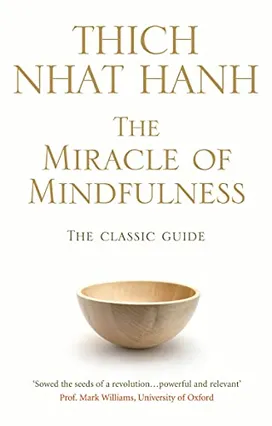
The Miracle of Mindfulness
by Thich Nhat Hanh
Started 20 June 2021 · 140 pages
A Zen teacher’s short guide to mindfulness in everyday life, through simple practices like conscious breathing and washing the dishes to wash the dishes.
About the book, from Open Library. Get the book.
11 highlights · Kindle location in the margin
- 153
Even everyday acts such as washing the dishes or eating a tangerine became acts of meditation with his guidance.
- 327
Raising children here is very different from the way we raise children at home. Here parents believe that “freedom is necessary for a child’s development.”
- 352
While washing the dishes one should only be washing the dishes, which means that while washing the dishes one should be completely aware of the fact that one is washing the dishes.
- 361
“There are two ways to wash the dishes. The first is to wash the dishes in order to have clean dishes and the second is to wash the dishes in order to wash the dishes.”
- 364
If while washing dishes, we think only of the cup of tea that awaits us, thus hurrying to get the dishes out of the way as if they were a nuisance, then we are not “washing the dishes to wash the dishes.” What’s more, we are not alive during the time we are washing the dishes. In fact we are completely incapable of realizing the miracle of life while standing at the sink. If we can’t wash the dishes, the chances are we won’t be able to drink our tea either. While drinking the cup of tea, we will only be thinking of other things, barely aware of the cup in our hands. Thus we are sucked away into the future – and we are incapable of actually living one minute of life.
- 433
You might well ask: Then how are we to practice mindfulness? My answer is: keep your attention focused on the work, be alert and ready to handle ably and intelligently any situation which may arise – this is mindfulness.
- 437
If we are not in control of ourselves but instead let our impatience or anger interfere, then our work is no longer of any value.
- 438
Mindfulness is the miracle by which we master and restore ourselves. Consider, for example: a magician who cuts his body into many parts and places each part in a different region – hands in the south, arms in the east, legs in the north, and then by some miraculous power lets forth a cry which reassembles whole every part of his body. Mindfulness is like that – it is the miracle which can call back in a flash our dispersed mind and restore it to wholeness so that we can live each minute of life.
- 446
Breath is the bridge which connects life to consciousness, which unites your body to your thoughts. Whenever your mind becomes scattered, use your breath as the means to take hold of your mind again.
- 449
The Sutra of Mindfulness teaches the method to take hold of one’s breath in the following manner: “Be ever mindful you breathe in and mindful you breathe out. Breathing in a long breath, you know, ‘I am breathing in a long breath.’ Breathing out a long breath, you know, ‘I am breathing out a long breath.’ Breathing in a short breath, you know, ‘I am breathing in a short breath.’ Breathing out a short breath, you know, ‘I am breathing out a short breath.’”
- 456
In a Buddhist monastery, everyone learns to use breath as a tool to stop mental dispersion and to build up concentration power. Concentration power is the strength which comes from practicing mindfulness.