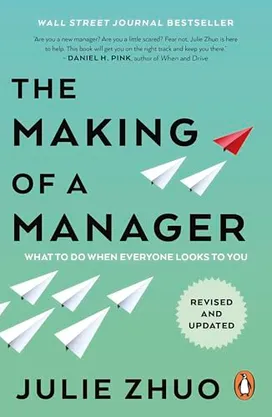
The Making of a Manager
by Julie Zhuo
Started 5 November 2019 · 312 pages
A guide for new managers, drawn from Zhuo’s years at Facebook: what managing actually is, running meetings, giving feedback, hiring and leading through growth.
About the book, from Open Library. Get the book.
15 highlights · Kindle location in the margin
- 383
A MANAGER’S JOB IS TO … build a team that works well together, support members in reaching their career goals, and create processes to get work done smoothly and efficiently.
- 414
This is the crux of management: It is the belief that a team of people can achieve more than a single person going it alone.
- 416
Your job, as a manager, is to get better outcomes from a group of people working together.
- 442
Half of what he looked at was my team’s results—did we achieve our aspirations in creating valuable, easy-to-use, and well-crafted design work? The other half was based on the strength and satisfaction of my team—did I do a good job hiring and developing individuals, and was my team happy and working well together?
- 445
The first criterion looks at our team’s present outcomes; the second criterion asks whether we’re set up for great outcomes in the future.
- 456
Hackman’s research describes five conditions that increase a team’s odds of success: having a real team (one with clear boundaries and stable membership),3 a compelling direction, an enabling structure, a supportive organizational context, and expert coaching.
- 459
I’ve come to think of the multitude of tasks that fill up a manager’s day as sorting neatly into three buckets: purpose, people, and process.
- 471
The first big part of your job as a manager is to ensure that your team knows what success looks like and cares about achieving it.
- 475
The next important bucket that managers think about is people, otherwise known as the who. Are the members of your team set up to succeed? Do they have the right skills? Are they motivated to do great work?
- 519
Your role as a manager is not to do the work yourself, even if you are the best at it, because that will only take you so far. Your role is to improve the purpose, people, and process of your team to get as high a multiplier effect on your collective outcome as you can.
- 620
I learned then one of my first lessons of management—the best outcomes come from inspiring people to action, not telling them what to do.
- 630
If you do try management and later realize that it isn’t what you want to do, that’s okay too. Have the honest conversation with your manager about your goals and ask her to help you explore alternative career paths.
- 637
“What makes a good leader is that they eschew the spotlight in favor of spending time and energy to do what they need to do to support and protect their people,”6 writes Simon Sinek in Leaders Eat Last. In return, “We offer our blood and sweat and tears and do everything we can to see our leader’s vision come to life.
- 661
“What turned out to be more challenging than you expected, and what was easier than you expected?”
- 684
What will be my scope to start, and how do you expect it to change over time? How will my transition be communicated? What do I need to know about the people that I’ll be managing? What important team goals or processes should I be aware of and help push forward? What does success look like in my first three and six months? How can the two of us stay aligned on who does what?