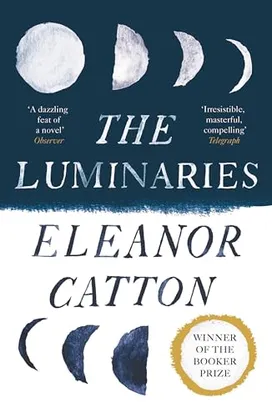
The Luminaries
by Eleanor Catton
Started 17 July 2021 · 832 pages
A Booker Prize–winning mystery set in the 1860s New Zealand gold rush, where a newcomer stumbles on a secret meeting of twelve men over a string of unsolved crimes.
About the book, from Open Library. Get the book.
8 highlights · page in the margin
- p. 11
his education had made him insular, for it had taught him that the proper way to understand any social system was to view it from above.
- p. 11
With his college chums (dressed in capes, and drunk on Rhenish wine) he would defend the merging of the classes with all the agony and vitality of the young, but he was always startled whenever he encountered it in practice.
- p. 31
(Suffering, he thought later, could rob a man of his empathy, could turn him selfish, could make him depreciate all other sufferers. This realisation, when it came, surprised him.)
- p. 34
As a child he had known instinctively that it was always better to tell a partial truth with a willing aspect than to tell a perfect truth in a defensive way. The appearance of co-operation was worth a great deal, if only because it forced a reciprocity, fair met with fair.
- p. 37
It often happens that when a soul under duress is required to attend to a separate difficulty, one that does not concern him in the least, then this second problem works upon the first as a kind of salve.
- p. 44
we shall apply our own mortar to the cracks and chinks of earthly recollection, and resurrect as new the edifice that, in solitary memory, exists only as a ruin.
- p. 56
deprecation always waits to be disputed, and, if the disputation does not come, becomes petulance.
- p. 80
He was unused to the awful compression that comes after a lie, when it dawns upon the liar that the lie he has uttered is one to which he is now bound; that he must now keep lying, and compound smaller lies upon the first, and be shuttered in lonely contemplation of his own mistake.