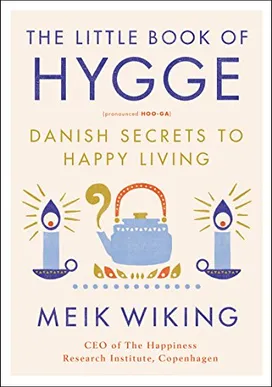
The Little Book of Hygge
by Meik Wiking
· 5 min read
The main take away
Denmark has been repeatedly described as one of the world’s happiest countries and the Danish people themselves self-describe as pretty happy. This book is an attempt to solve that riddle by Meik Wiking, the CEO of the Happiness Research Institute in Copenhagen, Denmark. Ever wanted to find out why Denmark is one of the happiest countries on Planet Earth and why the Danes are so happy? Then this book is for you. You can read more here.
My high level review
It’s an OK book that attempts to find the key to happiness but doesn’t succeed much. It starts with buying expensive lamps and adjusting the light colour temperature and mostly throughout the book finds superficial symptoms of happiness and mostly mistakes them as causes. Nevertheless, it’s worth reading just to get some good idea about Danish life and the lifestyle they live that leads to happiness even if it doesn’t delve deep into it.
Book Summary
Hygge is about an atmosphere and experience rather than about things. It’s about being with the people we love, feeling safe and letting our guard down.
Danes pay one of the highest taxes in the world but they view it as not paying taxes, rather purchasing quality of life.
Hygge originates from a Norwegian word meaning ‘well-being’.
What’s unique about Danes is that they are obsessed with Hygge.
The Sapir-Whorf hypothesis states that a culture’s language both reflects how people experience their world and affects their actions in it. Danish people value happiness and well-being to such an extent that they have a separate word for it. It’s called ‘Hygge’.
You can almost know when others are happy as their peaceful smiles light up the room.
Hygge is also a situation of relaxed thoughtfulness and embracing slowness in certain aspects of life.
Touch releases the neurohormone Oxytocin which makes us feel happy and reduces stress, fear and pain. Hence cuddling pets often reduces our stress levels and the same effect is obtained by cuddling or embracing or hugging other people as well.
There is a broad agreement amongst happiness researchers and scientists that social relations are essential for people’s happiness. It is generally seen that the more social relations someone has, the happier she is.
According to the Belongingness Hypothesis, humans have a basic need to feel connected with others and close, caring bonds with other people play a major part in our motivation and behaviour.
Hygge is also especially suited for introverts. It has a way of being social without being draining for them.
Preparing food and cooking together is a great way to generate Hygge. It fosters common bonding as well as shared time doing some activity that everybody involved loves.
Danes have relatively short working weeks, get free health care and a university education on top of the five weeks of paid holiday per year.
Taking a break with a great book is a cornerstone of Hygge. It doesn’t matter what book you are reading as long as you enjoy reading it. Another activity for reaching the flow state.
Keep a notebook in your emergency kit and record all the moments throughout the year when you feel the most hygge-like. These are the ones that you can go back to in times of need.
Most hygge-like moments are usually casual. In order for you and your guests to be in hygge, you need to be relaxed.
Whether you are sitting by a river in Sweden or in a vineyard in France, or just in your garden or nearby park, being surrounded by nature brings your guard down and adds a certain simplicity.
The best things in life are free.
Enjoy the non-screen-based activities in this digital age. Bring out the board games.
One of our issues as adults is that we become too focused on the results of an activity. We work to earn money. We go to the gym to lose weight. We spend time with people to network and further our careers. What happened to doing something just because it’s fun?
At the moment, community gardens seem to be popping up everywhere, and with good reason. They are a wonderful way of getting the hyggelig atmosphere of a village into a bigger city. Tending to your tomatoes while having a chat over coffee with the other gardeners is both hyggelig and meditative. In addition, it brings people in the local neighbourhood together and fosters the development of community spirit.
Go to picnics on the beach or in your local neighborhood garden. Go to your local farmers’ market and fill your basket with strawberries, cherries and watermelon. Add some bread and cheese to the basket, and you’re good to go. Bring all your friends, or just that one special person, and find a spot.
Cycling is not only beneficial for the individual and his or her well-being and health, it’s an indicator of the degree of neighbours’ and locals’ sense of community.
The sound of thunder can be very hyggeligt if you are inside and feel safe; if outside, not so much.
Robert Kennedy pointed out more than forty years ago: The gross national product does not allow for the health of our children, the quality of their education or the joy of their play. It does not include the beauty of our poetry or the strength of our marriages; the intelligence of our public debate or the integrity of our public officials … it measures everything, in short, except that which makes life worthwhile.
One of the reasons for the high level of happiness in Denmark is the good work–life balance, which allows people to make time for family and friends.
Hygge is making the most of the moment, but hygge is also a way of planning for and preserving happiness. Reliving hygge moments, sitting in front of the fire or on a balcony in the French Alps, or walking back into the summer cabin of my childhood, I was tripping on nostalgia. At the same time, I noticed that I was smiling. And hence nostalgia is part of hygge.
One of the most interesting findings in recent years is that the experience of positive emotions matters more to our overall well-being, measured in terms of life satisfaction, than the absence of negative emotions.
This is where most of our lives will play out. Not on cold, January days, but every day. Once a year – or more, if we are lucky – we may find ourselves on a beach in some exotic country and we may find both hygge and happiness on these distant shores. But hygge is about making the most of what we have in abundance: the everyday.
And to end this, here is a quote from Benjamin Franklin that I really liked:
‘Happiness consists more in small conveniences or pleasure that occur every day than in great pieces of good fortune that happen but seldom.’