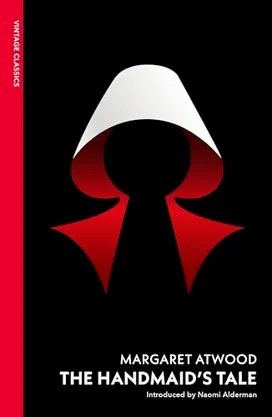
The Handmaid's Tale
by Margaret Atwood
Started 16 July 2020 · 352 pages
In a theocratic future America, a woman known as Offred is forced to bear children for the ruling class, and tells her story of survival and memory.
About the book, from Open Library. Get the book.
14 highlights · Kindle location in the margin
- 86
I knew that established orders could vanish overnight. Change could also be as fast as lightning. It can’t happen here could not be depended on: anything could happen anywhere, given the circumstances.
- 96
The immediate location of the book is Cambridge, Massachusetts, home of Harvard University, now a leading liberal educational institution but once a Puritan theological seminary.
- 101
Under totalitarianisms – or indeed in any sharply hierarchical society – the ruling class monopolizes valuable things, so the elite of the regime arrange to have fertile females assigned to them as Handmaids. The biblical precedent is the story of Jacob and his two wives, Rachel and Leah, and their two handmaids. One man, four women, twelve sons – but the handmaids could not claim the sons. They belonged to the respective wives.
- 125
Yes, women will gang up on other women. Yes, they will accuse others to keep themselves off the hook: we see that very publicly in the age of social media, which enables group swarmings. Yes, they will gladly take positions of power over other women, even – and, possibly, especially – in systems in which women as a whole have scant power: all power is relative, and in tough times any amount is seen as better than none. Some of the controlling Aunts are true believers, and think they are doing the Handmaids a favor: at least they haven’t been sent to clean up toxic waste, and at least in this brave new world they won’t get raped, not as such, not by strangers.
- 137
Without women capable of giving birth, human populations will die out. That is why the mass rape and murder of women, girls, and children has long been a feature of genocidal wars, and of other campaigns meant to subdue and exploit a population. Kill their babies and replace their babies with yours, as cats do; make women have babies they can’t afford to raise, or babies you will then remove from them for your own purposes, steal babies – it’s been a widespread, age-old motif.
- 146
The regime uses biblical symbols, as any authoritarian regime taking over America doubtless would: they wouldn’t be Communists or Muslims.
- 151
Many totalitarianisms have used clothing, both forbidden and enforced, to identify and control people – think of yellow stars and Roman purple – and many have ruled behind a religious front. It makes the creation of heretics that much easier.
- 153
In the book, the dominant “religion” is moving to seize doctrinal control, and religious denominations familiar to us are being annihilated.
- 158
So the book is not “anti-religion.” It is against the use of religion as a front for tyranny; which is a different thing altogether.
- 160
as forces within American society seize power and enact decrees that embody what they were saying they wanted to do, even back in 1984, when I was writing the novel.
- 164
So many different strands fed into The Handmaid’s Tale – group executions, sumptuary laws, book burnings, the Lebensborn program of the S.S. and the child-stealing of the Argentinian generals, the history of slavery, the history of American polygamy . . . the list is long.
- 166
the literature of witness. Offred records her story as best she can; then she hides it, trusting that it may be discovered later, by someone who is free to understand it and share it. This is an act of hope: every recorded story implies a future reader. Robinson Crusoe keeps a journal. So did Samuel Pepys, in which he chronicled the Great Fire of London. So did many who lived during the Black Death, although their accounts often stop abruptly. So did Roméo Dallaire, who chronicled both the Rwandan genocide and the world’s indifference to it. So did Anne Frank, hidden in her secret annex.
- 173
And many Dear Readers will become writers in their turn. That is how we writers all started: by reading. We heard the voice of a book speaking to us.
- 181
envied her sister; and said unto Jacob, Give me children, or else I die. And Jacob’s anger was kindled against Rachel: and he said, Am I in God’s stead, who hath withheld from thee the fruit of the womb? And she said, Behold my maid Bilhah, go in unto her; and she shall bear upon my knees, that I may also have children by her. – Genesis, 30:1–3