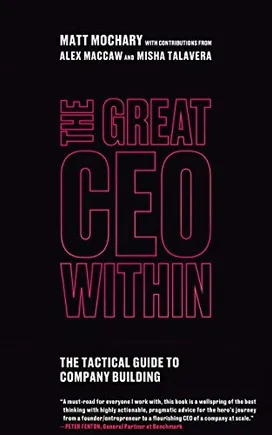
The Great CEO Within
by Matt Mochary and Alex MacCaw
Started 24 March 2020 · 202 pages
A tactical guide to company building for startup CEOs: hiring, management, meetings, feedback, goals and the everyday work of running an organisation.
About the book, from Open Library. Get the book.
29 highlights · Kindle location in the margin
- 130
There are many reasons to create a company, but only one good one: to deeply understand real customers (living humans!) and their problem, and then solve that problem.
- 139
Starting a company is hard. There are long hours, the constant fear of failing, and many rejections, among other challenges. This burden is further intensified if you try to do it alone. Solo founders have high rates of burnout. The emotional burden is just too high. As with any trend, there are exceptions. But the rule generally holds.
- 144
Your partner’s purpose is not to be value-add forever. As your company grows, you will likely find people with far greater skills whom you will hire. That’s okay. Your co-founder’s purpose is to help you achieve success in your march to product-market fit.
- 147
And when you do find a partner, avoid one cardinal mistake: do not create a 50/50 partnership. While 50/50 sounds ideal, it actually leads to real pain if there is no easy way to break a deadlock.
- 161
Y Combinator has another strong belief: founding teams should never grow beyond six until there is true product-market fit. Product-market fit (PMF) is the milestone of having created a product that customers are finding so much value in that they are willing to both buy it (after their test phase) and recommend it. Metrics that show whether PMF has been achieved include revenue, renewal rates, and Net Promoter Score.
- 167
There is no magic metric, but for a B2B company, it’s hard to imagine PMF at anything less than $1 million in annual recurring revenue. Why not grow beyond six team members before reaching PMF? Three main reasons: morale, communication and organization, and speed.
- 174
By contrast, with six or fewer people, the environment feels like a team in battle. Chaos is expected. So when chaos is actually encountered, the team meets it with glee. People who join small teams crave the challenge of new things. They want things to be hard.
- 182
You can create features in code about ten times faster when writing “prototype code” versus “industrial code.” Prototype code is meant only to create a prototype. It is not meant to handle many users, nor be easily understood by those who didn’t write it. Industrial code, by contrast, is meant to be easily debugged as well as handle many users. When you are just a few programmers, then there is no choice but to write prototype code, as you don’t have enough coder hours to do anything else.
- 191
Startups don’t usually fail because they grow too late. They usually fail because they grow too early (i.e., before they have achieved product-market fit).
- 197
As CEO, you are both the architect of the culture and the central hub in the wheel of information flow that enables the team to function effectively.
- 268
One of the most common complaints I hear from CEOs is that on a day-to-day basis, they seem to have infinite things to do, yet weeks will go by and they don’t feel like they have accomplished anything. This is the result of getting bogged down with the small, immediate things and losing track of the important, long-term ones.
- 272
Schedule two hours each day (i.e., put an event in your calendar) to work on your top goal only. And do this every single workday. Period.
- 297
I recommend that you plan to arrive to an outside meeting fifteen minutes before it is scheduled to begin. For a meeting in your office, wrap up your current project or previous meeting five to ten minutes before the scheduled time for the next meeting.
- 308
Whenever you find yourself saying something for a second time (to a second audience or in a second situation), it is highly likely that you will end up saying it again and again in the future. To vastly improve the quality of the communication and reduce the amount of time that you spend communicating the information, write it down.
- 317
Confirmation bias is the phenomenon that whatever belief we start out with, we will discover evidence to support it. A corollary to this is that whatever question we ask, we will focus on the answer.
- 350
In a First Round Review article titled “How to Become Insanely Well-Connected,” Chris Fralic of First Round Capital says that he reserves one hour each week for follow-ups and outreach, most of which include appreciations. I recommend that you do the same.
- 362
When finished, look for patterns of where and how your energy is drained. Now think of ways to outsource or eliminate those activities.
- 396
Trust dissipation is correlated with geographical distance. Humans are hardwired to trust their close friends the most, their immediate peers next, the people they meet in person after that, and the people they meet via videoconference last. By the time they’re meeting people over an email exchange, trust is a real issue to making a sale.
- 415
In my experience, the best person for this role has high EQ, medium technical understanding, and a fantastic work ethic. I’ve found a good indicator of their ability is if they understand (or can quickly learn) SQL.
- 424
All those things are important, but the only real answer I’ve found to this problem is customer success. You need dedicated support agents who will hand-hold your customers through the onboarding process, answer questions along the way, and be on hand for any technical issues that crop up.
- 454
This will only work if you embrace and learn to love company building. Finding joy in career development, making that key hire, and putting structures in place so that people love their jobs—these are all things that you must learn to revel in and love. And this will take time, but if your heart’s in it, it’s all achievable. And if your heart’s not in it, think about hiring another CEO.
- 469
Company building takes an emotional toll too. It is important that you have someone to speak to, listen to you, and help feelings flow through you. The alternative is bottling up anger, sadness, and fear until you and your company self-destruct. Build a CEO support group composed of your peers. Learn to be vulnerable in front of the company, and practice conscious leadership (chapter 15). Get a therapist; even if you think you don’t need one, you will invariably find it useful.
- 516
The general rule of thumb is that you should have no more than 25 percent of your net worth in “alternative assets” (illiquid assets).
- 540
So start by placing your liquid assets in a brokerage firm. Then invest all the cash into US Treasuries while you decide on your investment strategy.
- 564
You create buy-in when you make people feel that they are part of the decision and that their input contributes to the final outcome. The more influence they feel they have on the outcome, the more they’ll be invested in the final result.
- 575
Method 3: The manager invites the team to a meeting where the dilemma is discussed from scratch with no straw man. The manager and the team equally share ideas. The manager acknowledges each idea before making a final decision. ○ Pros: Creates the most buy-in. Gets a lot of benefit from the collective wisdom of the team. ○ Cons: Takes the most time.
- 702
Each time there is a decision to be made, rate it as irreversible or reversible. If it’s reversible, allow one of your reports to be the D (the decision maker in the RAPID process). The decision will be made faster, your report will get the chance to exercise their decision-making muscle, and you will have the chance to gain confidence in your reports’ ability to make decisions well.
- 750
When our egos make us afraid to be wrong, that fear leads us to defend our ideas at all costs and to work hard to convince others that we are right—often with anger.
- 777
Conscious leaders are open to the possibility that instead of controlling and changing the world, perhaps the world is just right the way it is. This creates huge growth opportunities on a personal and organization level.