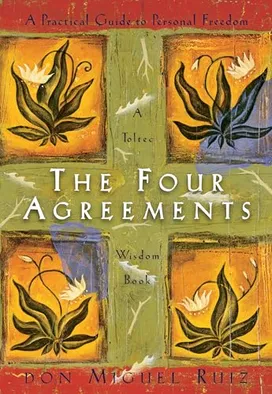
The Four Agreements
by Don Miguel Ruiz
Started 20 January 2021 · 152 pages
Four principles from Toltec wisdom for personal freedom: be impeccable with your word, don’t take anything personally, don’t make assumptions, and always do your best.
About the book, from Open Library. Get the book.
52 highlights · Kindle location in the margin
- 59
He looked at his hands, he felt his body, and he heard his own voice say, “I am made of light; I am made of stars.”
- 99
The dream of the planet includes all of society’s rules, its beliefs, its laws, its religions, its different cultures and ways to be, its governments, schools, social events, and holidays.
- 101
The outside dream has so many rules that when a new human is born, we hook the child’s attention and introduce these rules into his or her mind.
- 103
Attention is the ability we have to discriminate and to focus only on that which we want to perceive.
- 106
By using our attention we learned a whole reality, a whole dream. We learned how to behave in society: what to believe and what not to believe; what is acceptable and what is not acceptable; what is good and what is bad; what is beautiful and what is ugly; what is right and what is wrong.
- 115
Language is the code for understanding and communication between humans.
- 118
We never had the opportunity to choose what to believe or what not to believe. We never chose even the smallest of these agreements. We didn’t even choose our own name.
- 120
As children, we didn’t have the opportunity to choose our beliefs, but we agreed with the information that was passed to us from the…
- 123
Children believe everything adults say. We agree with them, and our faith is so strong that the belief system…
- 126
I call this process the domestication of humans. And through this domestication we learn how…
- 131
Children are domesticated the same way that we domesticate a dog, a cat,…
- 134
When we went against the rules we were punished; when we went along with the rules we got a reward. We were punished many times a day, and we were also rewarded many times a day. Soon we became afraid of being punished and also afraid of not receiving the reward. The reward is the attention that we got from our parents or from other people like siblings, teachers,…
- 138
The reward feels good, and we keep doing what others want us to do in order to get the reward. With that fear of being punished and that fear of not getting the reward, we start pretending to be what we are not, just to please others, just to be good enough for someone else. We try to please Mom and Dad, we try to…
- 141
The fear of being rejected becomes the fear of not being good enough. Eventually we become someone that we are not. We become a copy of Mamma’s beliefs, Daddy’s beliefs,…
- 146
The domestication is so strong that at a certain point in our lives we no longer need anyone to domesticate us. We don’t need Mom or Dad, the school or the church to domesticate us. We are so well trained that we are…
- 151
The belief system is like a Book of Law that rules our mind. Without question, whatever is in that Book of Law, is our truth. We base all of our judgments according to the Book of Law, even if…
- 154
There is something in our minds that judges everybody and everything, including the weather, the dog, the cat — everything. The inner Judge uses what is in our Book of Law to judge everything we do and don’t do, everything we…
- 158
There is another part of us that receives the judgments, and this part is called the Victim. The Victim carries the blame, the guilt, and the shame. It is the part of us that says, “Poor me, I’m not good enough, I’m not intelligent enough, I’m not attractive enough, I’m not worthy of love…
- 163
Whatever goes against the Book of Law will make you feel a funny sensation in your solar plexus, and it’s called fear. Breaking the rules in the Book of Law opens your emotional wounds, and your reaction is to create emotional poison. Because everything that is in the Book of Law has to be true, anything that challenges what you believe is…
- 166
That is why we need a great deal of courage to challenge…
- 169
Just as the government has a book of laws that rule the society’s dream, our belief system is the Book of Laws…
- 174
We have a powerful memory. We make a mistake, we judge ourselves, we find ourselves guilty, and we punish ourselves. If justice exists, then that was enough; we don’t need to do it again. But every time we remember, we judge ourselves again, we are guilty again, and we punish ourselves again, and again, and again.
- 181
Ninety-five percent of the beliefs we have stored in our minds are nothing but lies, and we suffer because we believe all these lies.
- 184
If we look at human society we see a place so difficult to live in because it is ruled by fear. Throughout the world we see human suffering, anger, revenge, addictions, violence in the street, and tremendous injustice. It may exist at different levels in different countries around the world, but fear is controlling the outside dream.
- 189
Fire is generated by emotions that come from fear. Whenever we feel the emotions of anger, jealousy, envy, or hate, we experience a fire burning within us. We are living in a dream of hell.
- 190
If you consider hell as a state of mind, then hell is all around us.
- 192
No human can condemn another to hell because we are already there. Others can put us into a deeper hell, true. But only if we allow this to happen.
- 202
We don’t see the truth because we are blind. What blinds us are all those false beliefs we have in our mind. We have the need to be right and to make others wrong.
- 206
Your whole mind is a fog which the Toltec called a mitote (pronounced MIH-TOE´-TAY).
- 208
In India they call the mitote maya, which means illusion. It is the personality’s notion of “I am.” Everything you believe about yourself and the world, all the concepts and programming you have in your mind, are all the mitote. We cannot see who we truly are; we cannot see that we are not free.
- 211
To be alive is the biggest fear humans have. Death is not the biggest fear we have; our biggest fear is taking the risk to be alive — the risk to be alive and express what we really are. Just being ourselves is the biggest fear of humans.
- 219
Not being perfect, we reject ourselves. And the level of self-rejection depends upon how effective the adults were in breaking our integrity.
- 221
We cannot forgive ourselves for not being what we wish to be, or rather what we believe we should be. We cannot forgive ourselves for not being perfect.
- 227
You see teenagers taking drugs just to avoid being rejected by other teenagers. They are not aware that the problem is that they don’t accept themselves. They reject themselves because they are not what they pretend to be.
- 229
Humans punish themselves endlessly for not being what they believe they should be. They become very self-abusive, and they use other people to abuse themselves as well.
- 234
In your whole life nobody has ever abused you more than you have abused yourself. And the limit of your self-abuse is exactly the limit that you will tolerate from someone else. If someone abuses you a little more than you abuse yourself, you will probably walk away from that person. But if someone abuses you a little less than you abuse yourself, you will probably stay in the relationship and tolerate it endlessly.
- 237
If you abuse yourself very badly, you can even tolerate someone who beats you up, humiliates you, and treats you like dirt. Why? Because in your belief system you say, “I deserve it. This person is doing me a favor by being with me. I’m not worthy of love and respect. I’m not good enough.”
- 240
We have the need to be accepted and to be loved by others, but we cannot accept and love ourselves. The more self-love we have, the less we will experience self-abuse. Self-abuse comes from self-rejection, and self-rejection comes from having an image of what it means to be perfect and never measuring up to that ideal. Our image of perfection is the reason we reject ourselves; it is why we don’t accept ourselves the way we are, and why we don’t accept others the way they are.
- 246
the most important agreements are the ones you made with yourself. In these agreements you tell yourself who you are, what you feel, what you believe, and how to behave. The result is what you call your personality.
- 250
If you want to live a life of joy and fulfillment, you have to find the courage to break those agreements that are fear-based and claim your personal power. The agreements that come from fear require us to expend a lot of energy, but the agreements that come from love help us to conserve energy and even gain extra energy.
- 270
The first agreement is to be impeccable with your word.
- 277
The word is the most powerful tool you have as a human; it is the tool of magic. But like a sword with two edges, your word can create the most beautiful dream, or your word can destroy everything around you.
- 280
Depending upon how it is used, the word can set you free, or it can enslave you even more than you know. All the magic you possess is based on your word. Your word is pure magic, and misuse of your word is black magic.
- 281
The word is so powerful that one word can change a life or destroy the lives of millions of people.
- 286
The human mind is like a fertile ground where seeds are continually being planted. The seeds are opinions, ideas, and concepts. You plant a seed, a thought, and it grows. The word is like a seed, and the human mind is so fertile! The only problem is that too often it is fertile for the seeds of fear.
- 293
Every human is a magician, and we can either put a spell on someone with our word or we can release someone from a spell. We cast spells all the time with our opinions. An example: I see a friend and give him an opinion that just popped into my mind. I say, “Hmmm! I see that kind of color in your face in people who are going to get cancer.” If he listens to the word, and if he agrees, he will have cancer in less than one year. That is the power of the word.
- 297
We believed these opinions and we lived in fear over these opinions, like not being good at swimming, or sports, or writing.
- 309
Impeccability means “without sin.” Impeccable comes from the Latin pecatus, which means “sin.” The im in impeccable means “without,” so impeccable means “without sin.”
- 312
A sin is anything that you do which goes against yourself. Everything you feel or believe or say that goes against yourself is a sin.
- 312
You go against yourself when you judge or blame yourself for anything. Being without sin is exactly the opposite. Being impeccable is not going against yourself.
- 314
When you are impeccable, you take responsibility for your actions, but you do not judge or blame yourself.
- 324
Being impeccable with your word is the correct use of your energy; it means to use your energy in the direction of truth and love for yourself.