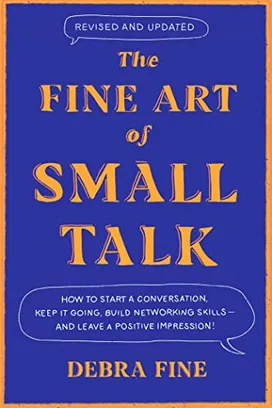
The Fine Art of Small Talk
by Debra Fine
Started 10 June 2021 · 213 pages
A practical guide to small talk: starting conversations, keeping them going and ending them gracefully, at work and in social settings.
About the book, from Open Library. Get the book.
29 highlights · Kindle location in the margin
- 165
People who excel at small talk are experts at making others feel included, valued, and comfortable.
- 173
Mark McCormack, a lawyer who founded one of the first sports management firms in the United States, once said, “All things being equal, people will buy from a friend. All things being not quite so equal, people will still buy from a friend.” The bottom line: It’s to your benefit to cultivate friendships, not just collect business cards.
- 188
Number one: Take the risk. It is up to us to take the risk of starting a conversation with a stranger. We cannot hope that others will approach us; instead, even if we are shy, it is up to us to make the first move. We all fear rejection at some level. Just remind yourself that there are more dire consequences in life than a rejection by someone at a networking event, singles function, back-to-school night, or association meeting.
- 191
Number two: Assume the burden. It is up to each and every one of us to assume the burden of conversation. It is our responsibility to come up with topics to discuss; it is up to us to remember people’s names and to introduce them to others; it is up to us to relieve the awkward moments or fill the pregnant pause.
- 194
If others are comfortable in our presence, then they will feel good about doing business or socializing with us.
- 197
Always begin and end your business conversation with small talk to humanize the relationship.
- 201
In general, people and organizations spend money for two reasons:
- 203
To solve a problem or fill a need.
- 205
To gain good, positive feelings.
- 209
A good conversationalist frequently evokes the positive feelings that people long to have, and the reality is that buyers’ choices about where to spend their money are influenced by the presence or absence of rapport.
- 212
Even a minimal amount of pleasant small talk will make prospective customers remember you better than they remember your competitor.
- 214
People appreciate a conversation in which they feel acknowledged, heard, and significant. While it’s understood that people seek these benefits in conversations with friends, it’s also true that people choose to buy goods and services from individuals perceived as warm, friendly, and caring.
- 217
buying decisions are all influenced by the rapport that has been established with the other party.
- 219
Effective managers use small talk at the front end of a meeting to set the tone for discussion and to create a bridge to more meaningful, and perhaps difficult, dialogue. Casual conversation and informal icebreakers offer opportunities to build rapport, create a cohesive team, and increase the chances of success.
- 251
Start thinking of strangers as people who can bring new dimensions to your life, not as persons to be feared.
- 260
Walk up to someone and introduce yourself. Extend your hand, make eye contact, and smile saying, “Hello. My name is Deb Fine. It’s nice to meet you.”
- 283
When the time came for a promotion, she got it and I didn’t. I simply wasn’t as visible because I was so silent.
- 290
It had never occurred to me that shyness could be mistaken for arrogance.
- 292
Don’t risk being taken as haughty or pretentious by keeping silent; it can cost you dearly. Start small talking and let others see your personality.
- 300
If ever there was a place you’d expect people to mingle, it’s a singles event. Yet they are notorious for attracting wallflowers. Most
- 305
Good things come to those who take action and start creating good things.
- it’s up to you to start a conversation
- 309
Do you know the biggest social fear in the West? It’s public speaking. And do you know the second? It’s fear of starting a conversation with a stranger.
- 310
remember when you walk into a luncheon or a cocktail party, most people there are scared to death to talk to you. Fear of rejection keeps many of us from risking conversation, but the probability of rejection is actually quite small.
- it’s up to you to assume the burden of conversation
- 320
The first step in becoming a great conversationalist is becoming invested in the conversation and actively working to help the other person feel comfortable.
- 324
The most famous and worn-out icebreaker is that age-old question What do you do for a living?
- 412
“I totally agree with you about the power of small talk. It is not about an agenda but is simply a way to acknowledge a person as being very real and there.
- 464
Using people’s names shows that you are interested in them and makes them feel special.