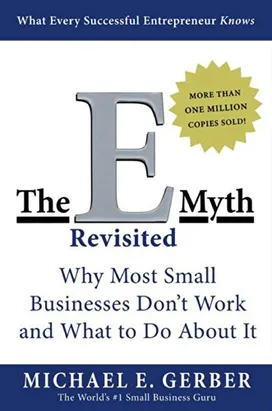
The E-Myth Revisited
by Michael E. Gerber
Started 9 October 2020 · 268 pages
Why most small businesses fail, and how to build one that works: treat the business as a system and work on it, not just in it.
About the book, from Open Library. Get the book.
44 highlights · Kindle location in the margin
- 48
Don Juan said in Tales of Power, that “The basic difference between an ordinary man and a warrior is that a warrior takes everything as a challenge while an ordinary man takes everything either as a blessing or a curse,”
- 74
Contrary to popular belief, my experience has shown me that the people who are exceptionally good in business aren’t so because of what they know but because of their insatiable need to know more.
- p. 4
what makes people work is an idea worth working for, along with a clear understanding of what needs to be done.
- p. 13
That Fatal Assumption is: if you understand the technical work of a business, you understand a business that does that technical work.
- p. 13
The technical work of a business and a business that does that technical work are two totally different things!
- p. 13
To the technician suffering from an Entrepreneurial Seizure, a business is not a business but a place to go to work.
- p. 13
In fact, rather than being their greatest single asset, knowing the technical work of their business becomes their greatest single liability.
- p. 13
For if the technician didn’t know how to do the technical work of the business, he would have to learn how to get it done. He would be forced to learn how to make the business work, rather than to do the work himself.
- p. 14
Suddenly the job he knew how to do so well becomes one job he knows how to do plus a dozen others he doesn’t know how to do at all.
- p. 17
I told Sarah that every technician suffering from an Entrepreneurial Seizure experiences exactly the same thing. First, exhilaration; second, terror; third, exhaustion; and, finally, despair. A terrible sense of loss—not only the loss of what was closest to them, their special relationship with their work, but the loss of purpose, the loss of self.
- p. 19
The problem is that everybody who goes into business is actually three-people-in-one: The Entrepreneur, The Manager, and The Technician. And the problem is compounded by the fact that while each of these personalities wants to be the boss, none of them wants to have a boss. So they start a business together in order to get rid of the boss. And the conflict begins.
- p. 19
To show you how the problem manifests itself in all of us, let’s examine the way our various internal personalities interact. Let’s take a look at two personalities we’re all familiar with: The Fat Guy and The Skinny Guy.
- p. 22
It happens to all of us, time and time again. Because we’ve been deluded into thinking we’re really one person.
- p. 22
And so when The Skinny Guy decides to change things we actually believe that it’s I who’s making that decision. And when The Fat Guy wakes up and changes it all back again, we think it’s I who’s making that decision too. But it isn’t I. It’s we.
- p. 22
The problem is that when you’re The Skinny Guy, you’re totally consumed by his needs, his interests, his lifestyle.
- p. 23
In other words, when you’re The Skinny Guy you’re always making promises for The Fat Guy to keep. And when you’re The Fat Guy, you’re always making promises for The Skinny Guy to keep.
- p. 23
It’s not that we’re indecisive or unreliable; it’s that each and every one of us is a whole set of different personalities, each with his own interests and way of doing things. Asking any one of them to defer to any of the others is inviting a battle or even a full-scale war.
- p. 23
that’s the kind of war going on inside the owner of every small business. But it’s a three-way battle between The Entrepreneur, The Manager, and The Technician. Unfortunately, it’s a battle no one can win.
- p. 23
The Entrepreneur
- p. 23
The entrepreneurial personality turns the most trivial condition into an exceptional opportunity. The Entrepreneur is the visionary in us. The dreamer. The energy behind every human activity. The imagination that sparks the fire of the future. The catalyst for change.
- p. 24
The Entrepreneur is our creative personality—always at its best dealing with the unknown, prodding the future, creating probabilities out of possibilities, engineering chaos into harmony.
- p. 24
Every strong entrepreneurial personality has an extraordinary need for control. Living as he does in the visionary world of the future, he needs control of people and events in the present so that he can concentrate on his dreams.
- p. 24
This then becomes the entrepreneurial worldview: a world made up of both an overabundance of opportunities and dragging feet.
- p. 25
To The Entrepreneur, most people are problems that get in the way of the dream.
- p. 25
The Manager
- p. 25
The managerial personality is pragmatic. Without The Manager there would be no planning, no order, no predictability.
- p. 25
Where The Entrepreneur invariably sees the opportunity in events, The Manager invariably sees the problems.
- p. 26
It is the tension between The Entrepreneur’s vision and The Manager’s pragmatism that creates the synthesis from which all great works are born.
- p. 26
The Technician
- p. 26
The Technician is the doer.
- p. 26
The Technician loves to tinker. Things are to be taken apart and put back together again. Things aren’t supposed to be dreamed about, they’re supposed to be done.
- p. 27
To The Technician, thinking is unproductive unless it’s thinking about the work that needs to be done. As a result, he is suspicious of lofty ideas or abstractions.
- p. 27
The Technician knows that if it weren’t for him, the world would be in more trouble than it already is. Nothing would get done, but lots of people would be thinking about it.
- p. 27
Put another way, while The Entrepreneur dreams, The Manager frets, and The Technician ruminates.
- p. 27
Everyone gets in The Technician’s way. The Entrepreneur is always throwing a monkey wrench into his day with the creation of yet another “great new idea.” On the other hand, The Entrepreneur is always creating new and interesting work for The Technician to do, thus establishing a potentially symbiotic relationship. Unfortunately, it rarely works out that way.
- p. 28
The Manager is also a problem to The Technician because he is determined to impose order on The Technician’s work, to reduce him to a part of “the system.”
- p. 28
To The Technician, “the system” is dehumanizing, cold, antiseptic, and impersonal. It violates his individuality.
- p. 28
To The Manager, however, work is a system of results in which The Technician is but a component part. To The Manager, then, The Technician becomes a problem to be managed. To The Technician, The Manager becomes a meddler to be avoided. To both of them, The Entrepreneur is the one who got them into trouble in the first place!
- p. 28
The fact of the matter is that we all have an Entrepreneur, Manager, and Technician inside us. And if they were equally balanced, we’d be describing an incredibly competent individual.
- p. 28
The Entrepreneur would be free to forge ahead into new areas of interest; The Manager would be solidifying the base of operations; and The Technician would be doing the technical work. Each would derive satisfaction from the work he does best, serving the whole in the most productive way.
- p. 29
Unfortunately, our experience shows us that few people who go into business are blessed with such a balance. Instead, the typical small business owner is only 10 percent Entrepreneur, 20 percent Manager, and 70 percent Technician.
- p. 30
“In short, you would see how The Entrepreneur in you dreams and schemes, The Manager in you is constantly attempting to keep things as they are, and The Technician in you drives the other two crazy. You would see that it not only matters that your personalities are not in a balanced relationship with each other but that your life depends on gaining that balance. That until you do, it’s a war! And it’s a war no one can win.
- p. 31
“So it is that an entrepreneurial business, without a Manager to give it order and without a Technician to put it to work, is doomed to suffer an early, and probably very dramatic, death. And that a Manager-driven business, without an Entrepreneur or a Technician to play their absolutely critical roles, will put things into little gray boxes over and over again, only to realize too late that there’s no reason for the things or the boxes she put them into! Such a business will die very neatly. “And that in a Technician-driven business, without The Entrepreneur to lead her and The Manager to supervise her, The Technician will work until she drops, only to wake up the next morning to go to work even harder, and the next, and the next. Only to discover, long after it’s too late, that while she was working someone moved a freeway through the store!”
- p. 32
“An Entrepreneur does the work of envisioning the business as something apart from you, the owner. The work of asking all the right questions about why this business, as opposed to that business? Why a pie baking business rather than a body shop? If you are a baker of pies, it’s easy for you to decide to open up a pie-baking business. But that’s just the point. If you are a baker of pies and are determined to do entrepreneurial work, you would leave your pie-baking experience behind you and engage in the internal dialogue with which every truly entrepreneurial personality is wonderfully familiar.