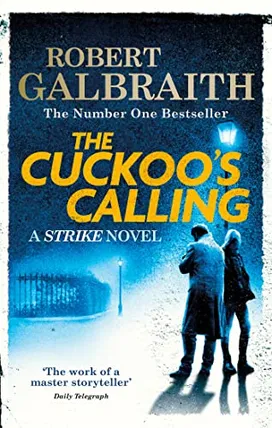
The Cuckoo's Calling
by Robert Galbraith
Started 22 October 2020 · 480 pages
Private detective Cormoran Strike is hired to investigate the death of a supermodel ruled a suicide, joined by his new temporary secretary, Robin.
About the book, from Open Library. Get the book.
20 highlights · page in the margin
- p. 27
Bombarded with the story, you grew interested against your will, and before you knew it, you were so well informed, so opinionated about the facts of the case, you would have been unfit to sit on a jury.
- p. 29
Suicides, in his experience, were perfectly capable of feigning an interest in a future they had no intention of inhabiting.
- p. 38
People thought her selfish, but she’d been the youngest in the family and rather indulged, and then she was ill and, naturally, the centre of attention, and then she was plunged into this extraordinary life where things, people, revolved around her, and she was pursued everywhere by the paparazzi. It wasn’t a normal existence.’
- p. 56
This was the hour when he found London most lovable; the working day over, her pub windows were warm and jewel-like, her streets thrummed with life, and the indefatigable permanence of her aged buildings, softened by the street lights, became strangely reassuring.
- p. 56
Seven and a half million hearts were beating in close proximity in this heaving old city, and many, after all, would be aching far worse than his. Walking wearily past closing shops, while the heavens turned indigo above him, Strike found solace in vastness and anonymity.
- p. 58
Next, with one of the biros Robin had assembled neatly in the top drawer, Strike began to write, fluently and rapidly, beginning with the date. The notes of Bristow’s interview he tore out and attached separately to the file; the actions he had taken thus far, including calls to Anstis and to Wardle, were noted, their numbers preserved (but the details of his other friend, the provider of useful names and addresses, were not put on file).
- p. 89
Hers was the kind of family that commissioned painters to immortalise its young: a background utterly alien to Strike, and one he had come to know like a dangerous foreign country. From Charlotte he had learned that the kind of money he had never known could coexist with unhappiness and savagery. Her family, for all their gracious manners, their suavity and flair, their erudition and occasional flamboyance, was even madder and stranger than his own. That had been a powerful link between them, when first he and Charlotte had come together.
- p. 136
He had never been able to understand the assumption of intimacy fans felt with those they had never met.
- p. 192
‘A lie would have no sense unless the truth were felt as dangerous.’
- p. 274
Nillness, thought Strike, for a second distracted. He had slept badly. Nillness, that was where Luna Landry had gone, and where all of them, he and Rochelle included, were headed. Sometimes illness turned slowly to nillness, as was happening to Bristow’s mother… sometimes nillness rose to meet you out of nowhere, like a concrete road slamming your skull apart.
- p. 308
‘It’s that wounded-poet crap, that soul-pain shit, that too-much-of-a-tortured-genius-to-wash bollocks. Brush your teeth, you little bastard. You’re not fucking Byron.’
- p. 341
The dead could only speak through the mouths of those left behind, and through the signs they left scattered behind them.
- p. 354
perhaps, thought Strike, that was because she had repeated the lie so often that the story had become easy, automatic.
- p. 360
‘It’s a psychological term. The Johari window. It’s all to do with how well we know ourselves, and how well other people know us.’
- p. 372
the majority of the symptoms associated with a crashing hangover were due to dehydration and hypoglycaemia,
- p. 387
She’s still on my phone, look at this.’ She rummaged in an enormous handbag, finally retrieving a white iPhone. Scrolling down the contact list, she leaned into him, showing him the name ‘Looly’. Her perfume was sweet and peppery. ‘I keep expecting her to call me,’ said Ciara, momentarily subdued, slipping the phone back into her bag. ‘I can’t delete her; I keep going to do it, and then just, like, bottling it, you know?’
- p. 393
the only thing worse than being talked about is not being talked about.” That’s Oscar Wilde,’
- p. 458
How easy it was to capitalise on a person’s own bent for self-destruction; how simple to nudge them into non-being, then to stand back and shrug and agree that it had been the inevitable result of a chaotic, catastrophic life.
- p. 549
I am become a name.
- p. 550
I cannot rest from travel: I will drink Life to the lees; all times I have enjoy’d Greatly, have suffer’d greatly, both with those That loved me, and alone; on shore and when Thro’ scudding drifts the rainy Hyades Vext the dim sea: I am become a name…