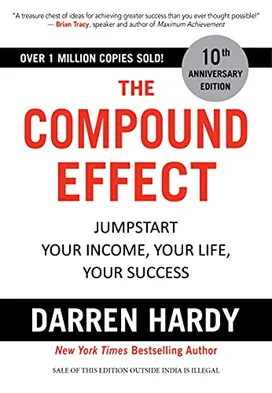
The Compound Effect
by Darren Hardy
Started 27 August 2021 · 172 pages
Hardy argues that small, consistent choices compound over time into big results, and describes how to build habits and momentum.
About the book, from Open Library. Get the book.
64 highlights · Kindle location in the margin
- 146
This book, The Compound Effect, is based on a principle I’ve used in my own life and training: Your decisions shape your destiny. Little, everyday decisions will either take you to the life you desire or to disaster by default. In fact, it’s the littlest decisions that shape our lives. From what to eat and where to work, to the people you spend your time with, to how you spend your day, every choice shapes how you live today, but more importantly, how you live the rest of your life.
- 149
You see, success isn’t about doing five thousand different things well. Success is doing the right things well five thousand times over.
- 185
success is simple. Do the right things—and keep doing them day in and day out—and I know you will experience the best life has to offer.
- 255
you have an aversion to work, discipline, and commitment, you’re welcome to turn the TV back on and put your hope in the next infomercial or webinar instead—the
- p. 3
“It doesn’t matter how smart you are or aren’t, you need to make up in hard work what you lack in experience, skill, intelligence, or innate ability.
- p. 5
The Compound Effect is the principle of reaping huge rewards from a series of small, smart choices.
- p. 6
Small, Smart Choices + Consistency + Time = RADICAL DIFFERENCE
- p. 10
In reality, his or her profound success was the result of small, smart choices, completed consistently over time.
- p. 10
the extra food makes Brad sluggish at night. He wakes up a little groggy, which makes him cranky. The crankiness and sleep deprivation begin to impact his work performance. He’s less productive, and as a result, gets discouraging feedback from his boss. By the end of the day, he feels dissatisfied with his job and his energy level is way down. The commute home seems longer and more stressful than ever. All of this makes him reach for more comfort food—stress has a way of doing that.
- p. 11
With fewer shared activities with his wife and an absence of fresh air and exercise, Brad’s not getting the endorphin release that had helped make him feel upbeat and enthusiastic. Because he’s not as happy, he starts finding fault with himself and others, and stops complimenting his wife. As his own body starts to feel flabby, he feels less self-confident, less attractive and becomes less romantic.
- p. 13
The secret to success was then, and is now, hard work, discipline, and good habits.
- p. 13
It’s interesting that wealth tends to skip a generation. Overwhelming abundance often leads to a lackadaisical mentality, which brings about a sedentary lifestyle. Children of the wealthy are especially susceptible. They weren’t the ones who developed the discipline and character to create the wealth in the first place, so it makes sense that they may not have the same sense of value for wealth or understand what’s necessary to keep it.
- p. 14
The truth is, complacency has impacted all great empires, including, but not limited to, the Egyptians, Greeks, Romans, Spanish, Portuguese, French, and English. Why? Because nothing fails like success. Once-dominant empires have failed for this very reason. People get to a certain level of success and get too comfortable.
- p. 16
Harvard psychologist Daniel Gilbert, author of Stumbling on Happiness, says if we gave lottery losers each thirty seconds on TV to announce not “I won!” but “I lost,” it would take almost nine years to get through the losers of a single drawing!
- p. 16
want you to know in your bones that your only path to success is through a continuum of mundane, unsexy, unexciting, and sometimes difficult daily disciplines compounded over time.
- p. 19
Everything in your life exists because you first made a choice about something. Choices are at the root of every one of your results.
- p. 19
Every decision, no matter how slight, alters the trajectory of your life—whether or not to go to college, whom to marry, to have that last drink before you drive, to indulge in gossip or stay silent, to make one more prospecting call or call it a day, to say I love you or let the moment pass by.
- p. 20
You’ll ask yourself (and be able to answer), “How many of my behaviors have I not ‘voted on’? What am I doing that I didn’t consciously choose to do, yet continue to do every day?”
- p. 20
Your biggest challenge is that you’ve been sleepwalking through your choices.
- p. 23
One Thanksgiving, I decided to keep a Thanks Giving journal for my wife. Every day for an entire year, I logged at least one thing I appreciated about her—the way she interacted with her friends, how she cared for our dogs, the fresh bed she prepared, a succulent meal she whipped up, or the beautiful way she styled her hair that day—whatever. I looked for the things my wife was doing that touched me, or revealed attributes, characteristics, or qualities I appreciated. I wrote them all down secretly for the entire year. By the end of that year, I’d filled an entire journal.
- p. 24
In that seminar I attended at eighteen, the speaker asked, “What percentage of shared responsibility do you have in making a relationship work?” I
- p. 25
The instructor turned to the easel and wrote 100/0 on the paper in big black letters. “You have to be willing to give 100 percent with zero expectation of receiving anything in return,” he said. “Only when you’re willing to take 100 percent responsibility for making the relationship work will it work. Otherwise, a relationship left to chance will always be vulnerable to disaster.”
- p. 25
If I always took 100 percent responsibility for everything I experienced—completely owning all of my choices and all the ways I responded to whatever happened to me—I held the power. Everything was up to me. I was responsible for everything I did, didn’t do, or how I responded to what was done to me.
- p. 26
You alone are responsible for what you do or don’t do, or how you respond to what’s done to you.
- p. 26
When I asked Richard Branson if he felt luck played a part in his success, he answered, “Yes, of course, we are all lucky. If you live in a free society, you are lucky. Luck surrounds us every day; we are constantly having lucky things happen to us, whether you recognize it or not. I have not been any more lucky or unlucky than anyone else. The difference is when luck came my way, I took advantage of it.”
- p. 27
The (Complete) Formula for Getting Lucky: Preparation (personal growth) + Attitude (belief/mindset) + Opportunity (a good thing coming your way) + Action (doing something about it) = Luck
- p. 27
Preparation: By consistently improving and preparing yourself—your skills, knowledge, expertise, relationships, and resources—you have the wherewithal to take advantage of great opportunities when they arise (when luck “strikes”).
- p. 27
Attitude: This is where luck evades most people, and where Sir Richard is spot-on with his belief that luck is all around us. It’s simply a matter of seeing situations, conversations, and circumstances as fortuitous.
- p. 28
Opportunity: It’s possible to make your own luck, but the luck I’m talking about here isn’t planned for, or it comes faster or differently than expected. In this stage of the formula, luck isn’t forced. It’s a natural occurrence and it often shows up seemingly of its own accord.
- p. 28
Action: This is where you come in. However this luck was delivered to you—from the universe, God, the Lucky Charms leprechaun, or whomever or whatever you associate delivering your good fortune—it’s now your job to act on it. This is what separates the Richard Bransons from the Joseph Wallingtons.
- p. 29
My mentor Jim Rohn said, “The day you graduate from childhood to adulthood is the day you take full responsibility for your life.”
- p. 29
Eliminate all of your excuses. Embrace the fact that you are freed by your choices, as long as you assume personal responsibility for them.
- p. 30
To help you become aware of your choices, I want you to track every action that relates to the area of your life you want to improve. If you’ve decided you want get out of debt, you’re going to track every penny you pull from your pocket. If you’ve decided you want to lose weight, you’re going to track everything you put into your mouth. If you’ve decided to train for an athletic event, you’re going to track every step you take, every workout you do. Simply carry around a small notebook, something you’ll keep in your pocket or purse at all times, and a writing instrument. You’re going to write it all down. Every day. Without fail.
- p. 30
tracking my progress and missteps is the one of the reasons I’ve accumulated the success I have. The process forces you to be conscious of your decisions.
- p. 31
as Jim Rohn would say, “What’s simple to do is also simple not to do.”
- p. 31
The biggest difference between successful people and unsuccessful people is that successful people are willing to do what unsuccessful people are not.
- p. 32
Here’s what my accountant had me do: carry a small notepad in my back pocket and write down every single cent I spent for thirty days. Whether it was a thousand dollars for a new suit or fifty cents for air to fill up my tires, it all had to go down on the notepad. Wow. This brought an instantaneous awareness of the many unconscious choices I was making that resulted in money pouring out of my pockets. Because I had to log everything, I resisted buying some things, just so I didn’t have to take out the notepad and write it in the dang book!
- p. 32
Keeping a money log for thirty days straight cemented a new awareness in me and created a completely new set of choices and disciplines surrounding spending. And, since awareness and positive behaviors compound, I found myself being more proactive with money in general, putting away more for retirement, finding areas to save where there was clear waste, and enjoying the fun quotient of money—“play money”—all the more.
- p. 32
Tracking is my go-to transformation model for everything that ails me. Over the years I’ve tracked what I eat and drink, how much I exercise, how much time I spend improving a skill, my number of sales calls, even the improvement of my relationships with family, friends, or my spouse. The results have been no less profound than my money-tracking wake-up call.
- p. 33
To get results, you have to take some action.
- p. 35
You’ve heard psychologists say that something doesn’t become a habit until you practice it for three weeks.
- p. 36
Am I saying that your four-dollar-a-day coffee habit is going to cost you $51,833.79 in twenty years? Yes, I am. Did you know that every dollar you spend today, no matter where you spend it, is costing you nearly five dollars in only twenty years (and ten dollars in thirty years)? That’s because if you took a dollar and grew it at 8 percent, in twenty years, that dollar would be worth almost five. Every time you spend a buck today, it’s like taking five dollars out of your future pocket.
- p. 37
I used to make the mistake of looking at a price tag and thinking that if an item was listed at fifty dollars, it cost me fifty dollars. Well, yes, in today’s dollars. But if you consider the potential value of that same fifty dollars after it has been invested for twenty years, the cost (what you lose by spending that money rather than using it to grow) is four or five times greater! In other words, every time you look at an item that costs fifty dollars you have to ask, “Is this item worth $250?” If it’s worth $250 to you today, then it’s worth buying.
- p. 38
Make the correct choice every day, every week for many years, and you can quickly see how you can become financially abundant.
- p. 38
You’ll be able to ask yourself, “Is having a coffee once every workday worth the eventual price of a Mercedes-Benz?”
- p. 52
Aristotle wrote, “We are what we repeatedly do.”
- p. 55
our need for immediate gratification can turn us into the most reactive, nonthinking animals around.
- p. 55
The problem is that the payoff or instant gratification derived from bad habits often far outweighs what’s going on in your rational mind concerning long-term consequences. Indulging in our bad habits doesn’t seem to have any negative effects at all in the moment.
- p. 58
Your choices are only meaningful when you connect them to your desires and dreams. The wisest and most motivating choices are the ones aligned with that which you identify as your purpose, your core self, and your highest values. You’ve got to want something, and know why you want it, or you’ll end up giving up too easily.
- p. 58
You’ve got to have a reason if you want to make significant improvements to your life. And to make you want to make the necessary changes, your why must be something that is fantastically motivating—to you. You’ve got to want to get up and go, go, go, go, go—for years! So, what is it that moves you the most? Identifying your why is critical. What motivates you is the ignition to your passion, the source for your enthusiasm, and the fuel of your persistence.
- p. 59
Why Everything’s Possible The power of your why is what gets you to stick through the grueling, mundane, and laborious. All of the hows will be meaningless until your whys are powerful enough.
- p. 60
when the reason is big enough, you will be willing to perform almost any how.
- p. 62
People are either motivated by something they want or something they don’t want. Love is a powerfully motivating force. But so is hate. Contrary to social correctness, it can be good to hate. Hate disease, hate injustice, hate ignorance, hate complacency, and so on. Sometimes identifying an enemy lights your fire. Some of my greatest motivation, determination, and dogged persistence came when I had an enemy to fight.
- p. 63
Enemies give us a reason to stand tall with courage. Having to fight challenges your skills, your character, and your resolve. It forces you to assess and exercise your talents and abilities. Without a motivating fight, we can become fat and lazy; we lose our strength and purpose.
- p. 63
Some of my mentorship clients worry that their why-power derives from less-than-noble goals. They feel guilty for wanting to prove the naysayers wrong. Or wanting to get back at the person who said they’d never amount to anything, or beat the competition, or finally one-up a sibling who always dominated them. But, really, it doesn’t matter what the motivation is (as long as it is legal and moral). You don’t have to be motivated for great humanitarian reasons. What matters is that you feel fully motivated. Sometimes that motivation can help you use a powerfully negative emotion or experience to create an even more powerful and successful end.
- p. 65
“Whatever you vividly imagine, ardently desire, sincerely believe, and enthusiastically act upon … must inevitably come to pass!”
- p. 65
the highest achievers in the world have all succeeded because they mapped out their visions. The person who has a clear, compelling, and white-hot burning why will always defeat even the best of the best at doing the how.
- p. 66
this is how the Law of Attraction really works.
- p. 66
We are bombarded with billions of sensory (visual, audio, physical) bites of information each day. To keep ourselves from going insane, we ignore 99.9 percent of them, only really seeing, hearing, or experiencing those upon which our mind focuses. This is why, when you “think” something, it appears that you are miraculously drawing it into your life.
- p. 67
When you define your goals, you give your brain something new to look for and focus on.
- p. 68
I suggest that you take some time today to make a list of your most important goals. I recommend considering goals in all aspects of your life, not just for your business or finances. Be wary of the high price of putting too much focus on any single aspect of your life, to the exclusion of everything else. Go for whole-life success—balance in all the aspects of life that are important to you: business, finances, health and well-being, spirituality, family and relationships, and lifestyle.
- p. 68
Success is something you attract by the person you become.”
- p. 69
I asked myself, “What kind of a man would a woman like this be looking for? Who do I need to become to be attractive to a woman of this substance?”
- p. 70
Your life comes down to this formula: