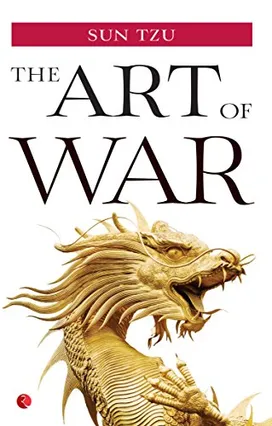
The Art of War
by Sun Tzu
Started 9 August 2020 · 90 pages
An ancient Chinese treatise on strategy, conflict and leadership, still read for its advice on knowing yourself and your opponent and winning without fighting.
About the book, from Open Library. Get the book.
13 highlights · page in the margin
- p. 1
(1) Which of the two sovereigns is imbued with the Moral law? (2) Which of the two generals has most ability? (3) With whom lie the advantages derived from Heaven and Earth? (4) On which side is discipline most rigorously enforced? (5) Which army is stronger? (6) On which side are officers and men more highly trained? (7) In which army is there the greater constancy both in reward and punishment?
- p. 2
All warfare is based on deception.
- p. 2
Hence, when able to attack, we must seem unable; when using our forces, we must seem inactive; when we are near, we must make the enemy believe we are far away; when far away, we must make him believe we are near.
- p. 2
If your opponent is of choleric temper, seek to irritate him. Pretend to be weak, that he may grow arrogant.
- p. 2
the general who wins a battle makes many calculations in his temple ere the battle is fought. The general who loses a battle makes but few calculations beforehand.
- p. 3
There is no instance of a country having benefited from prolonged warfare.
- p. 4
Now in order to kill the enemy, our men must be roused to anger; that there may be advantage from defeating the enemy, they must have their rewards.
- p. 4
Hence to fight and conquer in all your battles is not supreme excellence; supreme excellence consists in breaking the enemy’s resistance without fighting.
- p. 5
Therefore the skillful leader subdues the enemy’s troops without any fighting; he captures their cities without laying siege to them; he overthrows their kingdom without lengthy operations in the field.
- p. 5
It is the rule in war, if our forces are ten to the enemy’s one, to surround him; if five to one, to attack him; if twice as numerous, to divide our army into two.
- p. 6
If you know the enemy and know yourself, you need not fear the result of a hundred battles. If you know yourself but not the enemy, for every victory gained you will also suffer a defeat. If you know neither the enemy nor yourself, you will succumb in every battle.
- p. 6
To secure ourselves against defeat lies in our own hands, but the opportunity of defeating the enemy is provided by the enemy himself.
- p. 7
What the ancients called a clever fighter is one who not only wins, but excels in winning with ease.