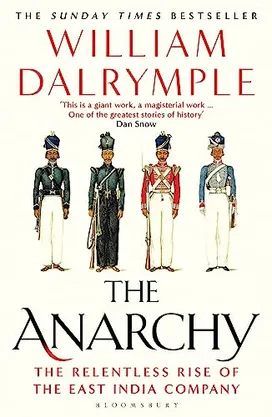
The Anarchy
by William Dalrymple
Started 28 July 2020 · 576 pages
Dalrymple tells how a private company, the East India Company, took over much of India in the eighteenth century, and the violence and plunder that came with it.
About the book, from Open Library. Get the book.
8 highlights · Kindle location in the margin
- 158
Corporations have neither bodies to be punished, nor souls to be condemned, they therefore do as they like. Edward, First Baron Thurlow (1731–1806), the Lord Chancellor during the impeachment of Warren Hastings
- 324
One of the very first Indian words to enter the English language was the Hindustani slang for plunder: loot.
- 355
By 1803, when its private army had grown to nearly 200,000 men, it had swiftly subdued or directly seized an entire subcontinent.
- 358
‘What honour is left to us?’ asked a Mughal official, ‘when we have to take orders from a handful of traders who have not yet learned to wash their bottoms?’
- 361
It was not the British government that began seizing great chunks of India in the mid-eighteenth century, but a dangerously unregulated private company headquartered in one small office, five windows wide, in London, and managed in India by a violent, utterly ruthless and intermittently mentally unstable corporate predator – Clive. India’s transition to colonialism took place under a for-profit corporation, which existed entirely for the purpose of enriching its investors.
- 414
With no stake in the just governance of the region, or its long-term well-being, the Company’s rule quickly turned into the straightforward pillage of Bengal, and the rapid transfer westwards of its wealth.
- 446
By 1803, when the EIC captured the Mughal capital of Delhi, and within it, the sightless monarch, Shah Alam, sitting blinded in his ruined palace, the Company had trained up a private security force of around 200,000 – twice the size of the British army – and marshalled more firepower than any nation state in Asia.
- 468
But the East India Company really was too big to fail. So it was that the following year, in 1773, the world’s first aggressive multinational corporation was saved by one of history’s first mega-bailouts – the first example of a nation state extracting, as its price for saving a failing corporation, the right to regulate and severely rein it in.