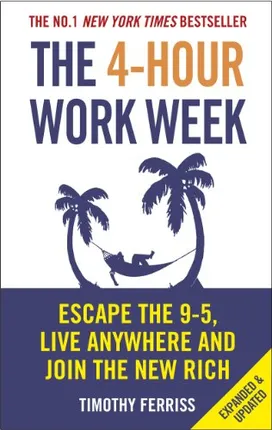
The 4-Hour Work Week
by Timothy Ferriss
Started 9 November 2019 · 416 pages
Ferriss’s manifesto for escaping the nine-to-five: eliminate low-value work, automate income and take mini-retirements instead of waiting for retirement.
7 highlights · Kindle location in the margin
- 494
People don’t want to be millionaires—they want to experience what they believe only millions can buy. Ski chalets, butlers, and exotic travel often enter the picture. Perhaps rubbing cocoa butter on your belly in a hammock while you listen to waves rhythmically lapping against the deck of your thatched-roof bungalow? Sounds nice.
- 505
Over the ensuing days, however, I realized that everyone seemed to be discussing how to build large and successful companies, sell out, and live the good life. Fair enough. The question no one really seemed to be asking or answering was, Why do it all in the first place? What is the pot of gold that justifies spending the best years of your life hoping for happiness in the last?
- 508
Test the most basic assumptions of the work-life equation.
- 510
How do your decisions change if retirement isn’t an option? What if you could use a mini-retirement to sample your deferred-life plan reward before working 40 years for it? Is it really necessary to work like a slave to live like a millionaire?
- 545
entrepreneur in the purer sense as first coined by French economist J. B. Say in 1800—one who shifts economic resources out of an area of lower and into an area of higher yield.
- 554
An expert is a person who has made all the mistakes that can be made in a very narrow field. —NIELS BOHR, Danish physicist and Nobel Prize winner
- 684
The first principle is that you must not fool yourself, and you are the easiest person to fool. —RICHARD P. FEYNMAN, Nobel Prize–winning physicist