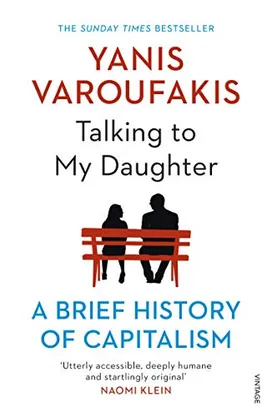
Talking to My Daughter
by Yanis Varoufakis and Jacob T. Moe
Started 22 January 2020 · finished 15 April 2020 · 224 pages
A former Greek finance minister explains the economy to his teenage daughter: markets, debt, money and inequality, told in plain language.
About the book, from Open Library. Get the book.
37 highlights · page in the margin
- p. 2
why the self-appointed experts on the economy, the economists, are almost always wrong.
- p. 9
history’s victims deserved what they got because they were not smart enough.
- p. 9
In the bubble of Western prosperity you’re growing up in most grown-ups would say to you that poor countries are poor because their ‘economies’ are weak – whatever that means. They would also say to you that poor people in your own community are poor because they do not have anything to sell that others really want – that, in short, they have nothing to offer the ‘market’.
- p. 10
a common error that many make: they think that markets and the economy are one and the same thing. They are not.
- p. 15
This is the origin of the word ‘credit’: it comes from the Latin credere, which means ‘to believe’.
- p. 18
agricultural surplus gave technology a gigantic boost by simultaneously giving rise to new technological needs – the need for ploughs and irrigation systems – and by concentrating resources in the hands of a powerful few.
- p. 23
it is much easier to make a million pounds once you’ve already got several million. On the other hand, if you’ve got nothing even a thousand pounds might seem like an unreachable dream.
- p. 24
When our eyes fall on those who lack the bare necessities, we immediately sympathize and express outrage that they do not have enough, but we do not for a moment allow ourselves to think that their deprivation may be the product of the same process that led to our affluence.
- p. 28
in the societies we live in we tend to confuse goods with commodities. We tend to think that the more expensive a good is the better it must be. And, even more importantly, there is a presumption that the more money you are offered for something you can do or pass on, the more readily you will deliver it.
- p. 31
Oscar Wilde wrote that a cynical person is someone who knows the price of everything but the value of nothing.
- p. 33
The very fact that most work, most production, took place within the confines of the extended household gave rise to the word oikonomia, which comprises two words: oikos (‘household’) and nomoi (‘laws, rules, constraints’). This is the etymology of ‘economy’, which literally means something like the ‘laws of running, or managing, a household’.
- p. 50
Today there is hardly a castle, painting or yacht that won’t be sold if the price is right.
- p. 50
In the triumph of exchange values over experiential values, as societies with markets evolved into market societies, something else happened: money was transformed from being a means into an end.
- p. 69
A brilliant economist once said that ‘the process by which banks create money is so simple that the mind is repelled’.
- p. 70
Once upon a time prudent bankers would only lend to Miriam and her ilk if they trusted her to invest her loan wisely and be able to repay it further down the line.
- p. 70
But in the 1920s or thereabouts banking became unhinged. Two things changed. One is that in the aftermath of the Industrial Revolution the economies of market societies grew enormously and the debt needed to fuel them rose massively as a result. The other was that bankers found ways to insulate themselves from the fallout if things went wrong.
- p. 73
I said that debt is indispensable for market societies? That there can be no profit without debt? And that without profit there is no surplus? Now allow me to add this: the very same process that generates profit and wealth generates financial crashes and crises.
- p. 79
we now come up against a fundamental paradox. The instability that bankers create in market societies can be reduced but it can never be entirely eradicated for the simple reason that the economy is fuelled by the thing they provide: debt.
- p. 81
A world in which the bankers are rescued but all other debtors, including governments, are not: this is the worst of all possible worlds. In fact it is a sterile world in which the economy produces only instability, failure and the grapes of wrath.
- p. 95
if a goal can only be achieved collectively, success depends not just on each individual pulling together but primarily on each individual believing that every other individual will do so.
- p. 119
Employers’ most intense desire is to eliminate the troublesome human element from their businesses while maintaining ownership of their machines’ products and profiting from this monopoly.
- p. 124
Every employer’s dream, after all, is not a society in which no one needs to work, profit is meaningless and each enjoys equally a commonwealth serviced by machines designed and directed by other machines. Their dream is having replaced all their workers with androids but no one else having done the same, allowing them to accumulate the profit and power unavailable to their competitors, who instead provide the market for their products by continuing to employ workers.
- p. 131
Currently, increasing automation reduces the portion of total income that goes to workers, diverting more and more money into the pockets of the rich who own the machines.
- p. 131
As long as highly skilled human labour remains necessary to design the machines that build other machines, full automation of the production process will not happen. In this scenario the effect of distributing profits as I have described would be to ensure that prices remain more or less stable while incomes rise, with the result that products become increasingly more affordable.
- p. 132
And if it ever happens that the production process does become fully robotized, with humans no longer needing to work on the design or the manufacture of the robots that make other robots, then all prices and all incomes will gradually recede until every product is like the air we breathe: so plentiful that no one needs to pay for it, however precious it may be. Then, and only then, we shall be able to boast, as Star Trek’s Captain Picard does, that ‘People are no longer obsessed with the accumulation of things.
- p. 132
In his essay on ‘the economic possibilities for our grandchildren’ one of the most highly regarded economists who ever lived, John Maynard Keynes, wrote the following: ‘The love of money as a possession … will be recognized for what it is, a somewhat disgusting morbidity, one of those semi-criminal, semi-pathological propensities which one hands over with a shudder to the specialists in mental disease.’
- p. 159
What Bitcoin supporters would not like, however, is what I am going to say next: that money can be kept separate from the state and from the political process leading to the formation of our governments and their policies is a dangerous illusion.
- p. 172
In ancient Greece a person who refused to think in terms of the common good was called an idiotis – a privateer, a person who minded his own business.
- p. 179
The reason the rich and powerful, along with their intellectual and ideological supporters, recommend the complete privatization of our environment is not that they are opposed to government; they’re just opposed to government interventions that undermine their property rights and threaten to democratize processes that they now control.
- p. 180
to paraphrase Winston Churchill’s tongue-in-cheek remark, democracy may be a terrible, terrible form of government – as flawed, fallible, inefficient and corrupt as the people of which it is comprised – but it’s better than any of the alternatives.
- p. 181
In both markets and democracies we vote.
- p. 188
John Stuart Mill, a British philosopher and political economist, warned us in 1863, ‘It is better to be a human being dissatisfied than a pig satisfied, better to be Socrates dissatisfied than a fool satisfied. And if the fool, or the pig, are of a different opinion, that is because they know only their side of the story.’
- p. 190
market society strives to accomplish: to satisfy your preferences.
- p. 190
The key to happiness, the American writer Henry David Thoreau once wrote, is not to look for it. It is like a colourful butterfly: ‘The more you chase it, the more it will elude you. But if you turn your attention to other things, it will come and sit softly on your shoulder.’
- p. 191
Something that angers and terrifies me more than almost anything else is the thought of being the plaything of forces and people of which I am oblivious. I think most people feel this way. That’s why movies like The Matrix and V for Vendetta have proved so popular: they appeal to our need to be self-directing, autonomous, free thinkers. The worst slavery is that of heavily indoctrinated happy morons who adore their chains and cannot wait to thank their masters for the joy of their subservience.
- p. 196
When economists insist that they too are scientists because they use mathematics, they are no different from astrologists protesting that they are just as scientific as astronomers because they also use computers and complicated charts.
- p. 200
We shall not cease from exploration And the end of all our exploring Will be to arrive where we started And know the place for the first time.