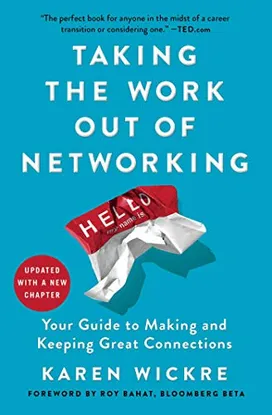
Taking the Work Out of Networking
by Karen Wickre
Started 18 May 2020 · 225 pages
A former Google and Twitter executive offers introverts a gentler way to build a professional network, through small, genuine connections rather than forced schmoozing.
About the book, from Open Library. Get the book.
37 highlights · Kindle location in the margin
- 93
As a lifelong introvert, the idea of forcing an introduction, talking too much about myself, or even asking for a business card has always been anathema. I get anxious if my calendar gets crowded with meetings, calls, and other obligations requiring me to talk too much or be in a crowd.
- 109
A contemporary definition of “networking” is to make an effort to meet and talk to a lot of people, especially in order to get information that can help you.
- 119
“Traditionally one is raised to not discuss work in social situations, to not be self-important, not be self-promoting, not be opportunistic, not make use of one’s friends—and then, as a professional adult, one has to somehow integrate the need to market oneself. The conflict never seems to feel any less awkward.”
- 158
I do it when I don’t need anything.
- 166
One example: our interest in others exceeds our need to talk about ourselves.
- 170
Another essential for networking is being a good observer—a clear advantage we have over chattier peers.
- 172
An equally vital and underleveraged element in the introvert’s arsenal is the use of social media and digital communication to reach people in ways that may feel more natural. By making good use of online interactions, it’s frankly easier to connect with people both within and outside your company minus the dread of working the room.
- 212
“An introvert who is silent in a group may actually be quite engaged—taking in what is said, thinking about it, waiting for a turn to speak.”) I
- 219
This is a key tactic: ask questions first. You learn to sort out how much you want to invest in another person when they’re talking to (or at) you.
- 231
These abilities—listening, observing, being curious—are wonderful tools for connecting with people.
- 308
He measures success in unavoidable group settings (such as conferences) as connecting with as few as five or ten people over a day when he might be with hundreds.
- 360
your default setting should be “I want to help, even if I don’t know how.” Our work and social worlds have gotten too small to keep doors shut (or risk being seen as an unhelpful jerk).
- 375
This is the biggest obstacle I see people impose on themselves: a very limited, and narrow, notion about who or what is going to be useful for their immediate need.
- 442
“the unpleasant task of trading favors with strangers.”
- 450
You—and virtually everyone else—are going to want to reach out to a number of people for contacts, information or insights, or support. And the same is true for others who will have these same needs, who will reach out to you. If remembering this helps you get over thinking of vulnerability as a weakness, that’s good! Presumably you’re already okay with giving a friendly ear to other people; now it’s time to get okay with seeking help for yourself. That’s key to making this whole thing work.
- 454
Another key to overcoming your fears about networking for a need is to practice a little bit every day—and do it when you don’t need specific help.
- 457
If you do this habitually when you’re not feeling needy, you’ll begin to see yourself as a giver, not a taker. If you can even occasionally be a problem-solver for others, that helps you get over the fear of feeling needy.
- 459
This is my guiding principle for an easier way to network: Nurture it before you need it.
- 467
Apart from the explosive growth of mobile phones for everything other than calls, we’ve become accustomed to many services based on time-shifting—meaning that we can do something when we want to, rather than at a set time. We’ve become asynchronous, in other words: We no longer have to call a retailer to put in an order or ask about a delivery. We don’t have to wait for a store to open or run around looking for a specific item in our desired volume/color/size. We don’t watch the six o’clock news; for better or worse, news comes to us 24/7. We’ve gotten extremely used to working, buying, socializing, and collaborating through many such time shifts.
- 474
Asynchronicity is also perfect for introverts, who may shy away from the immediacy of a real-time conversation. You can take the time to compose thoughtful messages, since you’re not as on-the-spot for the perfect response.
- 481
Instead of limiting ourselves to tit-for-tat exchanges, he writes, it’s better to act on the idea that “a gift is kept alive by its constant donation.”
- 520
“often it is our own sense that we are undeserving of help that has immobilized us. Whether it’s in the arts, at work, or in our relationships, we often resist asking not only because we’re afraid of rejection but also because we don’t even think we deserve what we’re asking for.”
- 525
People like to be asked to help and will help you—just as you’ll want to help others.
- 538
Ten minutes a day building your loose-touch habit can keep you in touch with an awful lot of people.
- 581
Twenty-five years ago, sociologist Ray Oldenburg argued for the idea of a “third place” besides home and work that occupied human activity and fostered community. Today many people (including me) would include online spaces, in addition to the local coffee bar, as being a kind of third place.
- 613
I should note that the impetus behind creating a loose-touch habit is not very different than a tactic salespeople have had for years: the tickler file. Salesfolk and business development pros often create “ticklers” to remind themselves to get in touch with clients or prospects again. Sales pros I know use ticklers to reflect the clients’ interests back to them, and to signal that they are still top of mind.
- 623
“It was such a great collegial environment, not competitive like other media outlets. We all helped each other. It was collaborative from the start. We’re not always in touch, but I still depend on them.
- 641
“Those to whom we are weakly tied are more likely to move in circles different from our own and will thus have access to information different from that which we receive.”
- 687
Not Ron, who passed on the meeting because he limited himself to what he already knew, or thought he knew. Guess what? He’s still looking. I hate it when this happens—and it doesn’t need to.
- 688
I’m telling you this story to encourage you to be more open as you think about new opportunities and directions for yourself. Don’t be like Ron and rule out encounters that might be informative. In most any career-related search, people you already know, especially your close friends, are not likely to be your best resources. Though they can (and should) absolutely cheer you on, it’s the weak ties—more remote, very occasional, not obvious—who are likely to provide breakthrough leads.
- 730
Technology journalist and author John Markoff observes that Moore’s Law means “nothing stays the same for more than a moment; no technology is safe from its successor . . . if you’re not running on what became known as ‘Internet time,’ you’re falling behind.”
- 756
We should see ourselves as a whole and integrated person, not as someone splintered into a million tiny pieces that must be kept isolated. —Rebecca Fraser-Thrill
- 762
As Cory Fernandez acknowledges in a Fast Company article, “It’s tricky balancing professionalism with personality, especially when you use social media to share funny memes and catch up with friends in addition to showcasing your expertise.” Yes, it is tricky—but I think it’s time we all get over the idea that our personal and professional lives can be kept in completely separate silos. Besides, recruiters and hiring managers want to get a sense of you to understand whether you are likely to work well with, and complement, the existing team.
- 834
Today Tim recognizes his “work-friends” as “a large group of people who know me, trust me, and hopefully respect me—exactly the things people are looking for in a business partner.
- 912
The internet has long invited us to explore, learn, and share, and through those activities, to connect with others. So it’s perfectly suited to—perfect for—introverts. From the comfort of your desk, kitchen table, or favorite coffee bar, you can put yourself in front of prospective employers, reconnect with former colleagues to gather intel on your next move, and meet with people on your terms in your field(s) of interest.
- 917
night) to make today’s social media services work for us. Much of my work in writing and consulting consists of a daily mix of these things: initiating and responding to email, instant messaging, Google searches, video calls, reading and sending tweets and private messages, LinkedIn research, texting, and a few side trips to Instagram and Facebook. This is not only how I work; these tasks and habits are how I connect with people to learn new things, consider new ideas, share news, and touch base.
- 929
In this chapter, we’ll look closely at three of them: LinkedIn, Twitter, and Instagram. I focus on these in particular because none of them requires a 1:1 relationship between you and another person; they are each what’s called an asymmetrical network. All were designed so that you can connect informally with people you already know, and also discover new people, whose posts, images, comments, and updates you can see and react to. You don’t have to know the people you’re looking up or following; you can reach out to meet or even just respond without being directly connected. The important idea here is that each one takes you beyond your immediate circle, so that you can easily enter new territory, beyond the familiar, via new contacts.