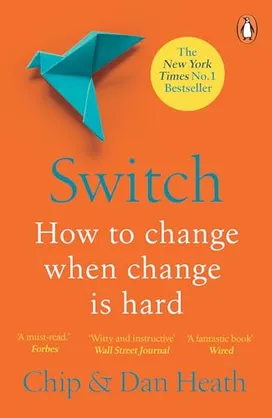
Switch
by Chip Heath and Dan Heath
Started 14 October 2021 · 305 pages
The Heath brothers explain how to make change happen when it’s hard, by directing the rational mind, motivating the emotional side and shaping the path.
About the book, from Open Library. Get the book.
23 highlights · page in the margin
- p. 2
Brian Wansink, the author of the study, runs the Food and Brand Lab at Cornell University, and he described the results in his book Mindless Eating:
- p. 2
People eat more when you give them a bigger container.
- p. 3
If you want people to eat less popcorn, the solution is pretty simple: Give them smaller buckets. You don’t have to worry about their knowledge or their attitudes.
- p. 3
You can see how easy it would be to turn an easy change problem (shrinking people’s buckets) into a hard change problem (convincing people to think differently).
- p. 3
And that’s the first surprise about change: What looks like a people problem is often a situation problem.
- p. 4
We know what you’re thinking—people resist change. But it’s not quite that easy. Babies are born every day to parents who, inexplicably, welcome the change.
- p. 4
In our lives, we embrace lots of big changes—not only babies, but marriages and new homes and new technologies and new job duties.
- p. 4
we argue that successful changes share a common pattern. They require the leader of the change to do three things at once. We’ve already mentioned one of those three things: To change someone’s behavior, you’ve got to change that person’s situation.
- p. 6
The conventional wisdom in psychology, in fact, is that the brain has two independent systems at work at all times. First, there’s what we called the emotional side. It’s the part of you that is instinctive, that feels pain and pleasure. Second, there’s the rational side, also known as the reflective or conscious system. It’s the part of you that deliberates and analyzes and looks into the future.
- p. 7
the duo’s tension is captured best by an analogy used by University of Virginia psychologist Jonathan Haidt3 in his wonderful book The Happiness Hypothesis. Haidt says that our emotional side is an Elephant and our rational side is its Rider. Perched atop the Elephant, the Rider holds the reins and seems to be the leader. But the Rider’s control is precarious because the Rider is so small relative to the Elephant. Anytime the six-ton Elephant and the Rider disagree about which direction to go, the Rider is going to lose. He’s completely overmatched.
- p. 8
If you want to change things, you’ve got to appeal to both. The Rider provides the planning and direction, and the Elephant provides the energy.
- p. 10
Self-control is an exhaustible resource. This is a crucial realization, because when we talk about “self-control,” we don’t mean the narrow sense of the word, as in the willpower needed to fight vice (smokes, cookies, alcohol). We’re talking about a broader kind of self-supervision. Think of the way your mind works when you’re giving negative feedback to an employee, or assembling a new bookshelf, or learning a new dance. You are careful and deliberate with your words or movements. It feels like there’s a supervisor on duty. That’s self-control, too.
- p. 11
The research shows that we burn up self-control in a wide variety of situations: managing the impression we’re making on others; coping with fears; controlling our spending; trying to focus on simple instructions such as “Don’t think of a white bear”; and many, many others.
- p. 12
Change is hard because people wear themselves out. And that’s the second surprise about change: What looks like laziness is often exhaustion.
- p. 12
John Kotter and Dan Cohen’s essential book The Heart of Change.
- p. 14
Stegner knew that if things were going to change, he had to get his colleagues’ Elephants on his side.
- p. 14
Remember that if you reach your colleagues’ Riders but not their Elephants, they will have direction without motivation. Maybe their Riders will drag the Elephant down the road for a while, but as we’ve seen, that effort can’t last long.
- p. 14
Once you break through to feeling, though, things change.
- p. 14
That got their Elephants fired up to move.
- p. 15
the Rider has his own issues. He’s a navel-gazer, an analyzer, a wheel-spinner. If the Rider isn’t sure exactly what direction to go, he tends to lead the Elephant in circles. And as we’ll see, that tendency explains the third and final surprise about change: What looks like resistance is often a lack of clarity.
- p. 15
This is exactly the kind of situation in which the Rider will spin his wheels, analyzing and agonizing and never moving forward.
- p. 16
If you want people to change, you must provide crystal-clear direction.
- p. 17
It’s so the Rider doesn’t spin his wheels.