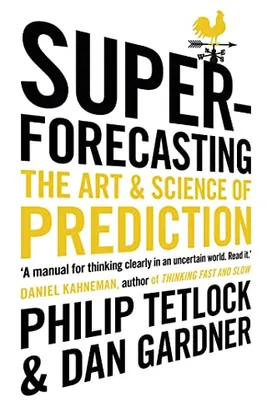
Superforecasting
by Philip Tetlock and Dan Gardner
Started 16 January 2021 · 338 pages
Drawing on a large forecasting tournament, Tetlock shows that some ordinary people predict events remarkably well, and explains the habits of mind that make them good.
About the book, from Open Library. Get the book.
29 highlights · page in the margin
- p. 3
Every day, the news media deliver forecasts without reporting, or even asking, how good the forecasters who made the forecasts really are. Every day, corporations and governments pay for forecasts that may be prescient or worthless or something in between. And every day, all of us—leaders of nations, corporate executives, investors, and voters—make critical decisions on the basis of forecasts whose quality is unknown.
- p. 3
when it comes to the forecasters who help us make decisions that matter far more than any baseball game, we’re content to be ignorant.3
- p. 4
the average expert was roughly as accurate as a dart-throwing chimpanzee.
- p. 4
It has popped up in the New York Times, the Wall Street Journal, the Financial Times, the Economist, and other outlets around the world. It goes like this: A researcher gathered a big group of experts—academics, pundits, and the like—to make thousands of predictions about the economy, stocks, elections, wars, and other issues of the day. Time passed, and when the researcher checked the accuracy of the predictions, he found that the average expert did about as well as random guessing.
- p. 4
I am that researcher and for a while I didn’t mind the joke. My study was the most comprehensive assessment of expert judgment in the scientific literature. It was a long slog that took about twenty years, from 1984 to 2004, and the results were far richer and more constructive than the punch line suggested.
- p. 5
Open any newspaper, watch any TV news show, and you find experts who forecast what’s coming. Some are cautious. More are bold and confident. A handful claim to be Olympian visionaries able to see decades into the future. With few exceptions, they are not in front of the cameras because they possess any proven skill at forecasting. Accuracy is seldom even mentioned. Old forecasts are like old news—soon forgotten—and pundits are almost never asked to reconcile what they said with what actually happened.
- p. 5
The one undeniable talent that talking heads have is their skill at telling a compelling story with conviction, and that is enough. Many have become wealthy peddling forecasting of untested value to corporate executives, government officials, and ordinary people who would never think of swallowing medicine of unknown efficacy and safety but who routinely pay for forecasts that are as dubious as elixirs sold from the back of a wagon.
- p. 5
The message became “all expert forecasts are useless,” which is nonsense. Some variations were even cruder—like “experts know no more than chimpanzees.” My research had become a backstop reference for nihilists who see the future as inherently unpredictable and know-nothing populists who insist on preceding “expert” with “so-called.”
- p. 6
Call me an “optimistic skeptic.”
- p. 8
In 1972 the American meteorologist Edward Lorenz wrote a paper with an arresting title: “Predictability: Does the Flap of a Butterfly’s Wings in Brazil Set Off a Tornado in Texas?” A decade earlier, Lorenz had discovered by accident that tiny data entry variations in computer simulations of weather patterns—like replacing 0.506127 with 0.506—could produce dramatically different long-term forecasts. It was an insight that would inspire “chaos theory”: in nonlinear systems like the atmosphere, even small changes in initial conditions can mushroom to enormous proportions.
- p. 9
Edward Lorenz shifted scientific opinion toward the view that there are hard limits on predictability, a deeply philosophical question.
- p. 9
For centuries, scientists had supposed that growing knowledge must lead to greater predictability because reality was like a clock—an awesomely big and complicated clock but still a clock—and the more scientists learned about its innards, how the gears grind together, how the weights and springs function, the better they could capture its operations with deterministic equations and predict what it would do.
- p. 13
How predictable something is depends on what we are trying to predict, how far into the future, and under what circumstances.
- p. 14
The consumers of forecasting—governments, business, and the public—don’t demand evidence of accuracy. So there is no measurement. Which means no revision. And without revision, there can be no improvement.
- p. 15
“I have been struck by how important measurement is to improving the human condition,” Bill Gates wrote. “You can achieve incredible progress if you set a clear goal and find a measure that will drive progress toward that goal. … This may seem basic, but it is amazing how often it is not done and how hard it is to get right.”
- p. 18
Foresight isn’t a mysterious gift bestowed at birth. It is the product of particular ways of thinking, of gathering information, of updating beliefs. These habits of thought can be learned and cultivated by any intelligent, thoughtful, determined person.
- p. 20
superforecasting demands thinking that is open-minded, careful, curious, and—above all—self-critical. It also demands focus. The kind of thinking that produces superior judgment does not come effortlessly. Only the determined can deliver it reasonably consistently, which is why our analyses have consistently found commitment to self-improvement to be the strongest predictor of performance.
- p. 23
Human thought is beset by psychological pitfalls, a fact that has only become widely recognized in the last decade or two. “So what I want is that human expert paired with a computer to overcome the human cognitive limitations and biases.”
- p. 25
We have all been too quick to make up our minds and too slow to change them.
- p. 26
Until quite recently in historical terms, it was not unusual for a sick person to be better off if there was no physician available because letting an illness take its natural course was less dangerous than what a physician would inflict.
- p. 27
Galen is an extreme example but he is the sort of figure who pops up repeatedly in the history of medicine. They are men (always men) of strong conviction and a profound trust in their own judgment. They embrace treatments, develop bold theories for why they work, denounce rivals as quacks and charlatans, and spread their insights with evangelical passion. So it went from the ancient Greeks to Galen to Paracelsus to the German Samuel Hahnemann and the American Benjamin Rush.
- p. 29
It was cargo cult science, a term of mockery coined much later by the physicist Richard Feynman to describe what happened after American airbases from World War II were removed from remote South Pacific islands, ending the islanders’ only contact with the outside world. The planes had brought wondrous goods. The islanders wanted more. So they “arranged to make things like runways, to put fires along the sides of the runways, to make a wooden hut for a man to sit in, with two wooden pieces on his head like headphones and bars of bamboo sticking out like antennas—he’s the controller—and they wait for the planes to land.”9 But the planes never returned. So cargo cult science has the outward form of science but lacks what makes it truly scientific.
- p. 31
When hospitals created cardiac care units to treat patients recovering from heart attacks, Cochrane proposed a randomized trial to determine whether the new units delivered better results than the old treatment, which was to send the patient home for monitoring and bed rest.
- p. 31
Cochrane got his trial: some patients, randomly selected, were sent to the cardiac care units while others were sent home for monitoring and bed rest.
- p. 31
Cochrane revealed he had played a little trick. He had reversed the results: home care had done slightly better than the cardiac units.
- p. 31
Unusually high heart disease rates among prisoners drew Cochrane’s attention to the justice system, where he encountered the same attitudes among prison wardens, judges, and Home Office officials. What people didn’t grasp is that the only alternative to a controlled experiment that delivers real insight is an uncontrolled experiment that produces merely the illusion of insight.
- p. 32
Cochrane cited the Thatcher government’s “short, sharp, shock” approach to young offenders, which called for brief incarceration in spartan jails governed by strict rules. Did it work? The government had simply implemented it throughout the justice system, making it impossible to answer. If the policy was introduced and crime went down, that might mean the policy worked, or perhaps crime went down for any of a hundred other possible reasons. If crime went up, that might show the policy was useless or even harmful, or it might mean crime would have risen even more but for the beneficial effects of the policy. Naturally, politicians would claim otherwise. Those in power would say it worked; their opponents would say it failed. But nobody would really know. The politicians would be blind men arguing over the colors of the rainbow. If the government had subjected its policy “to a randomized controlled trial then we might, by now, have known its true worth and be some way ahead in our thinking,” Cochrane observed. But it hadn’t. It had just assumed that its policy would work as expected. This was the same toxic brew of ignorance and confidence that had kept medicine in the dark ages for millennia.
- p. 32
Cochrane’s frustration is palpable in his autobiography. Why couldn’t people see that intuition alone was no basis for firm conclusions? It was “bewildering.”
- p. 35
A defining feature of intuitive judgment is its insensitivity to the quality of the evidence on which the judgment is based.