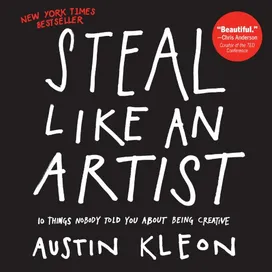
Steal Like an Artist
by Austin Kleon
· 10 min read
The Main Take Away
In this groundbreaking book, NYTimes bestselling author Austin Kleon suggests that no idea is new and that everything that had to be said has been said, but since no one was listening, everything needs to be said again. And thus he proposes the idea of Stealing like an Artist, that is one who copies multiple ideas from multiple people and then combines them to build something new, and in the process develops their own style. I found it an extension of what Arthur Conan Doyle said through his eponymous detective, Sherlock Holmes, (and I am paraphrasing here) that every crime that is to be committed has been committed. There is nothing new in the world of criminals and yet new combinations of crimes always happen that have never been in history. Austin advances the idea that like Newton said “If I have seen further, it is by standing upon the shoulders of giants”, similarly every artist creates nothing new from complete scratch, but stands on the shoulders of giants before him and creates something new. Read it here.
My High Level Review
This is a great book and a must-read for anyone who is pursuing his creativity or wants to delve into anything that is not a typical 9-5 job. The other advantage is that the book is really small and can be finished in a couple of hours, even by the people who are not really in the habit of reading books. This is a great primer for anyone struggling with creativity paralysis or not getting any ideas about what to create.
Book Summary
Austin says that when people give you advice, they are really just talking to themselves in the past. And this is so true. Even Indian author Nirad C. Chaudhuri says something like this.
First one has to figure out what’s worth stealing and then move on to the next thing to steal. When looked at the world through this glass, there’s no such thing as good or bad, only what’s worth stealing and what’s not.
Every new idea is a mashup or remix of one or more previous ideas.
Just as you have a family genealogy, you also have a genealogy of ideas. You don’t get to pick your family but you do get to pick your ideas.
You are a mashup of what you choose to let into your life. You are the sum of your influences.
The German writer Goethe said, “We are shaped and fashioned by what we love.”
But you have to remember that the artist is a collector, not a hoarder. The difference is that hoarders collect indiscriminately, artists collect selectively. They only collect things that they love. In other words, they have figured out what they love or what the purpose of their art is. And only then they transform from hoarder to artist.
There’s an economic theory that your income is pretty close to the average of five of your closest friends. And the same can be said about ideas, you are only as good as the stuff that you surround yourself with.
You can steal from anywhere that resonates with you. And to keep track of what resonates with you, maintain a resonance calendar.
Seeing yourself as part of a long tradition of creators will help you to feel less alone as you start creating your own stuff.
Be curious about the world you live in. Explore why things are the way they are. Google everything. Don’t ask a question before you Google it. You will either find the answer or you will come up with a better question.
Carry a notebook and a pen with you wherever you go (or a smartphone in today’s world and use an app like Draft) to quickly capture your ideas. Get used to pulling it out and jotting down your thoughts and observations. Copy your favourite passage out of books. Record overheard conversations.
Keep a swipe file. It is what it sounds like, keep track of stuff you have swiped from others.
If you wait to know who I was or what I was about before you start ‘being creative’, you would still be sitting around trying to figure it out instead of making things. It is in the act of making things and doing our work that we figure out who we are.
You might be scared and suffer from Imposter Syndrome. That’s very real and runs rampant in educated people. It ruins lives. But guess what, everybody is scared. None of them know what to do. Ask anybody and they will tell you they don’t know where the good stuff comes from. They just show up to do their thing.
William Shakespeare spelled out in his play As You Like It about 400 years ago: All the world’s a stage, And all the men and women merely players: They have their exits and their entrances; And one man in his time plays many parts.
In other words, Fake it till you make it.
Nobody is born with a style or a voice. We don’t come out of the womb knowing who we are. In the beginning, we learn by pretending to be our heroes. We learn by copying.
First, you have to figure out who to copy. Second, you have to figure out what to copy.
At some point, you’ll have to move from imitating your heroes to emulating them. Imitation is about copying. Emulation is when imitation goes one step further, breaking through into your own thing.
The best advice is not to write what you know, it’s to write what you like. Write the kind of story you like best—write the story you want to read. The same principle applies to your life and your career: Whenever you’re at a loss for what move to make next, just ask yourself, “What would make a better story?”
The manifesto is this: Draw the art you want to see, start the business you want to run, play the music you want to hear, write the books you want to read, build the products you want to use—do the work you want to see done.
Computers and digital devices have robbed us of the feeling that we are actually making things and hence today so-called knowledge work seems abstract.
One needs to sense the work they are doing through our six senses and touch is often the most effective one. There’s the phrase ‘going through the motions?’ and that is real, one needs to feel that in creative work.
The computer and other digital devices are great for editing ideas and great for ideas and creations getting published out into the world but not so great at generating ideas. It’s so easy to delete in a computer that we become too much of a perfectionist, we start editing ideas before we have them.
“The work you do while you procrastinate is probably the work you should be doing for the rest of your life.” —Jessica Hische
Work on multiple projects at the same time so you can move between them. When you get bored with one, move to the other one. The same applies to reading, read multiple books at the same time and when you get bored with one, move to the other one.
Practice productive procrastination.
Take time to be bored. The best ideas often come to us when we are bored. Practice being alone and enjoying being alone. It is when you are alone and immersed in deep thought that you get your best ideas. If you are always in the company of someone or always online and checking social media and cannot be alone for a while, you will never get good ideas. And even if you get it you will never be able to think through it. Practice boring things like ironing your shirts, or cooking or washing the dishes. These activities are so boring and occupy so little of your brain that your brain will automatically get busy in something else, and they will often be your best ideas.
Take time to mess around. Get lost. Wander. You never know where it’s going to lead you.
If you have multiple passions, do not choose one amongst them, rather have all of them and a common intersection between them will emerge.
If you love different things, spend time amongst all of them.
“Let them talk to each other. Something will begin to happen.”
Cultivate a hobby. A hobby is the best way to reach flow state. It’s something creative that is just for you, you don’t try to make money or get famous off it, you do it because it makes you happy. It’s something that gives but doesn’t take.
Don’t throw yourself away, don’t worry about some grand scheme beforehand, it will all make sense in the end.
“You can’t connect the dots looking forward, you can only connect them looking backwards.” —Steve Jobs
The real world starts when you leave college. Till then, in all your classrooms, your teacher got paid to give attention to your ideas and your classmates are there to pay attention to your ideas. You will never have such a ready audience ever again in life.
There’s only one not-so-secret formula for success: Do good work and share it. It’s a two-step process. First do good work. It’s incredibly hard, there are no shortcuts. It’s going to suck for a while. The only way to get better is to fall and get up and fall again and learn and get better in the process. And then step 2. Share it with people. This was really hard before the internet but now it has got way too easy.
Do things that nobody else is wondering about. If everybody else is wondering about apples, go wonder about oranges. The more you are open about it the better.
You don’t have to put yourself online because you have something to say, you can put yourself online to find something to say. Use the internet as an incubator of ideas.
Because most websites show posts in reverse chronological order, you have a constant pressure to keep doing good work and keep sharing them because you are only as good as your last work.
At the same time, don’t be on the internet all the time. Embrace offline activities like going on a hike. Practice digital detoxing.
Figure out where you want to live. You don’t have to live where you were born or where your parents live. You can choose to live at a different place. There are a bunch of factors to consider, and it depends on your personal tastes. You should surround yourself with interesting people and diversity helps. You should find a place that can feed your needs - creatively, socially, spiritually and literally.
In this hyperconnected world, everybody is going to find out what you say about them. The best way to make friends online? Say nice things about them. Compliment them thoughtfully.
Surround yourself in the digital space with people who are way smarter than you are and better than you, people who are doing interesting work. Because you are only as good as the people you surround yourself with. Pay attention to what they are talking about, what they are reading and what they are doing. If you ever find yourself to be the most talented person in a room, find another room.
Anger can be a pretty good creative resource. There are plenty of things going on in the world that would make you angry but instead of wasting your anger on complaining or trying to prove them wrong on Twitter, channel it to your creative work.
Create a repository of public fan letters. Life can be pretty tough and there are times when you will feel like nothing is working and you are a total loser. In those times, go back and check that repository and you will find all the times you helped someone find something or came to their aid and you will realise that you are not worthless. And suddenly all those memories will cover you like a warm glow and you will realise you are much loved and your contribution is greatly appreciated.
The problem with creative work is that you have no control over how people will react to your work. And so you can’t go looking for validation of your work from external sources. Ironically, good work will often seem effortless. It is so obvious in hindsight that everyone will think why they didn’t think of it themselves.
Not everybody will get your work. People will misinterpret you and what you do. Or hate you for your success. They might even call you names. So get used to that, the trick is to be so busy with work that you have no time for the haters.