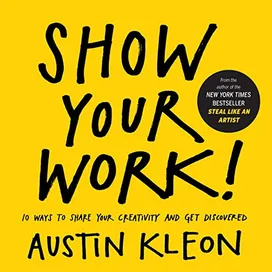
Show Your Work!
by Austin Kleon
Started 6 July 2020 · 224 pages
Ten short, illustrated lessons on sharing your work as you go, so that the right people find it: show your process, teach what you know and build an audience.
About the book, from Open Library. Get the book.
90 highlights · Kindle location in the margin
- 19
“Creativity is not a talent. It is a way of operating.” —John Cleese
- 21
How do I get my stuff out there? How do I get noticed? How do I find an audience? How did you do it?
- 23
If you just focus on getting really good, Martin says, people will come to you. I happen to agree: You don’t really find an audience for your work; they find you. But it’s not enough to be good. In order to be found, you have to be findable. I think there’s an easy way of putting your work out there and making it discoverable while you’re focused on getting really good at what you do.
- 26
Almost all of the people I look up to and try to steal from today, regardless of their profession, have built sharing into their routine.
- 28
instead of maintaining absolute secrecy and hoarding their work, they’re open about what they’re working on, and they’re consistently posting bits and pieces of their work, their ideas, and what they’re learning online.
- 30
Instead of wasting their time “networking,” they’re taking advantage of the network. By generously sharing their ideas and their knowledge, they often gain an audience that they can then leverage when they need it—for fellowship, feedback, or patronage.
- 33
book for people who hate the very idea of self-promotion. An alternative, if you will, to self-promotion.
- 33
I’m going to try to teach you how to think about your work as a never-ending process, how to share your process in a way that attracts people who might be interested in what you do, and how to deal with the ups and downs of putting yourself and your work out in the world.
- 37
Imagine if your next boss didn’t have to read your résumé because he already reads your blog.
- 47
the “lone genius” myth: An individual with superhuman talents appears out of nowhere at certain points in history, free of influences or precedent, with a direct connection to God or The Muse. When inspiration comes, it strikes like a lightning bolt, a lightbulb switches on in his head, and then he spends the rest of his time toiling away in his studio, shaping this idea into a finished masterpiece that he releases into the world to great fanfare. If you believe in the lone genius myth, creativity is an antisocial act, performed by only a few great figures—mostly dead men with names like Mozart, Einstein, or Picasso. The rest of us are left to stand around and gawk in awe at their achievements.
- 53
Brian Eno refers to as “scenius.” Under this model, great ideas are often birthed by a group of creative individuals—artists, curators, thinkers, theorists, and other tastemakers—who make up an “ecology of talent.”
- 55
If you look back closely at history, many of the people who we think of as lone geniuses were actually part of “a whole scene of people who were supporting each other, looking at each other’s work, copying…
- 57
that creativity is always, in some sense, a collaboration, the result of a mind…
- 59
What I love about the idea of scenius is that it makes room in the story of creativity for the rest of us: the people who don’t consider ourselves geniuses. Being a valuable part of a scenius is not necessarily about how smart or talented you are, but about what you have to contribute—the ideas you share, the quality of the connections you make, and the conversations you start. If we forget about genius and think more about how we can nurture and contribute to a scenius, we can adjust our own expectations and the…
- 64
We live in an age where it’s easier than ever to join a scenius. The Internet is basically a bunch of sceniuses connected together, divorced from physical geography. Blogs, social media sites, email groups, discussion boards, forums—they’re all the same thing: virtual scenes where people go to hang out and talk about the things they care about. There’s no bouncer, no gatekeeper, and no barrier to entering these scenes: You don’t have to be…
- 72
We’re all terrified of being revealed as amateurs, but in fact, today it is the amateur—the enthusiast who pursues her work in the spirit of love (in French, the word means “lover”), regardless of the potential for fame, money, or career—who often has the advantage over the professional. Because they have little to lose, amateurs are willing to try anything and share the results. They take chances, experiment, and follow their whims. Sometimes, in the process of doing things in an unprofessional way, they make new…
- 77
Amateurs are not afraid to make mistakes or look ridiculous in public. They’re in love, so they don’t hesitate to do work that others…
- 80
Mediocrity is, however, still on the spectrum; you can move from mediocre to good in increments. The real gap is between…
- 82
Amateurs might lack formal training, but they’re all lifelong learners, and they make a point of learning in the open, so that others can…
- 83
Writer David Foster Wallace said that he thought good nonfiction was a chance to “watch somebody reasonably bright but also reasonably average pay far closer attention and think at far more length about all sorts of different…
- 91
The world is changing at such a rapid rate that it’s turning us all into amateurs. Even for professionals, the best way to flourish is to retain an amateur’s spirit and embrace uncertainty and the unknown.
- 97
The best way to get started on the path to sharing your work is to think about what you want to learn, and make a commitment to learning it in front of others.
- 98
Find a scenius, pay attention to what others are sharing, and then start taking note of what they’re not sharing. Be on the lookout for voids that you can fill with your own efforts, no matter how bad they are at first. Don’t worry, for now, about how you’ll make money or a career off it. Forget about being an expert or a professional, and wear your amateurism (your heart, your love) on your sleeve.
- 101
Share what you love, and the people who love the same things will find you.
- 104
We’re always being told find your voice.
- 106
now I realize that the only way to find your voice is to use it. It’s hardwired, built into you. Talk about the things you love. Your voice will follow.
- 119
It sounds a little extreme, but in this day and age, if your work isn’t online, it doesn’t exist. We all have the opportunity to use our voices, to have our say, but so many of us are wasting it. If you want people to know about what you do and the things you care about, you have to share.
- 122
“Remembering that I’ll be dead soon is the most important tool I’ve ever encountered to help me make the big choices in life. Because almost everything—all external expectations, all pride, all fear of embarrassment or failure—these things just fall away in the face of death, leaving only what is truly important. Remembering that you are going to die is the best way I know to avoid the trap of thinking you have something to lose. You are already naked.” —Steve Jobs
- 131
I’m not going to sit here and wait for things to happen, I’m going to make them happen, and if people think I’m an idiot I don’t care.”
- 150
“A lot of people are so used to just seeing the outcome of work. They never see the side of the work you go through to produce the outcome.” —Michael Jackson
- 157
David Bayles and Ted Orland in their book, Art and Fear: “To all viewers but yourself, what matters is the product: the finished artwork. To you, and you alone, what matters is the process: the experience of shaping the artwork.”
- 171
human beings are interested in other human beings and what other human beings do. “People really do want to see how the sausage gets made.”
- 173
Dan Provost and Tom Gerhardt put it in their book on entrepreneurship, It Will Be Exhilarating. “By putting things out there, consistently, you can form a relationship with your customers. It allows them to see the person behind the products.” Audiences not only want to stumble across great work, but they, too, long to be creative and part of the creative process. By letting go of our egos and sharing our process, we allow for the possibility of people having an ongoing connection with us and our work, which helps us move more of our product.
- 183
Commander Hadfield wanted to show his work.
- 190
But whatever the nature of your work, there is an art to what you do, and there are people who would be interested in that art, if only you presented it to them in the right way.
- 193
How can you show your work even when you have nothing to show? The first step is to scoop up the scraps and the residue of your process and shape them into some interesting bit of media that you can share. You have to turn the invisible into something other people can see. “You have to make stuff,” said journalist David Carr when he was asked if he had any advice for students. “No one is going to give a damn about your résumé; they want to see what you have made with your own little fingers.”
- 197
Become a documentarian of what you do. Start a work journal: Write your thoughts down in a notebook, or speak them into an audio recorder. Keep a scrapbook. Take a lot of photographs of your work at different stages in your process. Shoot video of you working. This isn’t about making art, it’s about simply keeping track of what’s going on around you. Take advantage of all the cheap, easy tools at your disposal—these days, most of us carry a fully functional multimedia studio around in our smartphones.
- 201
Whether you share it or not, documenting and recording your process as you go along has its own rewards: You’ll start to see the work you’re doing more clearly and feel like you’re making progress. And when you’re ready to share, you’ll have a surplus of material to choose from.
- 207
Overnight success is a myth. Dig into almost every overnight success story and you’ll find about a decade’s worth of hard work and perseverance. Building a substantial body of work takes a long time—a lifetime, really—but thankfully, you don’t need that time all in one big chunk. So forget about decades, forget about years, and forget about months. Focus on days.
- 211
Once a day, after you’ve done your day’s work, go back to your documentation and find one little piece of your process that you can share. Where you are in your process will determine what that piece is. If you’re in the very early stages, share your influences and what’s inspiring you. If you’re in the middle of executing a project, write about your methods or share works in progress. If you’ve just completed a project, show the final product, share scraps from the cutting-room floor, or write about what you learned. If you have lots of projects out into the world, you can report on how they’re doing—you can tell stories about how people are interacting with your work.
- 217
A daily dispatch is even better than a résumé or a portfolio, because it shows what we’re working on right now. When the artist Ze Frank was interviewing job candidates, he complained, “When I ask them to show me work, they show me things from school, or from another job, but I’m more interested in what they did last weekend.”
- 221
Your daily dispatch can be anything you want—a blog post, an email, a tweet, a YouTube video, or some other little bit of media.
- 233
I like the tagline at dribbble.com: “What are you working on?” Stick to that question and you’ll be good. Don’t show your lunch or your latte; show your work.
- 235
Don’t worry about everything you post being perfect. Science fiction writer Theodore Sturgeon once said that 90 percent of everything is crap. The same is true of our own work. The trouble is, we don’t always know what’s good and what sucks. That’s why it’s important to get things in front of others and see how they react.
- 239
People often ask me, “How do you find the time for all this?” And I answer, “I look for it.” You find time the same place you find spare change: in the nooks and crannies. You find it in the cracks between the big stuff—your commute, your lunch break, the few hours after your kids go to bed. You might have to miss an episode of your favorite TV show, you might have to miss an hour of sleep, but you can find the time if you look for it. I like to work while the world is sleeping, and share while the world is at work.
- 243
Of course, don’t let sharing your work take precedence over actually doing your work. If you’re having a hard time balancing the two, just set a timer for 30 minutes. Once the timer goes off, kick yourself off the Internet and get back to work.
- 254
Be open, share imperfect and unfinished work that you want feedback on, but don’t share absolutely everything. There’s a big, big difference between sharing and over-sharing.
- 260
Always be sure to run everything you share with others through The “So What?” Test. Don’t overthink it; just go with your gut. If you’re unsure about whether to share something, let it sit for 24 hours. Put it in a drawer and walk out the door. The next day, take it out and look at it with fresh eyes. Ask yourself, “Is this helpful? Is it entertaining? Is it something I’d be comfortable with my boss or my mother seeing?”
- 267
“Stock and flow” is an economic concept that writer Robin Sloan has adapted into a metaphor for media: “Flow is the feed. It’s the posts and the tweets. It’s the stream of daily and sub-daily updates that remind people you exist. Stock is the durable stuff. It’s the content you produce that’s as interesting in two months (or two years) as it is today. It’s what people discover via search. It’s what spreads slowly but surely, building fans over time.” Sloan says the magic formula is to maintain your flow while working on your stock in the background.
- 272
In my experience, your stock is best made by collecting, organizing, and expanding upon your flow. Social media sites function a lot like public notebooks—they’re places where we think out loud, let other people think back at us, then hopefully think some more. But the thing about keeping notebooks is that you have to revisit them in order to make the most out of them. You have to flip back through old ideas to see what you’ve been thinking. Once you make sharing part of your daily routine, you’ll notice themes and trends emerging in what you share. You’ll find patterns in your flow. When you detect these patterns, you can start gathering these bits and pieces and turn them into something bigger and more substantial. You can turn your flow into stock. For example, a lot of the ideas in this book started out as tweets, which then became blog posts, which then became book chapters. Small things, over time, can get big.
- 280
“Carving out a space for yourself online, somewhere where you can express yourself and share your work, is still one of the best possible investments you can make with your time.” —Andy Baio
- 287
A blog is the ideal machine for turning flow into stock: One little blog post is nothing on its own, but publish a thousand blog posts over a decade, and it turns into your life’s work. My blog has been my sketchbook, my studio, my gallery, my storefront, and my salon. Absolutely everything good that has happened in my career can be traced back to my blog. My books, my art shows, my speaking gigs, some of my best friendships—they all exist because I have my own little piece of turf on the Internet.
- 295
Don’t think of your website as a self-promotion machine, think of it as a self-invention machine.
- 296
Online, you can become the person you really want to be. Fill your website with your work and your ideas and the stuff you care about. Over the years, you will be tempted to abandon it for the newest, shiniest social network. Don’t give in. Don’t let it fall into neglect. Think about it in the long term. Stick with it, maintain it, and let it change with you over time.
- 299
When she was young and starting out, Patti Smith got this advice from William Burroughs: “Build a good name. Keep your name clean. Don’t make compromises. Don’t worry about making a bunch of money or being successful. Be concerned with doing good work . . . and if you can build a good name, eventually that name will be its own currency.”
- 309
in 16th- and 17th-century Europe, it was fashionable to have a Wunderkammern, a “wonder chamber,” or a “cabinet of curiosities” in your house—a room filled with rare and remarkable objects that served as a kind of external display of your thirst for knowledge of the world. Inside a cabinet of curiosities you might find books, skeletons, jewels, shells, art, plants, minerals, taxidermy specimens, stones, or any other exotic artifact. These collections often juxtaposed both natural and human-made marvels, revealing a kind of mash-up of handiwork by both God and human beings. They were the precursors to what we think of today as the modern museum—a place dedicated to the study of history, nature, and the arts.
- 317
We all carry around the weird and wonderful things we’ve come across while doing our work and living our lives. These mental scrapbooks form our tastes, and our tastes influence our work.
- 319
A lot of the writers I know see the act of reading and the act of writing as existing on opposite ends of the same spectrum: The reading feeds the writing, which feeds the reading.
- 323
“All of us who do creative work, we get into it because we have good taste,” says public radio personality Ira Glass. “But there is this gap. For the first couple years you make stuff, it’s just not that good. It’s trying to be good, it has potential, but it’s not. But your taste, the thing that got you into the game, is still killer.” Before we’re ready to take the leap of sharing our own work with the world, we can share our tastes in the work of others.
- 327
Where do you get your inspiration? What sorts of things do you fill your head with? What do you read? Do you subscribe to anything? What sites do you visit on the Internet? What music do you listen to? What movies do you see? Do you look at art? What do you collect? What’s inside your scrapbook? What do you pin to the corkboard above your desk? What do you stick on your refrigerator? Who’s done work that you admire? Who do you steal ideas from? Do you have any heroes? Who do you follow online? Who are the practitioners you look up to in your field?
- 351
When you find things you genuinely enjoy, don’t let anyone else make you feel bad about it. Don’t feel guilty about the pleasure you take in the things you enjoy. Celebrate them. When you share your taste and your influences, have the guts to own all of it.
- 363
Attribution is all about providing context for what you’re sharing: what the work is, who made it, how they made it, when and where it was made, why you’re sharing it, why people should care about it, and where people can see some more work like it.
- 365
Another form of attribution that we often neglect is where we found the work that we’re sharing. It’s always good practice to give a shout-out to the people who’ve helped you stumble onto good work and also leave a bread-crumb trail that people you’re sharing with can follow back to the sources of your inspiration.
- 370
Online, the most important form of attribution is a hyperlink pointing back to the website of the creator of the work. This sends people who come across the work back to the original source. The number one rule of the Internet: People are lazy. If you don’t include a link, no one can click it. Attribution without a link online borders on useless: 99.9 percent of people are not going to bother Googling someone’s name.
- 388
our brains don’t work that way. “When shown an object, or given a food, or shown a face, people’s assessment of it—how much they like it, how valuable it is—is deeply affected by what you tell them about it.”
- 391
“Stories are such a powerful driver of emotional value that their effect on any given object’s subjective value can actually be measured objectively.”
- 398
our work doesn’t speak for itself. Human beings want to know where things came from, how they were made, and who made them. The stories you tell about the work you do have a huge effect on how people feel and what they understand about your work, and how people feel and what they understand about your work affects how they value it.
- 403
our audience is a human one, and humans want to connect.
- 407
If you want to be more effective when sharing yourself and your work, you need to become a better storyteller. You need to know what a good story is and how to tell one.
- 413
The most important part of a story is its structure. A good story structure is tidy, sturdy, and logical. Unfortunately, most of life is messy, uncertain, and illogical. A lot of our raw experiences don’t fit neatly into a traditional fairy tale or a Hollywood plot. Sometimes we have to do a lot of cropping and editing to fit our lives into something that resembles a story. If you study the structure of stories, you start to see how they work, and once you know how they work, you can then start stealing story structures and filling them in with characters, situations, and settings from your own life.
- 418
Emma Coats, a former storyboard artist at Pixar, outlined the basic structure of a fairy tale as a kind of Mad Lib that you can fill in with your own elements: “Once upon a time, there was _____. Every day, _____. One day, _____. Because of that, _____. Because of that, _____. Until finally, _____.” Pick your favorite story and try to fill in the blanks. It’s striking how often it works.
- 422
Author John Gardner said the basic plot of nearly all stories is this: “A character wants something, goes after it despite opposition (perhaps including his own doubts), and so arrives at a win, lose, or draw.”
- 424
You get a great idea, you go through the hard work of executing the idea, and then you release the idea out into the world, coming to a win, lose, or draw. Sometimes the idea succeeds, sometimes it fails, and more often than not, it does nothing at all. This simple formula can be applied to almost any type of work project: There’s the initial problem, the work done to solve the problem, and the solution.
- 430
Every client presentation, every personal essay, every cover letter, every fund-raising request—they’re all pitches. They’re stories with the endings chopped off. A good pitch is set up in three acts: The first act is the past, the second act is the present, and the third act is the future. The first act is where you’ve been—what you want, how you came to want it, and what you’ve done so far to get it. The second act is where you are now in your work and how you’ve worked hard and used up most of your resources. The third act is where you’re going, and how exactly the person you’re pitching can help you get there.
- 436
Whether you’re telling a finished or unfinished story, always keep your audience in mind. Speak to them directly in plain language. Value their time. Be brief. Learn to speak. Learn to write. Use spell-check. You’re never “keeping it real” with your lack of proofreading and punctuation, you’re keeping it unintelligible.
- 439
Everybody loves a good story, but good storytelling doesn’t come easy to everybody. It’s a skill that takes a lifetime to master. So study the great stories and then go find some of your own. Your stories will get better the more you tell
- 443
You’re standing at a party, enjoying your drink, when a stranger approaches, introduces herself, and asks the dreaded question, “So, what do you do?”
- 448
The way to get over the awkwardness in these situations is to stop treating them as interrogations, and start treating them as opportunities to connect with somebody by honestly and humbly explaining what it is that you do. You should be able to explain your work to a kindergartner, a senior citizen, and everybody in between. Of course, you always need to keep your audience in mind: The way you explain your work to your buddies at the bar is not the way you explain your work to your mother.
- 459
George Orwell wrote: “Autobiography is only to be trusted when it reveals something disgraceful.”
- 460
Have empathy for your audience. Anticipate blank stares. Be ready for more questions. Answer patiently and politely.
- 492
In their book, Rework, Jason Fried and David Heinemeier Hansson encourage businesses to emulate chefs by out-teaching their competition. “What do you do? What are your ‘recipes’? What’s your ‘cookbook’? What can you tell the world about how you operate that’s informative, educational, and promotional?” They encourage businesses to figure out the equivalent of their own cooking show.
- 495
Think about what you can share from your process that would inform the people you’re trying to reach. Have you learned a craft? What are your techniques? Are you skilled at using certain tools and materials? What kind of knowledge comes along with your job?
- 497
The minute you learn something, turn around and teach it to others. Share your reading list. Point to helpful reference materials. Create some tutorials and post them online.
- 500
Teaching people doesn’t subtract value from what you do, it actually adds to it. When you teach someone how to do your work, you are, in effect, generating more interest in your work. People feel closer to your work because you’re letting them in on what you know.
- 502
when you share your knowledge and your work with others, you receive an education in return. Author Christopher Hitchens said that the great thing about putting out a book is that “it brings you into contact with people whose opinions you should have canvassed before you ever pressed pen to paper. They write to you. They telephone you. They come to your bookstore events and give you things to read that you should have read already.” He said that having his work out in the world was “a free education that goes on for a lifetime.”
- 511
every writer knows, if you want to be a writer, you have to be a reader first.
- 532
If you want fans, you have to be a fan first. If you want to be accepted by a community, you have to first be a good citizen of that community.
- 535
If you want to be noticed, you have to notice. Shut up and listen once in a while. Be thoughtful. Be considerate. Don’t turn into human spam. Be an open node.
- 539
Stop worrying about how many people follow you online and start worrying about the quality of people who follow you. Don’t waste your time reading articles about how to get more followers. Don’t waste time following people online just because you think it’ll get you somewhere. Don’t talk to people you don’t want to talk to, and don’t talk about stuff you don’t want to talk about.
- 546
It is actually true that life is all about “who you know.” But who you know is largely dependent on who you are and what you do, and the people you know can’t do anything for you if you’re not doing good work.