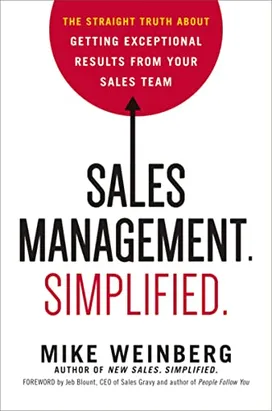
Sales Management. Simplified.
by Mike Weinberg
Started 13 April 2021 · 243 pages
A no-nonsense guide for sales managers on getting results from a team: clear expectations, a sales culture and coaching rather than administration.
About the book, from Open Library. Get the book.
17 highlights · page in the margin
- p. 6
“As goes the leader, so goes the organization.”
- p. 6
“The level of the team rarely, if ever, exceeds the level of the leader.”
- p. 10
“In sales, results are everything, and they do not lie.”
- p. 10
healthy sales organizations have regularly published and distributed sales reports and rankings. Sales versus Last Year. Sales versus Quota for the Month. Sales versus Goal Year-to-Date. Stack Rank of Salespeople by Percentage Increase over Goal or over Last Year. Number of New Accounts Opened/Acquired Year-to-Date versus Goal. Percent of Annual Goal Achieved.
- p. 10
Publishing sales results was a way of life, a simple reflection of important realities: first, that sales is, in fact, all about results; and second, that by nature, salespeople are not only results-focused but also competitive. The very act of articulating goals, tracking results against those goals, and publishing the results along with a relative ranking of sales team members’ performance was considered good sales management.
- p. 13
You cannot build a sustainable productive, healthy sales culture without a laser focus on goals and results.
- p. 15
one of the main causes of underperformance is that the very people charged with selling new pieces of business and acquiring new clients spend a surprisingly low percentage of their time selling new business.
- p. 24
Without actually saying the words, the CRM-addicted manager continually preaching about the need to keep the CRM updated is communicating that it is more important to enter tasks and opportunities swiftly and properly than it is to actually move sales opportunities forward and close deals.
- p. 25
If old-time (mid-1990s and earlier) sales managers wanted to evaluate how a salesperson sold—i.e., opened a dialogue, conducted an initial sales call, advanced an opportunity, built consensus, delivered a presentation, handled difficult buyers, etc.—that manager would go into the field and actually get in the salesperson’s car.
- p. 26
We’ve got salespeople on the front lines (in various capacities from territory managers to hunters to inside salespeople) who live and die based on their ability to connect with people relationally. All these attributes and behaviors—EQ, empathy, being a good listener, resilience, enthusiasm, and the ability to engage in productive dialogue—are critical for them to be successful.
- p. 27
a high-frequency sales attack almost always trumps low activity levels. It is essential to monitor key metrics and track opportunities through the pipeline.
- p. 30
The successful individual sales producer wins by being as selfish as possible with her time.
- p. 30
In general, top producers in sales tend to exhibit a characteristic I’ve come to describe as being selfishly productive.
- p. 31
Think about other key sales management responsibilities: Leading team meetings. Developing talent. Encouraging hearts. Removing obstacles. Coaching others. Challenging data, false assumptions, wrong attitudes, and complacency. Pushing for more. Putting the needs of your team members ahead of your own.
- p. 32
If you’re currently using a selling–sales manager model you may not like my blunt, simple answer to these questions. The hard truth is that you don’t and you can’t.
- p. 33
If a smaller company can’t afford a dedicated manager, I’d rather see the president or another key executive (as long as it’s not the head of operations—see Chapter 7) serve in a part-time sales management capacity. While that is not an ideal situation, it certainly is preferable to having a schizophrenic player-coach selling manager whose conflict of interests may sabotage the health of the entire team.
- p. 34
Wiseman had just released a powerful book titled Multipliers: How the Best Leaders Make Everyone Smarter (New York: HarperBusiness, 2010), which became a Wall Street Journal bestseller.