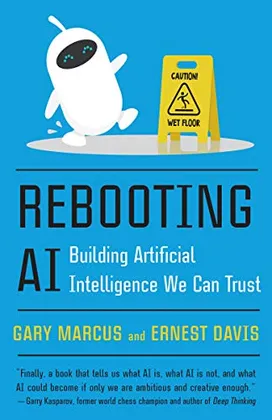
Rebooting AI
by Gary Marcus and Ernest Davis
Started 30 March 2023 · 288 pages
Two AI researchers argue that current AI is narrow and brittle, and that trustworthy AI will need common sense and a deeper understanding of the world.
About the book, from Open Library. Get the book.
9 highlights · Kindle location in the margin
- 274
The central problem, in a word: current AI is narrow; it works for particular tasks that it is programmed for, provided that what it encounters isn’t too different from what it has experienced before.
- 311
The core problem is trust. The narrow AI systems we have now often work—on what they are programmed for—but they can’t be trusted with anything that hasn’t been precisely anticipated by their programmers.
- 360
The first we call the gullibility gap, which starts with the fact that we humans did not evolve to distinguish between humans and machines—which leaves us easily fooled.
- 384
The second challenge we call the illusory progress gap: mistaking progress in AI on easy problems for progress on hard problems.
- 405
The third contributor to the AI Chasm is what we call the robustness gap. Time and again we have seen that once people in AI find a solution that works some of the time, they assume that with a little more work (and a little more data) it will work all of the time. And that’s just not necessarily so.
- 419
in contemporary research in AI, robustness has been underemphasized, in part because most current AI effort goes into problems that have a high tolerance for error, such as ad recommendation and product recommendation.
- 441
To move past the AI Chasm, we need three things: a clear sense of what is at stake, a clear understanding of why current systems aren’t getting the job done, and a new strategy.
- 463
in five fundamental ways, our human brains still vastly outperform our silicon counterparts: we can understand language, we can understand the world, we can adapt flexibly to new circumstances, we can learn new things quickly (even without gobs of data), and we can reason in the face of incomplete and even inconsistent information.
- 595
Third, modern machine learning depends heavily on the precise details of large training sets, and such systems often break if they are applied to new problems that extend beyond the particular data sets on which they were trained.