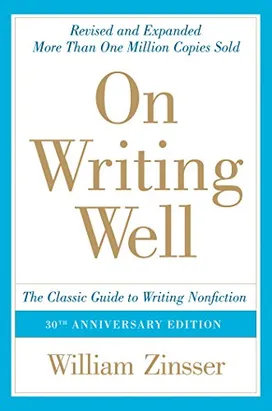
On Writing Well
by William Zinsser
Started 27 February 2020 · 288 pages
Zinsser’s classic guide to non-fiction writing: clarity, simplicity and humanity, with advice on everything from interviews and travel writing to memoir.
About the book, from Open Library. Get the book.
15 highlights · Kindle location in the margin
- 93
Nobody told all the new computer writers that the essence of writing is rewriting. Just because they’re writing fluently doesn’t mean they’re writing well.
- 146
Ultimately the product that any writer has to sell is not the subject being written about, but who he or she is.
- 157
Clutter is the disease of American writing. We are a society strangling in unnecessary words, circular constructions, pompous frills and meaningless jargon.
- 161
Our national tendency is to inflate and thereby sound important. The airline pilot who announces that he is presently anticipating experiencing considerable precipitation wouldn’t think of saying it may rain. The sentence is too simple—there must be something wrong with it.
- 163
But the secret of good writing is to strip every sentence to its cleanest components.
- 163
Every word that serves no function, every long word that could be a short word, every adverb that carries the same meaning that’s already in the verb, every passive construction that leaves the reader unsure of who is doing what—these are the thousand and one adulterants that weaken the strength of a sentence. And they usually occur in proportion to education and rank.
- 181
Clear thinking becomes clear writing; one can’t exist without the other.
- 183
The reader is someone with an attention span of about 30 seconds—a person assailed by many forces competing for attention. At one time those forces were relatively few: newspapers, magazines, radio, spouse, children, pets. Today they also include a galaxy of electronic devices for receiving entertainment and information—television, VCRs, DVDs, CDs, video games, the Internet, e-mail, cell phones, BlackBerries, iPods—as well as a fitness program, a pool, a lawn and that most potent of competitors, sleep. The man or woman snoozing in a chair with a magazine or a book is a person who was being given too much unnecessary trouble by the writer.
- 197
Writers must therefore constantly ask: what am I trying to say? Surprisingly often they don’t know.
- 252
As George Orwell pointed out in “Politics and the English Language,” an essay written in 1946 but often cited during the wars in Cambodia, Vietnam and Iraq, “political speech and writing are largely the defense of the indefensible. . . . Thus political language has to consist largely of euphemism, question-begging and sheer cloudy vagueness.”
- 277
Most first drafts can be cut by 50 percent without losing any information or losing the author’s voice.
- 314
Readers want the person who is talking to them to sound genuine. Therefore a fundamental rule is: be yourself.
- 374
Sell yourself, and your subject will exert its own appeal. Believe in your own identity and your own opinions. Writing is an act of ego, and you might as well admit it. Use its energy to keep yourself going.
- 380
“Who am I writing for?” It’s a fundamental question, and it has a fundamental answer: You are writing for yourself.
- 405
Never say anything in writing that you wouldn’t comfortably say in conversation. If you’re not a person who says “indeed” or “moreover,” or who calls someone an individual (“he’s a fine individual”), please don’t write it.