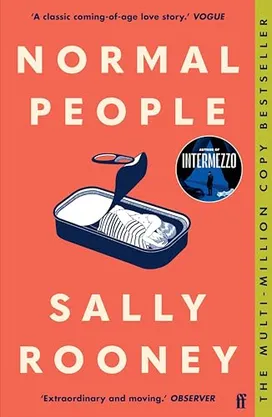
Normal People
by Sally Rooney
Started 4 January 2021 · 304 pages
Connell and Marianne, from opposite sides of a small Irish town, drift together and apart from school through university, in Rooney’s novel of intimacy and class.
About the book, from Open Library. Get the book.
40 highlights · page in the margin
- p. 46
Even in memory she will find this moment unbearably intense, and she’s aware of this now, while it’s happening. She has never believed herself fit to be loved by any person. But now she has a new life, of which this is the first moment, and even after many years have passed she will still think: Yes, that was it, the beginning of my life.
- p. 48
His friends seem so obsessed with their own fathers, obsessed with emulating them or being different from them in specific ways. When they fight with their fathers, the fights always seem to mean one thing on the surface but conceal another secret meaning beneath.
- p. 58
People in school don’t like her, do they? says Lorraine. So I suppose you were afraid of what they would say about you, if they found out.
- p. 62
She reads long articles about Syria and then researches the ideological backgrounds of the journalists who have written them.
- p. 69
Connell knew going to a party on his own would be a bad idea, but on the phone Lorraine said it would be a good idea. I won’t know anyone, he told her. And she said patiently: You won’t get to know anyone if you don’t go out and meet people. Now he’s here, standing on his own in a crowded room not knowing whether to take his jacket off. It feels practically scandalous to be lingering here in solitude. He feels as if everyone around him is disturbed by his presence, and trying not to stare.
- p. 70
All Connell’s classmates have identical accents and carry the same size MacBook under their arms. In seminars they express their opinions passionately and conduct impromptu debates. Unable to form such straightforward views or express them with any force, Connell initially felt a sense of crushing inferiority to his fellow students, as if he had upgraded himself accidentally to an intellectual level far above his own, where he had to strain to make sense of the most basic premises. He did gradually start to wonder why all their classroom discussions were so abstract and lacking in textual detail, and eventually he realised that most people were not actually doing the reading. They were coming into college every day to have heated debates about books they had not read. He understands now that his classmates are not like him. It’s easy for them to have opinions, and to express them with confidence. They don’t worry about appearing ignorant or conceited. They are not stupid people, but they’re not so much smarter than him either. They just move through the world in a different way, and he’ll probably never really understand them, and he knows they will never understand him, or even try.
- p. 71
It feels intellectually unserious to concern himself with fictional people marrying one another. But there it is: literature moves him. One of his professors calls it ‘the pleasure of being touched by great art’. In those words it almost sounds sexual.
- p. 73
Back home, Connell’s shyness never seemed like much of an obstacle to his social life, because everyone knew who he was already, and there was never any need to introduce himself or create impressions about his personality. If anything, his personality seemed like something external to himself, managed by the opinions of others, rather than anything he individually did or produced. Now he has a sense of invisibility, nothingness, with no reputation to recommend him to anyone.
- p. 73
He has become self-conscious about his clothes. All the guys in his class wear the same waxed hunting jackets and plum-coloured chinos,
- p. 77
There was no one he could talk to about that. He was excruciatingly lonely.
- p. 91
People here are such snobs. Even if they liked me I honestly wouldn’t want to be friends with them.
- p. 94
Because it was humiliating. You mean like, the way I treated you. Well, yeah, she said. And just the fact that I put up with it.
- p. 100
The conversations that follow are gratifying for Connell, often taking unexpected turns and prompting him to express ideas he had never consciously formulated before.
- p. 102
Rich people look out for each other, and being Marianne’s best friend and suspected sexual partner has elevated Connell to the status of rich-adjacent: someone for whom surprise birthday parties are thrown and cushy jobs are procured out of nowhere.
- p. 108
She had been sad before, after the film, but now she was happy. It was in Connell’s power to make her happy. It was something he could just give to her, like money or sex.
- p. 112
Marianne replaces the yoghurt pot in the freezer now and asks Joanna if she finds it strange, to be paid for her hours at work – to exchange, in other words, blocks of her extremely limited time on this earth for the human invention known as money.
- p. 112
Time consists of physics, money is just a social construct.
- p. 112
I would venture that your decision-making is also a social construct.
- p. 112
I don’t buy into the morality of work, she says. Some work maybe, but you’re just moving paper around an office, you’re not contributing to the human effort.
- p. 113
Her smile feels gummy and childish.
- p. 120
She was the one who had introduced Connell to everyone, who had told them all what great company he was, how sensitive and intelligent, and he had repaid her by staying in her apartment almost every night for three months, drinking the beer she bought for him, and then abruptly dumping her. It made her look like such a fool.
- p. 121
Joanna wanted to know if Connell knew about Marianne’s family. Everyone in Carricklea knows each other, Marianne said. Joanna shook her head and said: But I mean, does he know what they’re like? Marianne couldn’t answer that. She feels that even she doesn’t know what her family are like, that she’s never adequate in her attempts to describe them, that she oscillates between exaggerating their behaviour, which makes her feel guilty, or downplaying it, which also makes her feel guilty, but a different guilt, more inwardly directed.
- p. 121
Of course Connell can’t. He’s a well-adjusted person raised in a loving home. He just assumes the best of everyone and knows nothing.
- p. 169
Jamie is somehow both boring and hostile at the same time, always yawning and rolling his eyes when other people are speaking. And yet he is the most effortlessly confident person Connell has ever met. Nothing fazes him. He doesn’t seem capable of internal conflict.
- p. 174
Marianne was so totally uninterested in what people thought of her, so extremely secure in her own self-perception, that it was hard to imagine her caring for attention one way or another. She did not altogether, as far as Connell knew, actually like herself, but praise from other people seemed as irrelevant to her as disapproval had been in school.
- p. 180
The whole idea of ‘meritocracy’ or whatever, it’s evil, you know I think that.
- p. 195
In Sweden we have a saying, he says. There’s no such thing as bad weather, only bad clothes.
- p. 195
Lukas has bad manners, which, to Marianne, makes him seem childish. He never offers her coffee or tea when she arrives, or even a glass of water.
- p. 198
She couldn’t accept Marianne’s laissez-faire attitude to the situation.
- p. 213
His anxiety, which was previously chronic and low-level, serving as a kind of all-purpose inhibiting impulse, has become severe.
- p. 219
Nothing had meant more to Rob than the approval of others; to be thought well of, to be a person of status. He would have betrayed any confidence, any kindness, for the promise of social acceptance.
- p. 232
Not for the first time Marianne thinks cruelty does not only hurt the victim, but the perpetrator also, and maybe more deeply and more permanently.
- p. 234
Marianne wanted her life to mean something then, she wanted to stop all violence committed by the strong against the weak, and she remembered a time several years ago when she had felt so intelligent and young and powerful that she almost could have achieved such a thing, and now she knew she wasn’t at all powerful, and she would live and die in a world of extreme violence against the innocent, and at most she could help only a few people.
- p. 236
I heard Jamie was pissed off you broke up with him and he went around talking shit about you. But like, that’s not even gossip, that’s just how lads behave. I didn’t know anyone really cared. I think it’s more a case of reputational damage.
- p. 239
It’s funny the decisions you make because you like someone, he says, and then your whole life is different. I think we’re at that weird age where life can change a lot from small decisions.
- p. 254
She’s missing some primal instinct, self-defence or self-preservation, which makes other human beings comprehensible. You lean in expecting resistance, and everything just falls away in front of you.
- p. 263
I guess everyone is a mystery in a way, she says. I mean, you can never really know another person, and so on.
- p. 264
In bed he would say lovingly: You’re going to do exactly what I say now, aren’t you? He knew how to give her what she wanted, to leave her open, weak, powerless, sometimes crying. He understood that it wasn’t necessary to hurt her: he could let her submit willingly, without violence. This all seemed to happen on the deepest possible level of her personality.
- p. 266
On the way home from Dublin in the car, she and Connell talked without stopping, joking and putting on funny voices to make each other laugh.
- p. 269
No one can be independent of other people completely, so why not give up the attempt, she thought, go running in the other direction, depend on people for everything, allow them to depend on you, why not.