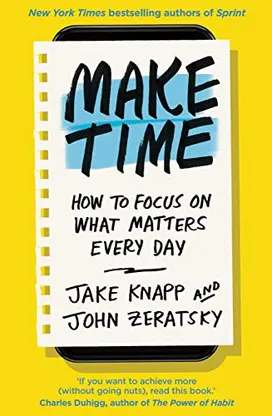
Make Time
by Jake Knapp and John Zeratsky
Started 20 June 2020 · 306 pages
Two former Google designers offer a daily system for making time for what matters: choose a highlight for each day, defend focus against distraction, and keep your energy up.
About the book, from Open Library. Get the book.
124 highlights · Kindle location in the margin
- 168
Make Time is not about productivity. It’s not about getting more done, finishing your to-dos faster, or outsourcing your life. Instead, it’s a framework designed to help you actually create more time in your day for the things you care about, whether that’s spending time with your family, learning a language, starting a side business, volunteering, writing a novel, or mastering Mario Kart.
- 215
The ideas in this book can give you space in your calendar, in your brain, and in your days. That space can bring clarity and calm to everyday life. It can create opportunities to start new hobbies or get to that “someday” project. A little space in your life might even unlock creative energy you lost or never found in the first place.
- 225
As designers, our job was to turn abstract ideas (like “Wouldn’t it be cool if email sorted itself?”) into real-life solutions (like Gmail’s Priority Inbox).
- 244
Every day, I realized, I was reacting: to my calendar, to incoming email, to the infinite stream of new stuff on the Internet.
- 250
If I started the morning with two hundred emails and got to zero by midnight, was that really a successful day?
- 251
Being more productive didn’t mean I was doing the most important work; it only meant I was reacting to other people’s priorities faster.
- 252
As a result of being constantly online, I wasn’t present enough with my children. And I was perpetually putting off my big “someday” goal of writing a book. In fact, I’d procrastinated for years without typing so much as a page. I’d been too busy treading water in a sea of other people’s emails, other people’s status updates, and snapshots of other people’s lunch.
- 261
Without my apps, I expected to feel anxiety and isolation. And in the days after that, I did notice a change. But I wasn’t stressed; instead, I felt relief. I felt free.
- 297
While working at Google, Jake created something he called a “design sprint”: basically a workweek redesigned from the ground up. For five days, a team would cancel all meetings and focus on solving a single problem, following a specific checklist of activities. It was our first effort at designing time rather than products, and it worked—the design sprint quickly spread across Google.
- 306
The first thing we learned was that something magic happens when you start the day with one high-priority goal.
- 309
This focal point creates clarity and motivation. When you have one ambitious but achievable goal, at the end of the day, you’re done. You can check it off, let go of work, and go home satisfied.
- 311
Another lesson from our design sprints was that we got more done when we banned devices. Since we set the rules, we were able to prohibit laptops and smartphones, and the difference was phenomenal. Without the constant lure of email and other Infinity Pools, people brought their complete attention to the task at hand, and the default switched to focus.
- 317
Lastly, these experiments taught us the power of, well, experiments. Experimenting allowed us to improve the process, and seeing the results of our changes firsthand gave us a deep confidence that we never could have built just by reading about someone else’s results.
- 323
And this experimental approach also allowed us to be kinder to ourselves when we made mistakes—after all, every mistake was just a data point, and we could always try again tomorrow.
- 355
The first step is choosing a single highlight to prioritize in your day. Next, you’ll employ specific tactics to stay laser-focused on that highlight—we’ll offer a menu of tricks to beat distraction in an always-connected world. Throughout the day, you’ll build energy so you can stay in control of your time and attention. Finally, you’ll reflect on the day with a few simple notes.
- 361
The first step in Make Time is deciding what you want to make time for. Every day, you’ll choose a single activity to prioritize and protect in your calendar. It might be an important goal at work, like finishing a presentation. You might choose something at home, like cooking dinner or planting your garden. Your Highlight might be something you don’t necessarily have to do but want to do, like playing with your kids or reading a book.
- 367
Asking yourself “What’s going to be the highlight of my day?” ensures that you spend time on the things that matter to you and don’t lose the entire day reacting to other people’s priorities. When you choose a Highlight, you put yourself in a positive, proactive frame of mind.
- 380
To achieve focus and make time for what matters, your brain needs energy, and that energy comes from taking care of your body. That’s why the third component of Make Time is to charge your battery with exercise, food, sleep, quiet, and face-to-face time.
- 409
None of us can be perfect eaters, perfectly productive, perfectly mindful, and perfectly rested all the time.
- 410
Perfection is a distraction—another shiny object taking your attention away from your real priorities.
- 416
When Jake is traveling, he temporarily installs an email app on his phone, and JZ has been known to binge-watch Netflix on occasion—Stranger Things is so good!
- 459
I created lists of one-year, three-year, five-year, and ten-year goals, which I asked my girlfriend to review and discuss with me. (The next year she married me, so I guess she was on the same page with at least one of my goals.)
- 463
And living a “someday” life was demoralizing. In the words of author James Clear, I was essentially saying, “I’m not good enough yet, but I will be when I reach my goal.”
- 474
Instead of checking off as many to-dos as possible or racing to clear my inbox before heading home, I focused on accomplishments that were satisfying and important.
- 481
I loved thinking about big, lofty goals and I was good at getting things done hour by hour, but neither was truly satisfying. I was happiest when I had something I could hold on to in the present—a chunk of time that was bigger than a to-do but smaller than a five-year goal. An activity I could plan for, look forward to, and appreciate when it was done.
- 493
When you look back on your day, what activity or accomplishment or moment do you want to savor? That’s your Highlight.
- 498
Research shows that the way you experience your days is not determined primarily by what happens to you. In fact, you create your own reality by choosing what you pay attention to.fn1 This might seem obvious, but we think it’s a big deal: You can design your time by choosing where you direct your attention. And your daily Highlight is the target of that attention.
- 502
Focusing on a daily Highlight stops the tug-of-war between Infinity Pool distractions and the demands of the Busy Bandwagon. It reveals a third path: being intentional and focused about how you spend your time.
- 514
If you have something that absolutely positively must be accomplished today, make it your Highlight.
- 522
At the end of the day, which Highlight will bring me the most satisfaction?
- 533
The third strategy focuses on joy: When I reflect on today, what will bring me the most joy?
- 538
You only waste time if you’re not intentional about how you spend it.
- 545
A good rule of thumb is to choose a Highlight that takes sixty to ninety minutes.
- 557
It’s never too late in the day to choose (or change) your Highlight.
- 581
but there’s a special, almost magical power to writing down your plans: The things you write down are more likely to happen. If you want to make time for your Highlight, start by writing it down.
- 583
Make writing down your Highlight a simple daily ritual. You can do it at any time, but the evening (before bed) and the morning work best for most people.
- 588
But if we had to pick one method for writing down a Highlight, we’d choose sticky notes. They’re easy to get and easy to use, and they don’t require batteries or software updates.
- 645
Bundle up the small tasks and use batch processing to get them all done in one Highlight session. In other words, make a batch of small things your big thing. For example, one day this week, JZ’s Highlight will be “catch up on email” or “return phone calls.”
- 647
These small tasks may not sound like Highlight material—no one wishes they could make time for email—but there’s a surprising satisfaction that comes from catching up. And when you catch up all at once instead of constantly trying to keep your inbox or to-do list empty, you supercharge that feeling of satisfaction.
- 696
Get out a single blank sheet of paper and create two columns by drawing a line down the middle. The left-hand column is going to be your front burner, and the right-hand column your back burner.
- 698
You are allowed to have one and only one project, activity, or objective on the front burner. Not two, not three—just one.
- 735
I’ve seen this effect with my writing. The first day after a long break is hard. I may not write much of anything, and I get frustrated and cranky. The second day is still slow, but I feel I’m starting to boot up. By the third day and fourth day, I’m in the zone—and I do whatever I can to keep the momentum.
- 753
When you schedule something, you’re making a commitment to yourself, sending yourself a tiny message that says: “I’m going to do this.” But scheduling your Highlight has another important benefit: It forces you to confront the trade-offs in how you spend your time.
- 758
Once you’ve scheduled your Highlight, that time is taken. You can’t schedule any meetings or commit to any other activity. When other things come up, you get to decide whether to schedule them in the remaining time around your Highlight or whether they can wait. You can see your priorities take form right there on your calendar.
- 793
When you start out with this tactic, you might try blocking an hour or two each day and then adjust from there.
- 890
Don’t underestimate the importance of light in waking up. Humans are hardwired to wake when it’s light and get sleepy when it’s dark.
- 893
And I try to always watch the sunrise, even if it’s an hour or two after I get up; seeing the sky go from dark to light reminds my brain that it’s time to transition from night to day.
- 897
My slow coffee ritual keeps me occupied during the low-willpower period when I would otherwise check email or look at Twitter, both of which are likely to send me into a reactive vortex of unproductivity.
- 902
Exercise is a great morning activity.
- 916
It’s not always easy for me to wake up at 5:30 a.m., but I’ve learned to love mornings. And the payoff is amazing; by 9:30 a.m. most days I’ve had an hour of productive work, showered and dressed, walked two miles, had breakfast, and enjoyed two cups of coffee.
- 978
Okay, you’ve chosen a Highlight for the day and you’ve made time for it in your busy schedule. Now that time has arrived, and you need to focus. And, of course, this is the hard part.
- 1104
These tactics are all based on the same philosophy: The best way to defeat distraction is to make it harder to react.
- 1271
When I’m out and about, I usually carry my phone in my bag. And when I get home, I put my bag on a shelf and go about my life. Sometimes I forget about my phone for hours. It’s a small daily reminder that life goes on without my smartphone.
- 1285
When you wake up in the morning, whether you slept for five hours or ten, you’ve had a nice long break from the Busy Bandwagon and the Infinity Pools. This is a golden moment. The day is fresh, your brain is rested, and you have no reason to feel distracted yet. No news items to stress about, no work emails to stew over.
- 1294
Skipping the morning check-in is essential to my morning routine (described in tactic #14). The morning is prime time for my Highlight, which usually involves the computer. So each night I do myself a favor by closing all my browser tabs (#26) and logging out of Twitter and Facebook (#18). Then, after I wake up and make coffee, I’m ready to start my Highlight without any distractions from the morning check-in.
- 1322
Harriette found that although some friendships fizzled without Facebook, others got stronger. The people who really wanted to spend time with her—or who she really wanted to see—found ways to contact her by phone, email, or text. “I’m not exactly incommunicado,” says Harriette. “But I’m not going back to the Infinity Pool any time soon.”
- 1372
Take it a step further and hide the bookmarks bar in your browser (we know you’ve got a couple of Infinity Pools in there) and configure your browser settings so that your homepage is something unobtrusive (like a clock) rather than something noisy (like a collection of sites you visit frequently).
- 1378
Because you’re literally buckled into a chair, I’ve always found planes a terrific spot to do a lot of writing and reading and drawing and thinking. —AUSTIN KLEON
- 1423
Chryssa sent us an extreme tactic for getting into Laser mode: She doesn’t have home Internet service at all. That’s right—no Internet. Yeah. Wow. And Chryssa’s results speak for themselves. In the year since she first shared the tactic with us, she used her undistracted time to write fiction, design a new kind of pill bottle, and invent a line of toys. She’s focused and prolific.
- 1452
Sharing tweets, Facebook updates, and Instagram photos can create time craters, but they’re dangerous for another reason: They’re fake wins. Contributing to the conversation on the Internet feels like an accomplishment, and our brains tell us, “We’ve done some work!” But 99 times out of 100, these contributions are insignificant. And they come at a cost—they take up time and energy you could be using on your Highlight. Fake wins get in the way of focusing on what you really want to do.
- 1478
I used to spend way too much time browsing Twitter until I decided to think of it as a tool. I decided I wanted to use Twitter to spread the word about my work and respond to questions from readers. But to do that, I realized, I didn’t need much time, and I didn’t need to see the main feed at all. Now, I use Twitter only on my laptop—not my phone—and I limit myself to thirty minutes each day. To use that time well, I go directly to Twitter’s notifications screen (by typing in the URL), skipping the distracting feed. Then, when I’m done, I log out (#18) until tomorrow’s daily Twitter time.
- 1485
I have less self-control than JZ, so I use a browser plug-in to limit myself to just four minutes per day, combined, on Twitter and news websites. This restriction has trained me to move fast. A couple of times a week, I turn off my browser plug-in and take the time to reply to the most important messages … and, okay, maybe read a few tweets. (As always, for our software recommendations, see maketimebook.com.)
- 1524
For years, inspired by experts like David Allen and Merlin Mann, we made it a daily goal to process every single message we received.
- 1578
The Busy Bandwagon’s immediate-reply culture is powerful, and you need faith to overcome it and change your mindset. Believe in your Highlight: It is worth prioritizing over random disruption. Believe in Laser mode: You will accomplish more with a singular focus than by ricocheting through your inbox. And believe in other people: If their thing is really and truly urgent and important, they will track you down in person or on the phone.
- 1594
Some work—such as sales and customer support—really does require fast responses.
- 1670
As Jake found with his fiction-writing projects, if you’re constantly exposed to other people’s ideas, it can be tough to think up your own.
- 1734
The trouble is that deadlines are usually for things we dread (like doing taxes), not for things we want to do (like practicing the ukulele). But this is an easy problem to solve. You can invent a deadline.
- 1754
When you’re not sure where to start, try breaking your Highlight into a list of small, easy-to-do bits. For example, if your Highlight is “Plan vacation,” you can explode it into bits like these: • Check calendar for vacation dates. • Skim guidebook and make list of possible destinations. • Discuss destinations with family and choose favorite. • Research airfare online. Note that each item includes a verb. Each one is specific. And each one is small and relatively easy.
- 1766
A cue is any trigger that causes you to act consciously or unconsciously. It’s the first step in the “habit loop” Charles Duhigg describes in The Power of Habit: First, a cue prompts your brain to start the loop. The cue triggers you to perform a routine behavior without thinking, on autopilot. Finally, you get a reward: some result that makes your brain feel good and encourages it to run the same routine again the next time you encounter the cue.
- 1771
We suggest using music as your cue for Laser mode. Try playing the same song or album every time you start your Highlight, or choose a specific song or album for each type of Highlight.
- 1776
After a few songs, he’s in the zone. The music reminds his brain which routine to run. He doesn’t play the songs at other times—they’re reserved for these special activities. So after a few repetitions, the music becomes part of the habit loop, cuing his brain to get into a distinct version of Laser mode.
- 1790
If you use the Time Timer when you’re getting into Laser mode, you’ll feel an instant, visceral sense of urgency in a totally good way. By showing you that time is elapsing, the Time Timer will get you to focus on the task at hand.
- 1800
Unless you’re a carpenter, a mechanic, or a surgeon, choosing the perfect tool is usually a distraction, yet another way to stay busy instead of doing the work you want to be doing.
- 1836
It’s natural to feel twitchy for your phone or browser. You’ll wonder if you have any new email.fn17 You’ll feel a burning desire to know Who was that actor in that movie?fn18 Instead of reacting to every twitch, write your questions on a piece of paper (How much do wool socks cost on Amazon? Any Facebook updates?). Then you can stay in Laser mode, secure in the knowledge that those pressing topics have been captured for future research.
- 1846
Paying attention to your body shuts up the noise in your brain. And even a pause that lasts only one breath can bring your attention back to where you want it—on your Highlight.
- 1849
When you’re deprived of distraction, you may feel bored—but boredom is actually a good thing. Boredom gives your mind a chance to wander, and wandering often leads you to interesting places.
- 1870
Wholeheartedness is complete commitment, holding nothing back. It’s letting go of caution and allowing yourself to care about your work, a relationship, a project, anything. Throwing yourself into the moment with enthusiasm and sincerity. We believe wholeheartedness is fundamental to everything this book is about: presence, attention, and making time for what matters.
- 1886
I feel this every time I go sailing offshore. It can be truly exhausting—remaining alert, moving around a constantly shifting boat, sleeping in two- or three-hour shifts—but it’s an experience that rewards wholeheartedness. No matter how I’m feeling, when I head out to sea, I embrace the challenge wholeheartedly. Any feelings of exhaustion, stress, or unease just fall away.
- 1891
But perhaps the biggest obstacle is when your heart isn’t really in the current task—for example, when you’re working at a job that’s not right for you. In fact, that’s the context for Brother David’s quote: He was advising a friend who was burned out at work to leave and focus on his passion. We aren’t advising you to quit your job, but we are reminding you that it’s important to be proactive and seek out moments when you can be passionate about your efforts. If you choose exciting ways to spend your time, being wholehearted isn’t so hard.
- 1914
If you have energy, it’s easier to maintain your focus and priorities and avoid reacting to distractions and demands. With a full battery, you have the power to be present, think clearly, and spend your time on what matters, not default to what’s right in front of you. To get the energy you need to maintain a focused, high-performing brain, you’ve got to take care of your body. Of course, everyone knows our brains and bodies are connected.
- 1967
That means we’re still wired for a lifestyle of constant movement, varied but relatively sparse diets, ample quiet, plenty of face-to-face time, and restful sleep that’s aligned with the rhythm of the day.
- 1982
Today’s world is not a utopia planned out by geniuses. It’s been shaped very accidentally by the technologies that have stuck over the last few centuries, decades, and years. We’re built for one world, but we live in another.
- 1996
Just a twenty- to thirty-minute session can make the brain work better, reduce stress, improve your mood, and make it easier to sleep well, providing more energy for the next day—a pretty sweet positive feedback loop. We’ll suggest lots of tactics for adding more movement into your day.
- 2029
What you do every day matters more than what you do once in a while. —GRETCHEN RUBIN
- 2072
I feel better on days when I exercise a little: less stressed, more energetic, and generally happier.
- 2083
And walking helps make time you can use to think, daydream, or meditate. JZ often uses walk time to plan and think about his Highlight. Sometimes he starts drafting a new chapter, blog post, or story in his head.
- 2165
Eat food. Not too much. Mostly plants.
- 2197
Intermittent fasting has become a bit of a fad, but there are lots of reasons to try it beyond the endorsements of Beyoncé and Benedict Cumberbatch. Food tastes better when you’re hungry, and there are some great health benefits from fasting: cardiovascular fitness, longevity, muscle development, and maybe even reduced cancer risk.
- 2228
Dark chocolate has way less sugar than most other treats, so you’ll get less of a crash. Many studiesfn7 suggest that dark chocolate even has health benefits. And because it’s rich and delicious, you won’t have to eat as much to satisfy your craving. In short, dark chocolate is freaking awesome and you should have it more often.fn8
- 2262
To the brain, caffeine molecules look a lot like a molecule called adenosine, whose job is to tell the brain to slow down and feel sleepy or groggy. Adenosine is helpful in the evening as you get ready for bed. But when adenosine makes us sleepy in the morning or afternoon, we usually reach for caffeine. When caffeine shows up, the brain says, “Hey good-lookin’!” and the caffeine binds to the receptors where the adenosine is supposed to go. The adenosine is left to just float around, and as a result, the brain doesn’t get the sleepy signal.
- 2266
What’s interesting in this (at least to us) is that caffeine doesn’t technically give you an energy boost; instead, it blocks you from having an energy dip caused by adenosine-induced sleepiness. But once the caffeine wears off, all that adenosine is still hanging around, ready to pounce. If you don’t recaffeinate, you crash. And over time, your body adjusts to more and more caffeine by producing more and more adenosine to compensate. This is why, if you normally drink lots of caffeine, you probably feel extra groggy and headachy when you don’t have it.
- 2271
Knowing all this, Ryan devised a perfect system that allowed him to enjoy as much coffee as possible, maintain steady energy, and not fry his nerves or disrupt his sleep. In the end, his personalized formula, backed by science and proven by experience, was crazy simple: • Wake up without caffeine (in other words, get out of bed, eat breakfast, and start the day without any coffee). • Have the first cup between 9:30 and 10:30 a.m. • Have the last cup between 1:30 and 2:30 p.m.
- 2286
In the morning, your body naturally produces lots of cortisol, a hormone that helps you wake up. When cortisol is high, caffeine doesn’t do much for you (except for temporarily relieving your caffeine addiction symptoms).
- 2295
The tricky thing about caffeine is that if you wait to drink it until you get tired, it’s too late: The adenosine has already hooked up with your brain, and it’s hard to shake the lethargy. We’ll repeat that because it’s a crucial detail: If you wait until you get tired, it’s too late.
- 2300
One slightly complicated but high-yield way to take advantage of caffeine mechanics is to wait till you get tired, drink some caffeine, then immediately take a fifteen-minute nap. The caffeine takes a while to be absorbed into your bloodstream and reach the brain. During your light sleep, the brain clears out the adenosine. When you wake up, the receptors are clear and the caffeine has just shown up. You’re fresh, recharged, and ready to go. Studies have shown that caffeine naps improve cognitive and memory performance more than coffee or a nap alone does.fn10
- 2306
I used caffeine naps for an afternoon boost while writing Sprint. For me, a good fifteen-minute caffeine nap gives me about two hours of focused energy.
- 2326
What most people (including us before Camille explained it to Jake) don’t realize is that the half-life of caffeine is five to six hours. So if the average person has a coffee at 4 p.m., half the caffeine is out of the bloodstream by 9 or 10 p.m., but the other half is still around. The upshot is that at least some caffeine is blocking at least some adenosine receptors for many hours after you have caffeine and very possibly interfering with your sleep and in turn the next day’s energy.
- 2330
You’ve got to experiment to figure out your own unique “Last Call for Caffeine,” but if you have trouble sleeping, your last call might be earlier than you think. Experiment with cutting yourself off earlier and earlier and note if and when it becomes easier to fall asleep.
- 2355
even brief exposure to a forest lowers stress, heart rate, and blood pressure.
- 2359
When walking through nature, you’re freed from having to direct your attention, as there are few challenges to navigate (like crowded street crossings), and experience enough interesting stimuli to keep your mind sufficiently occupied to avoid the need to actively aim your attention. This state allows your directed attention resources time to replenish.
- 2375
When I get off the city streets and hit the trail, my head seems to loosen up and my stress evaporates. I guess Dad was right—the woods sure are nice.
- 2382
When you meditate, instead of passively going along with the thoughts, you stay quiet and notice the thoughts, and that slows them down and gives your brain a break. So okay, meditation is rest for your brain. But here’s the crazy thing: Meditation is also exercise for your brain. Staying quiet and noticing your thoughts is refreshing, but ironically, it’s also hard work. The act of slowing down and noticing your thoughts is exertion that leaves you invigorated, just as exercise does.
- 2386
In fact, the effects of meditation look a lot like the effects of exercise. Studies show that meditation increases working memory and the ability to maintain focus.fn12 Meditation even makes parts of the brain thicker and stronger, just as exercise builds muscle.fn13
- 2399
You don’t have to sit in the lotus position. Try guided meditation while riding the bus, lying down, walking, running, or even eating.
- 2413
As I used Headspace, it became easier to concentrate for long periods. My thoughts had more clarity. And, though I know this sounds odd, I felt more willing to be myself. (Which I think is a good thing.)
- 2423
But if you put on headphones every time you work, walk, exercise, or commute, your brain never gets any quiet. Even an album you’ve listened to a million times still creates a bit of mental work. Your music, podcast, or audiobook prevents boredom, but boredom creates space for thinking and focus (#57). Take a break and leave your headphones at home. Just listen to the sounds of traffic, or the clack of your keyboard, or your footsteps on the pavement. Resist the itch to fill the blank space.
- 2434
Instead, try to take breaks without screens: Gaze out the window (it’s good for your eyes), go for a walk (it’s good for your mind and body), grab a snack (it’s good for your energy if you’re hungry), or talk to someone (it’s usually good for your mood unless you talk to a jerk).
- 2450
I love taking real-world breaks, but sometimes they’re not enough. When I’ve been working super hard and I get that “brain drain” feeling like my head is a squeezed-out sponge, I know it’s time to take a megabreak: I’ll stop everything and watch a whole movie. Why a movie? Unlike a a TV series, a movie is relatively short and finite. Unlike social media or email or the news, it won’t make me anxious. It’s pure escapism and a chance for my brain to stop and relax without the risk of falling into a time crater of energy-draining distraction.
- 2463
It’s a cruel irony of modern life that we’re surrounded by people yet more isolated than ever. This is a big deal, especially if you consider the findings from Harvard’s 75-year Study of Adult Development: People with strong relationships are more likely to live long, healthy, fulfilling lives.
- 2472
Not every person lifts our spirits, of course, but we all know a few people who give us energy most times we talk to them. Here’s a simple experiment to try: 1. Think of one of those energy-giving people. 2. Go out of your way to have a real conversation with her or him. You can talk in person or on the phone, but your voice must be involved. 3. Afterward, note your energy level.
- 2479
Even if it’s only once a week, reach out to friends whom you admire, who inspire you, who make you laugh, who let you be yourself. Spending time with interesting, high-energy people is one of the best—and most enjoyable—ways to recharge your battery.
- 2508
If you want to improve your sleep, keep the phone out of your bedroom—at all times. And don’t stop there. Remove all electronic devices to transform your bedroom into a true sanctuary for sleep. No TVs, no iPads. No Kindles with backlights. In other words: Make your bedroom a bed room.
- 2523
When we see bright light, our brains think, “It’s morning. Time to wake up!” This is an ancient and automatic system. For Urk, the system worked great: He fell asleep when it got dark and woke when the sun rose. The natural cycle of the day helped regulate his sleep and energy.
- 2531
He needed to fake the sunset. Here’s how to do it: 1. Starting when you eat dinner or a few hours before your ideal bedtime, turn down the lights in your home. Switch off bright overhead lights. Instead, use dim table or side lamps. For bonus points, light candles at the dinner table. 2. Turn on your phone, computer, or TV’s “night mode.” These features shift screen colors from blue to red and orange. Instead of looking at a bright sky, it’s like sitting around a campfire. 3. When you go to bed, kick all devices out of the room
- 2541
In recent years, automatic “dawn simulator” lights have become smaller and cheaper thanks to improved LED technology and a healthy market of people who hate winter mornings. The idea is simple: Before the alarm sounds, a bright light gradually turns on, simulating a perfectly timed sunrise and tricking your brain into waking up. If you combine that with turning down the lights in the evening, it’s the next best thing to living in a cave.
- 2564
She told us that sleeping late on weekends is basically like giving yourself jet lag: It confuses your internal clock and makes it even harder to bounce back from the original deficit. So just as you would when traveling to a different time zone, she recommends resisting the temptation to oversleep and trying to stick as closely as possible to your regular schedule. “Sleep debt” is a real thing, and it’s bad news for your health, wellness, and ability to focus.
- 2595
the scientific method itself is straightforward: 1. OBSERVE what’s going on. 2. GUESS why things are happening the way they are. 3. EXPERIMENT to test your hypothesis. 4. MEASURE the results and decide whether you were right.
- 2635
Changing defaults isn’t always easy, so it’s helpful to look back on the day through a grateful lens. Quite often you’ll find that even if lots of things didn’t go your way, your hard work of making time still paid off with a moment you’re grateful for. When that happens, the feeling of gratitude becomes a powerful incentive to do the steps again tomorrow.
- 2666
Sure, the insights (“Exercise is good, sugar is bad”) aren’t groundbreaking. But even if they should have been obvious, recording them for myself was powerful. It’s one thing to read about a research study in the news and quite another to experience the results firsthand.
- 2669
I started finding ways to move my body in the morning, and after a couple of months, my morning exercise routine began to stick.
- 2702
But unlike work, the satisfaction from sailing wasn’t tied to external rewards; it was an intrinsic motivation that came from learning hands-on skills, seeing the world from a different perspective, and finding joy in the process.
- 2713
When you create a practice of setting your own most important priority, daily life changes. Perhaps you’ll find your inner compass perfectly aligned with your current work, in which case you’ll now be that much more capable of identifying and acting on the most important opportunities. Make Time could provide a long-term sustained boost to your career. Your hobbies and side projects, strengthened with Make Time, could be a perfect complement. But it is also possible that those side projects might gradually take on a life of their own. A new and unexpected path may emerge. And you may find yourself ready to follow that path and see where it goes.
- 2722
As long as we’re making time for what matters to us, the system is working.
- 2722
Regardless of whether your goal is to find more balance in life, grow in your current career, or even pivot to a new one, we predict that Make Time will create more time and attention for the things you’re passionate about. As Howard Thurman said, the world needs people who have come alive. Don’t wait for “someday” to make time for what makes you come alive. Start today.