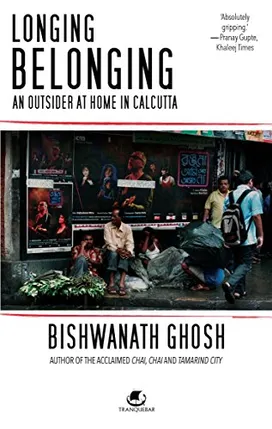
Longing Belonging
by Biswanath Ghosh
Started 1 December 2019 · finished 15 April 2020 · 372 pages
A journalist who moved to Calcutta writes about the city as an outsider learning to belong: its streets, people, history and contradictions.
About the book, from Open Library. Get the book.
46 highlights · page in the margin
- p. 4
At the same time, it bore comforting similarities with Chennai: simplicity, absence of ostentation, pride in culture, spiritual bent of mind, worship of knowledge. I felt rooted.
- p. 12
Calcutta is the most sneered-at, most maligned metropolis of India—and also the one most battered by the swing of the pendulum. Just until a century ago, it was the capital of Imperial India, the city of palaces, the city of cities, the Indian London.
- p. 12
The stage for its decline was set in 1912 when the British, faced with rising nationalist sentiments in Bengal, moved the seat of governance away to the more centrally-located Delhi. Over the next two decades, a brand new administrative capital—which they called New Delhi— was constructed
- p. 13
and Calcutta ceased to be the most important address in India. By the 1940s, the film industry too began moving its base to Bombay. Then a crippling famine struck in 1943. In 1947, when India became independent at the cost of a partitioned Bengal, Calcutta was flooded by a river of refugees fleeing the newly-carved East Bengal, which had now become a part of Pakistan. Even before this river could reduce to a trickle, yet another wave of refugees swept into the city in 1971, when East Bengal fought for freedom from Pakistan to become Bangladesh. With the two successive influxes, Calcutta's population exploded. Its civic infrastructure nearly collapsed. Shortages grew, opportunities shrank. The city had far too many poor and unemployed than it could ever handle. There was hopelessness all around. With the British now gone, the collective Bengali anger came to be trained against the new rulers and Calcutta, having long baked in the flames of revolution, easily transformed into a hub for communists. It became a city of protests and strikes, witnessing frequent upheavals
- p. 13
and violence on its streets over political ideology. Business houses moved out as red hammer-and-sickle flags took over factories.
- p. 14
The empty trams, in a way, define Calcutta. That they mostly run empty means the city has long moved on; but that they continue to run despite poor patronage shows that the city, even as
- p. 15
changing
- p. 15
times push it into the future, finds great comfort in its past.
- p. 15
Calcutta's eagerness to hold on to the days bygone— perhaps born out of the Bengali's inherent love for nostalgia—is what sets it apart. It's a once-upon-a-time-city.
- p. 26
CALCUTTA IS LIKE no other city in India. Give a third-world look to London, spray it with the permissive air of Paris, lend it the temperament of Latin America, people it with Bengalis—Calcutta would be that city.
- p. 36
Park Street is an event: an elegant dance of the colonial times in the courtyard of contemporary.
- p. 39
Madras—or Chennai—is India's first British city, founded by the Company in 1640 with the construction of Fort St George. Practically every modern institution in the country—army, judiciary, education, engineering—traces its origins to the fort at Madras.
- p. 41
It was Charles Eyre who, in 1696, began the construction of Fort William on the site marked by Goldsborough.
- p. 57
‘THERE IS ONE thing about Calcutta,’ the writer Sunil Gangopadhyay tells me, ‘If you come here for two or three days, you may not like the city; you might even hate it. But live here for a month and you will fall in love with it.’
- p. 60
I once met an American in America; he was a banker who had been a pilot during the Second World War. His memory of Calcutta was that of a beautiful city. I asked him, “Are you joking?” He said, “No, I remember it as a beautiful city.”
- p. 61
You write when your love is not fulfilled, when your heart is broken. The inspiration for writing comes from grief. What is supposed to be the very first poem written in our civilisation came from grief. It all began with two birds—one bird gets killed and the other bird is wailing over the sudden death of its partner. Hearing the bird's cries, Valmiki uttered two lines—that is supposed to be the first poetry.
- p. 64
‘Later when I met Jack Kerouac (another Beat writer, who became a cult figure for his travel-based novel, On The Road) in America, he told me that if you take four pills of LSD at a time, you will be able to recall your existence even in your mother's womb.
- p. 66
‘I suddenly remembered Jack Kerouac's advice. When I met him in America, he had told me, “Writing a novel is very easy. Just take a piece of paper and think of one day in your life. It could be, say, April 24, when you were waiting at the bus stop. Start your story from the bus stop, and as the bus moves, your story moves too.” So I wrote a story called Atma Prakash.
- p. 68
‘There are some clues in the original text which indicate that Sita got pregnant by Ravana when she was in his custody, which is why Rama was so angry and not willing to take her back.
- p. 70
In Kalighat live Bengal's two most powerful women: Goddess Kali and Mamata Banerjee. They live a stone's throw from each other, their homes joined by the road where the prostitutes are standing. Three dramatically disparate
- p. 70
female forms—the divine, derided and the deified—sharing space without conflict.
- p. 74
But a quintessentially Calcutta man, no matter what his occupation, likes to speak in enigmas—even in the most mundane of situations. He never lets go of an opportunity to bring out the poet-philosopher-satirist in him, be it in the corridors of power or on the aisle of a local train.
- p. 76
In Calcutta, you can usually guess the historical or social importance of a road by the number of sweet shops dotting it.
- p. 79
The older you grow, the more precious the sounds and smells of childhood become—and Calcutta is full of them.
- p. 80
You may possess an impressive collection of songs of your idols and have the luxury of listening to them at will—even playing the same song several times in a row, but it is an altogether different sensation when the radio plays a song you love. It is a validation of your craze. You feel victorious.
- p. 82
CTC, now owned by the government of West Bengal, was formed in London in 1880, when horse-drawn trams began to run between Sealdah and Armenian Ghat, a distance of about three kilometres.
- p. 84
‘The police will readily seize licences of other vehicles that are at fault, but will never touch an autorickshaw driver. That is because they know that the autorickshaw driver enjoys the patronage
- p. 104
His company, which dates back to 1938, offers laboratory testing for minerals and metals imported by international firms; and as the world shrinks, his horizon expands.
- p. 105
I silently wonder about the cruel irony of life: Sajal is not a writer but he gets to travel around the
- p. 105
world, whereas I am the one who likes to write about places but who is forever desk-bound for the lack of enough money or leave—or the courage of Sunil Gangopadhyay.
- p. 120
Having thrived on politics of criticism for several decades, she has come to believe that criticism is solely her preserve and is unwilling to be at the receiving end. She has never lived in a glass house before to know that if you continuously throw stones at others, you must expect at least a stone or two in return if not a fusillade.
- p. 128
he had probably forgotten that he belonged to the same Marxist government whose sole mission once upon a time was to take away excess land from the rich and distribute it among the peasants.
- p. 131
During dinner, the governor, Phani Bhushan Chakraborty, asked Atlee why the British had left India in such a hurry. Atlee replied that the British had left because Subhas Bose's campaign was leading to an uprising in the Indian army and the navy, and that Gandhi had a minimal role in their withdrawal. The governor mentioned this conversation in a book that he wrote later on.
- p. 156
Calcutta remains a British city at heart and retains great respect for the sahib—pronounced shaheb in Bengali— which literally means master. Since the British had been the masters of Calcutta for nearly two-and-a-half centuries, shaheb became a generic word for British men and—by extension—all white men. The inmates, who must have grown up listening to stories about India being ruled by shahebs, are now being attended to by one.
- p. 161
‘She wants to turn Calcutta into another London. I say it would be easier to turn London into another Calcutta.’
- p. 200
‘What can be done in a day takes seven days in Calcutta,’ Mukherjee sums up the
- p. 200
general attitude towards work in the city. ‘This is the sole contribution of irresponsible trade unionism, and now it has become part of the society's DNA. The same Bengali, when he goes to Hyderabad or Bangalore, works. In Calcutta, because of trade unionism, they know they will get their wages irrespective of work.’
- p. 201
Mukherjee is the typical anglicised, intellectual Calcuttan, who grew up in the ambience of Tagore but went to Oxford, who is a foodie, who loves his single-malt whisky, who has stopped watching Bengali films ever since Satyajit Ray died—and who was a family friend of Ray.
- p. 202
‘Calcutta used to be a gracious city, now it has lost its grace. There was a sense of space, a sense of class, but now all that is completely gone. It's a city where one can't even walk. The only business that seems to be doing well is real estate.’
- p. 203
I feel I am visiting home— home being the memories of sights, sounds and smells that surrounded you until the age of fifteen; before increasing testosterone levels made you want to get away and chart your own course.
- p. 203
once testosterone deposits begin to decline, you yearn to return home and become fifteen all over again.
- p. 254
Dr Roy saw him, he told the parents, “This boy won't live beyond three months.” Hearing this, the boy lost all interest in eating, and as he lost weight his ailments too began to disappear. The family came back to meet Dr Roy after three months and this time the boy was perfectly healthy. That was how he treated patients
- p. 263
The beauty of street food lies in watching it being prepared. The same alu-kabli, were it to be sold readymade, would evoke no special feeling: it would have been just a soggy salad. It is the live demonstration of the hawker's skill that works your salivary glands.
- p. 295
The lesson I learn from him this afternoon is that life is not just about living but looking forward to live, to unapologetically keep on doing things that give you pleasure no matter how old you are—even if that means smoking, drinking, gambling and watching porn at the age of seventy-five.
- p. 309
Calcutta, to me, is a sturdy, grime-coated grandfather's clock, whose pendulum was set into motion over 300 years ago and which continues to swing with the same precision between extremities: despair and joy; anger and celebration; chaos and culture; the permissive and the conservative; defiance and deference. As long as the pendulum continues to swing between these extremities, Calcutta will live on.
- p. 326
Like any other Hindu festival in Calcutta, Saraswati Puja too is more of a social occasion than religious.