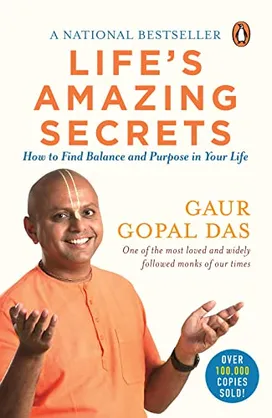
Life’s Amazing Secrets
by Gaur Gopal Das
Started 21 January 2019 · 256 pages
A monk uses the metaphor of a car’s four wheels, personal life, relationships, work and service, to offer advice on living a balanced and purposeful life.
About the book, from Open Library. Get the book.
32 highlights · Kindle location in the margin
- 212
Behind the smiles, everyone is going through personal struggles we know nothing about.
- 287
Our silent presence can be more powerful than a million empty words. We all have two ears and one mouth; the amount we listen and the amount we speak should be done proportionately. Rarely do people want an active solution to their problems before they have been thoroughly heard and understood.
- 291
In my immaturity, I would pounce on the solution as soon as it came to me, not understanding that people don’t care what you know unless they know you care. In fact, the answer to all problems related to the human condition seldom excludes a conscious, compassionate ear. The attitude of listening attentively is equally essential to the solutions we may present.
- 309
‘We all have three things in common: we are all stuck, we all have a journey to complete, and we all have a destination.
- 338
Things that once looked bright now look dull and lifeless. The things themselves haven’t changed. Our perception has.’
- 387
when we think negatively of people, we should immediately counteract that energy by contemplating three positive qualities they have.
- 408
Gratitude is not a feeling; it is a state of mind that can be developed, and it allows us to tap into a reservoir of unlimited positive energy. Being grateful happens in two steps. The first is to realize that there is good in the world and that good has fallen upon us. The second is to know that goodness is coming from something other than us, an external reality is giving the gifts of grace to our very own reality. This could be our family, our friends, nature and even God. We have so much to be grateful for!
- 416
When upon life’s billows you are tempest-tossed, When you are discouraged, thinking all is lost, Count your many blessings, name them one by one, And it will surprise you what the Lord has done.
- 491
We must have a positive state of mind when dealing with problems. Think: Is there anything positive about this situation I am in?
- 494
Gratitude is a state of being that allows us to see the positive. It comes from realizing that there is good in the world, that some of that good is with us and that those good things are coming from an external reality. That state of consciousness imbibes us with positivity.
- 674
Learning to detach ourselves from situations that are outside our control is an imperative skill to learn for personal growth.
- 677
What we see as bad at one point in time can turn out to be good for us, and what we see as good at another point in time can turn out to be bad for us. Most things in life are beyond our control; we should not judge any situation by its face value.
- 690
Some things in life are beyond our control. When we are in that situation, we feel overwhelmed as we try everything in our power to control it. But that is useless!
- 707
The fear of missing out, thinking that the grass is greener elsewhere, and living a life out of balance are all symptoms of having incorrectly prioritized happiness outside of ourselves.
- 839
My golden rule to know whether or not you are being adequately sensitive to another person is: treat someone better than you would like to be treated.
- 869
When we treat inanimate objects, like buckets or our possessions, with disrespect or insensitivity, we will end up treating people the same.
- 972
Before he had a meeting with him, Birla took out a notepad and wrote a title at the top: Points in favour of this employee. He then made a list of all the strengths this man had, including the time he had made the company millions of dollars. Aditya Birla had consciously chosen to shift his attention to all the good that this executive had done for the company before making any judgement or dealing with the mistake.
- 977
I convince myself to sit down and write a list of all the good qualities they have. This may not necessarily change my decision, but it helps me put things into perspective and control my anger.’
- 1118
The bottom line: hot heads do not give good feedback—choose a better time.
- 1137
Saying things in anger damages our relationships. Hence, we should try to avoid doing so.
- 1139
Corrective feedback is an art. It has four principles. Ask yourself: Am I the right person to give corrective feedback? Do I have the right motive to give corrective feedback? Do I know the right way to give corrective feedback? Is it the right time?
- 1262
‘Do you want to choose justice or do you want to choose forgiveness? Either is fine, but you have to make the choice—justice may cost you your marriage and this news may go public, ruining many lives. And that’s fine, if justice is what you need. People have their own capacity for what is acceptable to them and what is not.’
- 1277
Love is when we have every reason to break up but we do not.’
- 1361
‘Watch your thoughts, they turn into words. Watch your words, they turn into actions. Watch your actions, they turn into habits. Watch your habits, they turn into character. Watch your character, it turns into your destiny.’ It all begins with a thought.
- 1493
‘And to my hero. That’s who I chase. Now when I was fifteen years old, I had a very important person in my life come to me and say, “Who’s your hero?” And I said, “I don’t know, I gotta think about that. Give me a couple of weeks.” I come back two weeks later, this person comes up and says, “Who’s your hero?” I said, “I thought about it. You know who it is? It’s me in ten years.” So I turned twenty-five. Ten years later, that same person comes to me and says, “So, are you a hero?” And I was like, “Not even close. No, no, no.” She said, “Why?” I said, “Because my hero’s me at thirty-five.” So, you see, every day, every week, every month and every year of my life, my hero’s always ten years away. I’m never gonna be my hero. I’m not gonna attain that. I know I’m not, and that’s just fine with me because that keeps me with somebody to keep on chasing.
- 1501
‘We should imbibe this thought pattern of self-competition, rather than feeling insecure about others going ahead. We should be striving to do our very best to realize our dreams about our future selves. Not only will this attitude keep our mind free from envy and insecurity but it will also help us reach our fullest potential, bringing immense success and a deep sense of satisfaction.’
- 1515
The late Steve Jobs, the founder of Apple, believed that competing with others was a distraction from your own inner creativity. To not strive for originality would have been disastrous for Apple. If we compare ourselves with others too much, we succumb to ordinariness. We can start blindly imitating others and even lose our essence. In the worst-case scenario, we becoming boring! Steve Jobs was notorious for paying careful attention to detail in all his products. He wanted to change the world, not just copy the next best company to increase his stock price. He wanted to express himself fully, not just follow the expressions of others. He
- 1519
wanted to compare himself to what he had done in the past, not just with Bill Gates!
- 1548
‘If there is one thing that I think is the foundation of growth, it is understanding who you are. You can only compete with yourself if you have a clear idea of your potential, your capacities and certainly your limitations,’ I replied.
- 1883
However, the ideology behind the ice cream is: enjoy your life before it melts. It symbolizes hedonism; to savour every moment of your life through personal enjoyment.
- 1904
Compassion fatigue is a state of stress experienced by those who help others to the extent that they start suffering because of their preoccupation with the suffering of others.
- 1906
Therefore, we need to be slightly selfish to start our journey on a sure footing in order to reach the stage where we can afford to be completely selfless without causing damage to our own well-being.