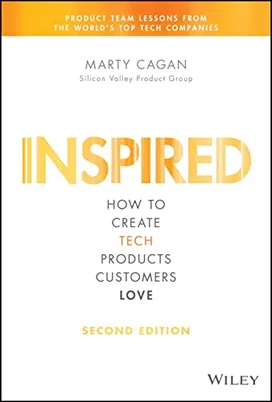
Inspired
by Marty Cagan
Started 5 September 2020 · 368 pages
A product leader’s guide to building tech products customers love: strong product teams, product discovery and the role of the product manager.
About the book, from Open Library. Get the book.
9 highlights · Kindle location in the margin
- 655
It doesn't matter how good your engineering team is if they are not given something worthwhile to build.
- 910
The biggest flaw of the old waterfall process has always been, and remains, that all the risk is at the end, which means that customer validation happens way too late.
- 944
Risks are tackled up front, rather than at the end.
- 949
Products are defined and designed collaboratively, rather than sequentially.
- 954
Finally, it's all about solving problems, not implementing features. Conventional product roadmaps are all about output. Strong teams know it's not only about implementing a solution. They must ensure that solution solves the underlying problem. It's about business results.
- 1001
The purpose of product discovery is to quickly separate the good ideas from the bad. The output of product discovery is a validated product backlog.
- 1004
Will the user buy this (or choose to use it)? Can the user figure out how to use this? Can our engineers build this? Can our stakeholders support this?
- 1037
So, we use prototypes to conduct rapid experiments in product discovery, and then in delivery, we build and release products in hopes of achieving product/market fit, which is a key step on the way to delivering on the company's product vision.
- 1325
To summarize, these are the four critical contributions you need to bring to your team: deep knowledge (1) of your customer, (2) of the data, (3) of your business and its stakeholders, and (4) of your market and industry.