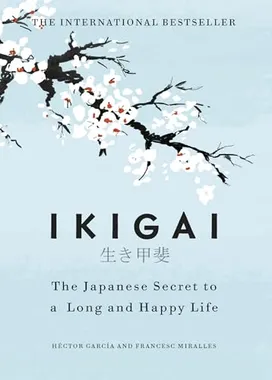
Ikigai
by Héctor García and Francesc Miralles
Started 14 February 2020 · finished 15 April 2020 · 208 pages
Based on visits to Okinawa, one of the world’s longest-lived places, the authors explore ikigai, a reason for being, and habits of diet, community and purpose.
About the book, from Open Library. Get the book.
30 highlights · Kindle location in the margin
- 93
According to the Japanese, everyone has an ikigai—what a French philosopher might call a raison d’être. Some people have found their ikigai, while others are still looking, though they carry it within them.
- 147
the keys to longevity are diet, exercise, finding a purpose in life (an ikigai), and forming strong social ties—that is, having a broad circle of friends and good family relations.
- 209
Presented with new information, the brain creates new connections and is revitalized. This is why it is so important to expose yourself to change, even if stepping outside your comfort zone means feeling a bit of anxiety.
- 337
What, then, does logotherapy do?1 The answer is pretty clear: It helps you find reasons to live.
- 351
“Everything can be taken from a man but one thing: the last of the human freedoms—to choose one’s attitude in any given set of circumstances, to choose one’s own way.”
- 362
In Man’s Search for Meaning, Frankl cites one of Nietzsche’s famous aphorisms: “He who has a why to live for can bear with almost any how.”
- 365
Frankl believed that our health depends on that natural tension that comes from comparing what we’ve accomplished so far with what we’d like to achieve in the future. What we need, then, is not a peaceful existence, but a challenge we can strive to meet by applying all the skills at our disposal.
- 367
Existential crisis, on the other hand, is typical of modern societies in which people do what they are told to do, or what others do, rather than what they want to do. They often try to fill the gap between what is expected of them and what they want for themselves with economic power or physical pleasure, or by numbing their senses. It can even lead to suicide.
- 380
We don’t create the meaning of our life, as Sartre claimed—we discover it.
- 427
In the West, we tend to believe that what we think influences how we feel, which in turn influences how we act. In contrast, Morita therapy focuses on teaching patients to accept their emotions without trying to control them, since their feelings will change as a result of their actions.
- 443
Vietnamese monk Thich Nhat Hanh, who would say, “Hello, solitude. How are you today? Come, sit with me, and I will care for you.”6
- 486
We are what we repeatedly do. Excellence, then, is not an act but a habit. —Aristotle
- 497
As the quip attributed to Einstein goes, “Put your hand on a hot stove for a minute and it seems like an hour. Sit with a pretty girl for an hour, and it seems like a minute. That is relativity.”
- 510
flow is “the state in which people are so involved in an activity that nothing else seems to matter; the experience itself is so enjoyable that people will do it even at great cost, for the sheer sake of doing it.”
- 528
Every task, sport, or job has a set of rules, and we need a set of skills to follow them. If the rules for completing a task or achieving a purpose are too basic relative to our skill set, we will likely get bored. Activities that are too easy lead to apathy.
- 533
Ernest Hemingway meant when he said, “Sometimes I write better than I can.”
- 576
“a happy man is too satisfied with the present to dwell on the future.”4
- 589
Concentrating on one thing at a time may be the single most important factor in achieving flow.
- 716
The Japanese are skilled at bringing nature and technology together: not man versus nature, but rather a union of the two.
- 792
Life is inherently ritualistic. We could argue that humans naturally follow rituals that keep us busy. In some modern cultures, we have been forced out of our ritualistic lives to pursue goal after goal in order to be seen as successful. But throughout history, humans have always been busy. We were hunting, cooking, farming, exploring, and raising families—activities that were structured as rituals to keep us busy throughout our days.
- 803
Focus on enjoying your daily rituals, using them as tools to enter a state of flow. Don’t worry about the outcome—it will come naturally. Happiness is in the doing, not in the result. As a rule of thumb, remind yourself: “Rituals over goals.”
- 805
The happiest people are not the ones who achieve the most. They are the ones who spend more time than others in a state of flow.
- 900
Carmen Herrera, a painter who just entered her one hundredth year, sold her first canvas at age eighty-nine. Today her work is in the permanent collections of the Tate Modern and the Museum of Modern Art.
- 1019
“The grand essentials to happiness in this life are something to do, something to love, and something to hope for.”
- 1215
White tea, with its high concentration of polyphenols, may be even more effective against aging. In fact, it is considered to be the natural product with the greatest antioxidant power in the world
- 1217
Drinking green or white tea every day can help us reduce the free radicals in our bodies, keeping us young longer.
- 1289
Yoga comes from India, where it was developed millennia ago to unite our mental and physical elements. The word yoga itself comes from the Sanskrit term for “yoke,” which refers to the crosspiece that binds draft animals to one another and to the cart they’re pulling. Yoga strives to unite body and mind in the same way, guiding us toward a healthy lifestyle in harmony with the world around us.
- 1524
“It’s not what happens to you, but how you react that matters.”
- 1526
meditation is a way to become aware of our desires and emotions and thereby free ourselves from them. It is not simply a question of keeping the mind free of thoughts but instead involves observing our thoughts and emotions as they appear, without getting carried away by them. In this way, we train our minds not to get swept up in anger, jealousy, or resentment.
- 1661
Life is not a problem to be solved. Just remember to have something that keeps you busy doing what you love while being surrounded by the people who love you.