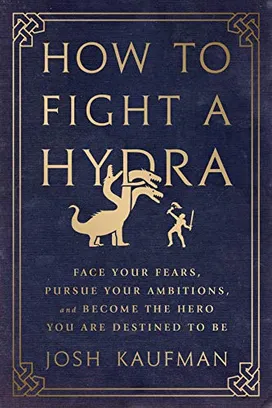
How to Fight a Hydra
by Josh Kaufman
Started 25 August 2020 · 125 pages
A short allegorical tale about facing fears and pursuing ambitious goals, framed as the story of a would-be hero setting out to slay a many-headed monster.
About the book, from Open Library. Get the book.
70 highlights · page in the margin
- p. 8
I know why my loved ones do not support my choice: they are afraid. Afraid it will be a terrible decision. Afraid I will sacrifice much and gain nothing. Afraid I will come to harm, or die in the pursuit.
- p. 9
If I try, and they don’t, what does that say about them?
- p. 10
I cannot control the outcome of my quest. I can only control myself: how I prepare, how I manage my fears, and how I conduct myself in the battle to come.
- p. 11
When you cut off one of the Hydra’s heads, legend says, it will grow two more unless you cauterize the wound with a torch. Hercules prevailed in this way, and I will follow his example.
- p. 13
I have also set myself to physical training. I must be strong enough to swing the sword with force, and quick enough to apply the torch while dodging the enemy’s vicious strikes. This training does not come naturally to me. The sword is heavy in my hand, and my footwork is too slow. I must work to improve.
- p. 13
I must also improve my strength and stamina. Endurance is necessary to win the battle. The fight will be exhausting, and I must be able to withstand fatigue and injury.
- p. 14
I am afraid. That is not a reason to avoid the beast. Courage means being afraid and acting anyway. I leave at dawn.
- p. 19
Will I find what I seek? Am I doing the right thing? I can’t be sure. Should I keep going or turn back before it’s too late?
- p. 20
What is this thing I’m doing, exactly? I’m no longer bound by the demands of daily life in town. I have no one to tell me what to do. There are no orders to follow, nor is there the promise of a reward for a job well done. It’s difficult to tell if I’m even making progress.
- p. 20
I am wandering, but wandering with a purpose. I have an outcome in mind, but the future is impossible to know. I suppose this is the essence of adventuring. You know what you want, but the only way you can get it is to abandon what you know, set off into the world, and trust in preparation, skill, and Fortune to see you through to a good end.
- p. 21
The routine is comforting. I don’t have to make new decisions about what to do each day. I’ve already decided, so I don’t have to think: I can get straight to work.
- p. 21
At first, I found hunting and foraging discouraging. Once I understood that supporting my body is essential to victory, the chores no longer bothered me.
- p. 22
My daily practice is working. The sword no longer feels so heavy, and I’m becoming swifter and more sure-footed. I keep my blade sharp, and it no longer takes me so long to make torches in the evening.
- p. 23
Every time I’m tempted to complain about the difficulty and unfairness of life, I remind myself that I knew it was going to be hard before I left home, and that there is no victory without struggle.
- p. 28
I always have a reason to delay: I need to sharpen my sword. I need to make better torches. I didn’t sleep well last night. I may be coming down with a sickness. It’s too cold, too windy, too rainy. All excuses designed to fool myself into avoiding the confrontation. Where is the courage I felt when I set out on this journey? No more excuses. My fears are justified, but not useful: I will proceed, even though I still feel afraid. This Hydra is not going to fight itself.
- p. 29
I must consider my first foray into the cave a success. I didn’t fight, but I took a small step closer to the objective. That is progress, and I need every victory I can claim right now.
- p. 36
I have faced the monster, and I have survived. I have struck my first blow. I know my enemy, and I know its weakness: it is afraid of fire. That is why it did not hunt me that night: my campfire kept me safe.
- p. 37
I don’t have to overpower it: I can outlast it.
- p. 37
I am still afraid, but less so than before. I have seen the enemy, I know the terrain, and I have a plan of action.
- p. 38
Still, I am glad I tried: this information is valuable and could be learned no other way.
- p. 40
Every once in a while, my fear recedes, and I have a glimpse of transcendence. The world fades, my mind is quiet, and all that exists is the task at hand. I am feeling confident in my progress. A few more days of battle and it will be over.
- p. 43
I must be patient with myself. I will make mistakes, and I can’t predict the future or change what happened. The only thing I can do is learn by trial, and try to do better in the future.
- p. 46
Unless I do something, I am dead. It is worth a try: if the moss harms me, I won’t be any worse off than I am now.
- p. 46
Fortune smiles upon me: I’m still alive.
- p. 47
Patience. I must keep my goal in mind, but act with prudence. Better to wait until the wounds heal over before I strike out again. If I act before I’m ready, I risk permanent harm.
- p. 48
As stories are told, feats of prowess are embellished, and the mundane reality of the struggle is left out to make the telling more exciting.
- p. 48
The heroes of legend did not slay the abomination in an hour, then return to their homes in time for dinner. It was just as difficult for them as it has been for me. This truth is not obvious, but it is important, and it helps to know it.
- p. 54
As I reached the mouth of the cave, I remembered a lesson: examine your environment and circumstances, and see if there’s anything you can use to your benefit. What could I do? What could I try?
- p. 55
The Hydra wasn’t guarding a treasure: it was the treasure.
- p. 58
In the stories, I am fearless, confident, and self-assured. The battle is over in a day, and my success was foretold from the beginning.
- p. 60
One beautiful autumn morning, a few months after I came back to the village, I set off on a new quest. I was getting restless. It was time to face the Hydra once more.
- p. 62
This journal has accompanied me on each foray. It reminds me of how I started and how far I’ve come since the day I first set off into the wilds.
- p. 62
After each battle with the Hydra, I had hoped the next would be easier. It wasn’t. This line of work is worthwhile, but it is never easy.
- p. 62
I’ve seen the lack of adventuring destroy more souls than a Hydra ever will. For every adventurer who has been defeated by a Hydra in combat, thousands have been defeated by their own minds and refuse to face the Hydra at all.
- p. 64
You’re looking for a deep, dark, ominous cavern: something that scares you.
- p. 64
There’s no sense in fighting with a dull, rusty sword. Invest your gold in well-forged weapons. Keep your sword sharp, your torches ready, and your armor well-maintained. Take care of your tools, learn how to use them, and they’ll serve you well.
- p. 65
Set aside the terror and the risk: almost anything else in the world is more enticing than facing the beast.
- p. 66
When you set out to face the Hydra, you will feel fear. No matter how many monstrosities you slay, you will experience anxiety, trepidation, and a sense of dread as you approach the cave.
- p. 66
Fear doesn’t mean you’re weak: it means you’re sane. Unpleasant emotions do not dictate your actions.
- p. 66
Many novices claim to be adventurers but never quite get around to standing toe-to-maw with the beast. Instead, they say to themselves, “I don’t feel like it. Maybe tomorrow.” Always tomorrow. Always later. Always any time but right now.
- p. 67
Your mind can invent horrors beyond those that actually exist. Rumination is not your friend. Action allows you to see the…
- p. 67
Fear of the unknown will always be with you, no matter what you do. That’s comforting in a way: if there’s nothing you can do to change it,…
- p. 68
Some attacks will hit. Others will miss. You can’t predict which will be which in advance. You have to commit to every attack with the same intention: to strike the enemy. That is the essence of battle. You cannot change it. Setbacks, mistakes, and bad days are normal. There will be long…
- p. 69
Think back to all of the times you’ve struggled, adapted, and prevailed. You’ve done it…
- p. 69
Risk is an unavoidable part of adventuring. A single mistake, made out of ignorance or…
- p. 70
The wise adventurer spends just as much time learning how to evade being hit as they invest in improving their skill with the sword and torch. Treasure isn’t…
- p. 70
No matter how careful you are, you will make mistakes. After every engagement, there will be a hundred things that, looking back, you could’ve done better. Since that’s the case, the best approach is to make valuable mistakes:…
- p. 70
Over the course of your adventuring career, you’ll earn more than a few battle scars. That’s fine,…
- p. 71
The novices who quit are the ones who think this profession is all glory and heroics. They’re the ones who experience the dire consequences of foolish risks…
- p. 71
Knowing it’s going to be difficult makes it easier…
- p. 71
What if I fail this time? What will people think of me if I fall or…
- p. 72
The moment you prove you’re capable of slaying a Hydra, everyone will have thoughts about who you are, what you’re capable of, and how you should do your job. You’ll hear an endless stream of commentary and advice from people who have never picked up a sword…
- p. 73
Your confidence grows with every successful venture. Unless you’re wary, it’s easy to develop the mistaken…
- p. 73
There’s a middle path between humility and hubris:…
- p. 74
Everyone wants a guaranteed reward before they put themselves at risk. The world…
- p. 74
Not everyone succeeds. No matter how much you plan or prepare, a good portion of the outcome will remain in the hands of Fortune and happenstance. Generations…
- p. 74
On the other hand, you can’t succeed if you never try. Fortune tends to smile on those who act, even when the final outcome is not guaranteed. At some point, you must choose to move…
- p. 76
Ending a chapter of your life on your own terms is a feat worthy of…
- p. 84
If I decline and the party succeeds, will I regret my choice? How will I react if I learn that I was offered a chance at lasting glory but didn’t have the nerve to take it?
- p. 89
You may win glory and renown, or be considered a fool, worse off than you were before. This is the essence of life. The outcome of your actions and decisions is unknown and unknowable. What separates the adventurer from the bulk of humanity is the willingness to fight in spite of the risks: to meet the enemy on the field of valor, trusting in skill, instinct, and determination to see them through to a good end.
- p. 90
The moment you lock eyes with the beast, steel your mind, and stand your ground, you earn yourself a place among the heroes of legend, who are honored, first and foremost, for overcoming their own fears.
- p. 93
In Metaphors We Live By, George Lakoff and Mark Johnson argue that metaphor is at the core of language and perception, both of which profoundly influence our thoughts and actions. The metaphors we use determine how we understand and relate to everything we experience in our daily lives.
- p. 94
The best modern example is The War of Art by Steven Pressfield. Pressfield personifies the fear, anxiety, uncertainty, reluctance, and existential dread that accompanies any act of creation as “the Resistance”: a malevolent force of nature that has a personal interest in your failure, embarrassment, and permanent disgrace.
- p. 97
The metaphor “projects are Hydras” is a useful way to change the way you think about complex projects and the fundamental nature of every form of creative or speculative work:
- p. 97
The best general strategy is to focus on completing one critical task at a time.
- p. 98
Instead of being paralyzed by fear and doubt, they develop their skills and abilities, apply them to the task at hand, and commit themselves to the work until it is complete.
- p. 98
Everything you want to accomplish in life will require you to grapple with the unknown, unsure of the outcome of your actions and decisions. Knowing this in advance makes it easier to keep going when the going gets tough.
- p. 104
Confidence is a potent ally: trust your experience, insight, and intuition. Beware the dangers of inattention, impatience, and hubris.
- p. 104
Often, the reward at the end of the journey is not what you expect. Be open to the possibility of finding treasure in unexpected places and in uncommon forms.
- p. 104
Weigh each new opportunity against your current objective, then decide what to do based on what you value most.