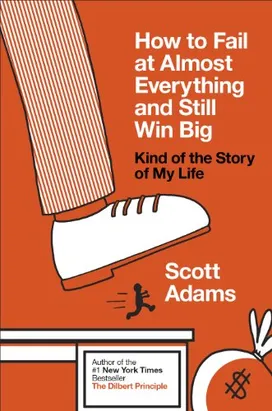
How to Fail at Almost Everything and Still Win Big
by Scott Adams
Started 1 March 2020 · finished 15 April 2020 · 248 pages
The creator of Dilbert tells the story of his many failures and what he learned from them, arguing for systems over goals and building a stack of useful skills.
About the book, from Open Library. Get the book.
95 highlights · Kindle location in the margin
- 78
Making comics is a process by which you strip out the unnecessary noise from a situation until all that is left is the absurd-yet-true core. A cartoonist has to accomplish that feat with as few as four short sentences. I’ve performed that trick nearly nine thousand times, sometimes successfully.
- 121
The most important metric to track is your personal energy.
- 124
Conquer shyness by being a huge phony (in a good way).
- 167
The best example of the power of simplicity is capitalism. The central genius of capitalism is that all of its complexities, all of the differences across companies, all of the challenges, decisions, successes, and failures can be boiled down into one number: profits.
- 198
Sometimes the only real difference between crazy people and artists is that artists write down what they imagine seeing.
- 215
Research shows that loneliness damages the body in much the same way as aging.
- 284
the best loan customer is one who has no passion whatsoever, just a desire to work hard at something that looks good on a spreadsheet. Maybe the loan customer wants to start a dry-cleaning store or invest in a fast-food franchise—boring stuff. That’s the person you bet on. You want the grinder, not the guy who loves his job.
- 292
You can’t be humble and say, “I succeeded because I am far smarter than the average person.” But you can say your passion was a key to your success, because everyone can be passionate about something or other.
- 311
If you ask a billionaire the secret of his success, he might say it is passion, because that sounds like a sexy answer that is suitably humble. But after a few drinks I think he’d say his success was a combination of desire, luck, hard work, determination, brains, and appetite for risk.
- 314
You already know that when your energy is right you perform better at everything you do, including school, work, sports, and even your personal life. Energy is good. Passion is bullshit.
- 328
Nietzsche famously said, “What doesn’t kill us makes us stronger.” It sounds clever, but it’s a loser philosophy. I don’t want my failures to simply make me stronger,* which I interpret as making me better able to survive future challenges. Becoming stronger is obviously a good thing, but it’s only barely optimistic. I do want my failures to make me stronger, of course, but I also want to become smarter, more talented, better networked, healthier, and more energized. If I find a cow turd on my front steps, I’m not satisfied knowing that I’ll be mentally prepared to find some future cow turd. I want to shovel that turd onto my garden and hope the cow returns every week so I never have to buy fertilizer again.* Failure is a resource that can be managed.
- 342
Good ideas have no value because the world already has too many of them. The market rewards execution, not ideas. From that point on, I concentrated on ideas I could execute. I was already failing toward success, but I didn’t yet know it.
- 348
I figured my academic excellence would be the advantage I needed for a sales position. That is how ignorant I was.
- 416
timing is often the biggest component of success. And since timing is often hard to get right unless you are psychic, it makes sense to try different things until you get the timing right by luck.
- 558
I asked what he did for a living and he told me he was CEO of a company that made screws. Then he offered me some career advice. He said that every time he got a new job, he immediately started looking for a better one. For him, job seeking was not something one did when necessary. It was an ongoing process. This makes perfect sense if you do the math. Chances are the best job for you won’t become available at precisely the time you declare yourself ready. Your best bet, he explained, was to always be looking for the better deal. The better deal has its own schedule. I believe the way he explained it is that your job is not your job; your job is to find a better job.
- 563
This was my first exposure to the idea that one should have a system instead of a goal. The system was to continually look for better options.
- 572
Throughout my career I’ve had my antennae up, looking for examples of people who use systems as opposed to goals. In most cases, as far as I can tell, the people who use systems do better. The systems-driven people have found a way to look at the familiar in new and more useful ways.
- 584
Goal-oriented people exist in a state of continuous presuccess failure at best, and permanent failure at worst if things never work out. Systems people succeed every time they apply their systems, in the sense that they did what they intended to do. The goals people are fighting the feeling of discouragement at each turn. The systems people are feeling good every time they apply their system.
- 588
The system-versus-goals model can be applied to most human endeavors. In the world of dieting, losing twenty pounds is a goal, but eating right is a system. In the exercise realm, running a marathon in under four hours is a goal, but exercising daily is a system. In business, making a million dollars is a goal, but being a serial entrepreneur is a system.
- 590
For our purposes, let’s say a goal is a specific objective that you either achieve or don’t sometime in the future. A system is something you do on a regular basis that increases your odds of happiness in the long run. If you do something every day, it’s a system. If you’re waiting to achieve it someday in the future, it’s a goal.
- 611
Warren Buffett’s system for investing involves buying undervalued companies and holding them forever, or at least until something major changes. That system (which I have grossly oversimplified) has been a winner for decades. Compare that with individual investors who buy a stock because they expect it to go up 20 percent in the coming year; that’s a goal, not a system. And not surprisingly, individual investors generally experience worse returns than the market average.
- 634
In time I started to understand something called the odds. Some things were, by their very nature, likely, and some were not. I learned by observation that people who pursued extraordinarily unlikely goals were overly optimistic at best, delusional at worst, and just plain stupid most of the time.
- 697
As I learned more about the legal profession, I realized it wasn’t a good fit for my personality. I’m not the sort of person who feels comfortable winning when it means the other side loses something of equal or greater value. I’d feel even worse if I were to win a victory for my client that was ill deserved and accomplished only through my weasel-tastic skills. I had been raised to decline offers of candy from family friends under the theory that I had done nothing to deserve it. I was the kind of person who needed a job that made other people happy, ideally with a side benefit of making me rich and famous too. And for that I needed a system.
- 705
This brings me to my system. I still have the diary I wrote when I graduated from Hartwick, in which I outlined my entrepreneurial plan. The idea was to create something that had value and—this next part is the key—I wanted the product to be something that was easy to reproduce in unlimited quantities. I didn’t want to sell my time, at least not directly, because that model has an upward limit. And I didn’t want to build my own automobile factory, for example, because cars are not easy to reproduce. I didn’t want to do any sort of custom work, such as building homes, because each one requires the same amount of work. I wanted to create, invent, write, or otherwise concoct something widely desired that would be easy to reproduce.
- 796
One of the best pieces of advice I’ve ever heard goes something like this: If you want success, figure out the price, then pay it.
- 825
The most important form of selfishness involves spending time on your fitness, eating right, pursuing your career, and still spending quality time with your family and friends. If you neglect your health or your career, you slip into the second category—stupid—which is a short slide to becoming a burden on society.
- 866
The way I approach the problem of multiple priorities is by focusing on just one main metric: my energy. I make choices that maximize my personal energy because that makes it easier to manage all of the other priorities.
- 908
Capitalism is rotten at every level, and yet it adds up to something extraordinarily useful for society over time. The paradox of capitalism is that adding a bunch of bad-sounding ideas together creates something incredible that is far more good than bad. Capitalism inspires people to work hard, to take reasonable risks, and to create value for customers. On the whole, capitalism channels selfishness in a direction that benefits civilization, not counting a few fat cats who have figured out how to game the system.
- 1081
Good health and sufficient money are necessary for a base level of happiness, but you need to be right with your family, friends, and romantic partners to truly enjoy life.
- 1099
Priorities are the things you need to get right so the things you love can thrive.
- 1190
A great strategy for success in life is to become good at something, anything, and let that feeling propel you to new and better victories. Success can be habit-forming.
- 1227
You too can sometimes get what you want by adopting a practical illusion. Reality is overrated and impossible to understand with any degree of certainty. What you do know for sure is that some ways of looking at the world work better than others. Pick the way that works, even if you don’t know why.
- 1236
Free yourself from the shackles of an oppressive reality. What’s real to you is what you imagine and what you feel. If you manage your illusions wisely, you might get what you want, but you won’t necessarily understand why it worked.
- 1246
The group of people who read books on how to succeed is an excellent group to be in. You’re the people most likely to succeed because you’re putting real thought and research into the mechanics of success.
- 1256
We fake it until it becomes real. Our core personality doesn’t change, but we quickly adopt the mannerisms and skills associated with our new status and position.
- 1340
It’s a cliché that who you know is helpful for success. What is less obvious is that you don’t need to know CEOs and billionaires. Sometimes you just need a friend who knows different things than you do. And you can always find one of those.
- 1412
When you hear stories about famous actors as kids, one of the patterns you notice is that before they were stars they were staging plays in their living rooms and backyards. That’s gutsy for a kid. A child who eagerly accepts the risk of embarrassment in front of a crowd—even a friendly crowd—probably has some talent for entertaining.
- 1417
Where there is a tolerance for risk, there is often talent.
- 1462
I was chatting with the television executive in charge of the project and asking what the cutoff was for an acceptable test-audience response. The executive explained that for television shows, the best predictor is not the average response. Averages don’t mean much for entertainment products. What you’re looking for is an unusually strong reaction from a subset of the public, even if the majority hates it.
- 1500
There’s no denying the importance of practice. The hard part is figuring out what to practice.
- 1505
My observation is that some people are born with a natural impulse to practice things and some people find mindless repetition without immediate reward to be a form of torture. Whichever camp you’re in, it probably won’t change. It’s naive to expect the average person to embrace endless practice in pursuit of long-term success. It makes more sense to craft a life plan for yourself that embraces your natural inclinations, assuming you’re not a cannibal. Most natural inclinations have some sort of economic value if you channel them right.
- 1509
The first filter in deciding where to spend your time is an honest assessment of your ability to practice. If you’re not a natural “practicer,” don’t waste time pursuing a strategy that requires it.
- 1511
You simply need to pick a life strategy that rewards novelty seeking more than mindless repetition. For example, you might want to be an architect, designer, home builder, computer programmer, entrepreneur, Web site designer, or even doctor. All of those professions require disciplined study, but every class will be different, and later on all of your projects will be different. Your skills will increase with experience, which is the more fun cousin of practice. Practice involves putting your consciousness in suspended animation. Practicing is not living. But when you build your skills through an ever-changing sequence of experiences, you’re alive.
- 1519
The primary purpose of schools is to prepare kids for success in adulthood. That’s why it seems odd to me that schools don’t have required courses on the systems and practices of successful people. Success isn’t magic; it’s generally the product of picking a good system and following it until luck finds you. Unfortunately, schools barely have the resources to teach basic course work. Students are on their own to figure out the best systems for success.
- 1527
Books about success can be somewhat useful. But for marketing reasons, a typical book is focused on a single topic to make it easier to sell and packed with filler to get the page count up. No one has time to sort through that much filler.
- 1529
When I speak to young people on the topic of success, as I often do, I tell them there’s a formula for it. You can manipulate your odds of success by how you choose to fill out the variables in the formula. The formula, roughly speaking, is that every skill you acquire doubles your odds of success. The Success Formula: Every Skill You Acquire Doubles Your Odds of Success Notice I didn’t say anything about the level of proficiency you need to achieve for each skill. I didn’t mention anything about excellence or being world-class. The idea is that you can raise your market value by being merely good—not extraordinary—at more than one skill.
- 1547
When writing a résumé, a handy trick you’ll learn from experts is to ask yourself if there are any words in your first draft that you would be willing to remove for one hundred dollars each. Here’s the simple formula: Each Unnecessary Word = $100 When you apply the formula to your résumé, you surprise yourself by how well the formula helps you prune your writing to its most essential form. It doesn’t matter that the hundred-dollar figure is arbitrary and that some words you remove are more valuable than others. What matters is that the formula steers your behavior in the right direction. As is often the case, simplicity trumps accuracy. The hundred dollars in this case is not only inaccurate; it’s entirely imaginary. And it still works.
- 1557
When you accept without necessarily believing that each new skill doubles your odds of success, you effectively hack (trick) your brain to be more proactive in your pursuit of success. Looking at the familiar in new ways can change your behavior even when the new point of view focuses on the imaginary.
- 1723
we don’t always have an accurate view of our own potential. I think most people who are frightened of public speaking can’t imagine they might feel different as a result of training. Don’t assume you know how much potential you have. Sometimes the only way to know what you can do is to test yourself.
- 1726
It’s hard to imagine any business or social activity that doesn’t require a basic understanding of how the human brain perceives the world. Almost any decision you make is in the context of managing what other people will think of you. We’re all in the business of selling some version of ourselves. Psychology is embedded in everything we do.
- 1764
Quality is not an independent force in the universe; it depends on what you choose as your frame of reference.
- 1806
You’ve heard the old saying that knowledge is power. But knowledge of psychology is the purest form of that power. No matter what you’re doing or how well you’re doing it, you can benefit from a deeper understanding of how the mind interprets its world using only the clues that somehow find a way into your brain through the holes in your skull.
- 1819
My experience with hypnosis completely changed the way I view people and how I interpret the choices they make. I no longer see reason as the driver of behavior. I see simple cause and effect, similar to the way machines operate. If you believe people use reason for the important decisions in life, you will go through life feeling confused and frustrated that others seem to have bad reasoning skills. The reality is that reason is just one of the drivers of our decisions, and often the smallest one.
- 1833
It is tremendously useful to know when people are using reason and when they are rationalizing the irrational. You’re wasting your time if you try to make someone see reason when reason is not influencing the decision.
- 1842
If your view of the world is that people use reason for their important decisions, you are setting yourself up for a life of frustration and confusion. You’ll find yourself continually debating people and never winning except in your own mind. Few things are as destructive and limiting as a worldview that assumes people are mostly rational.
- 1875
This was part of my larger strategy of learning as much as I could about whatever might someday be useful while my employer was willing to foot the bill.
- 1909
I also learned that art composition for anything from a magazine cover to an oil painting to a PowerPoint slide should conform to a few basic templates. The most common is the L-shaped layout. You imagine a giant letter L on the page and fill in the dense stuff along its shape, leaving less clutter in one of the four open quadrants. Artists call the uncluttered part negative space.
- 1948
The secret to making the list of six questions work without seeming awkward is in understanding that the person you meet will feel every bit as awkward as you. That person wants to talk about something interesting and to sound knowledgeable. Your job is to make that easy. Nothing is easier than talking about one’s self. I would go so far as to say that 99 percent of the general public love talking about themselves. When you ask a stranger a personal question, you make that person happy. Your question relieves the stress of awkward silence and gets the conversation moving. Best of all, it signals that you have interest in the stranger, which most people interpret as friendliness and social confidence, even if you’re faking it. And faking social confidence leads to the real thing over time.
- 1971
If you’re unattractive—and this is my area of expertise—your conversation skills will be especially important. It might be all you have to sell yourself unless you’re accomplished in some world-class way. You’ll need to take your conversation skills up a notch. And that means becoming the master of short but interesting stories.
- 2020
Smile, ask questions, avoid complaining and sad topics, and have some entertaining stories ready to go. It’s all you need to be in the top 10 percent of all conversationalists.
- 2037
The single best tip for avoiding shyness involves harnessing the power of acting interested in other people. You don’t want to cross into nosiness, but everyone appreciates it when you show interest.
- 2038
You should also try to figure out which people are thing people and which ones are people people. Thing people enjoy hearing about new technology and other clever tools and possessions. They also enjoy discussions of processes and systems, including politics.
- 2041
People people enjoy only conversations that involve humans doing interesting things. They get bored in a second when the conversation turns to things. Once you know whether you are dealing with a thing person or a people person, you can craft your conversation to his or her sweet spot. It makes a big difference in how people react to you, and that in turn will make you more confident and less shy.
- 2044
People who appear outgoing are usually employing a learned social skill that you think is somehow natural. It probably isn’t, at least not entirely. Outgoing people usually come from families with at least one outgoing parent. They observe and imitate. Being outgoing is partly genetic, but you still need to know what to say when. That part is learned. And the good news is that you can learn it too. Observe outgoing people and steal their little tricks if you can. I’ve been doing that for years. It works great.
- 2053
In the interest of full disclosure, my own shyness dissipated when I realized I was semifamous and I had an interesting profession. Success builds confidence and confidence suppresses shyness. If you can’t control your shyness directly through the tricks I outlined, wait until you’re rich and famous; the shyness might leave on its own.
- 2099
The simple rule for “I” versus “me” is that the sentence has to make sense if you remove the other person mentioned in the sentence. For example, if you say, “Bob and I went to a movie,” it would still make sense if you removed “Bob and” and said, “I went to a movie.” If the sentence is “Please give the documents to Bob and me,” you can remove “Bob and” and it still makes sense as “Please give the documents to me.” You’ll often hear smart people get this rule wrong, so don’t be fooled by how many times you hear it incorrectly.
- 2161
Sometimes you hear statements that are so mind-numbingly stupid, evil, or mean that you know a direct frontal assault would only start a fight. People tend to double down when challenged, no matter how wrong they are. A more effective way to approach a dangerous social or business situation is sideways, by asking a question that starts with “I just wanted to clarify …”
- 2197
The right approach to sharing a secret is to start small. Make sure the small secrets stay secret before you try anything riskier. One way to judge your risk is to be alert for other people’s secrets that are being relayed to you. Someone who is bad at keeping one kind of secret is probably bad at keeping all secrets. You won’t be exempt.
- 2215
In any kind of negotiation, the worst thing you can do is act reasonable. Reasonable people generally cave in to irrational people because it seems like the path of least resistance.
- 2527
The success of Dilbert is mostly a story of luck. But I did make it easier for luck to find me, and I was thoroughly prepared when it did. Luck won’t give you a strategy or a system—you have to do that part yourself.
- 2529
I find it helpful to see the world as a slot machine that doesn’t ask you to put money in. All it asks is your time, focus, and energy to pull the handle over and over. A normal slot machine that requires money will bankrupt any player in the long run. But the machine that has rare yet certain payoffs, and asks for no money up front, is a guaranteed winner if you have what it takes to keep yanking until you get lucky. In that environment, you can fail 99 percent of the time, while knowing success is guaranteed. All you need to do is stay in the game long enough.
- 2665
where you live might influence the energy you put into your career. If you live near optimistic winners, those qualities are sure to rub off to some extent. And I advise you to consider this fact a primary tool for programming your moist-robot self. The programming interface is your location. To change yourself, part of the solution might involve spending more time with the people who represent the change you seek.
- 2703
For starters, the single biggest trick for manipulating your happiness chemistry is being able to do what you want, when you want. I’m contrasting that with the more common situation, in which you might be able to do all the things you want, but you can’t often do them when you want.
- 2713
Step one in your search for happiness is to continually work toward having control of your schedule.
- 2724
Happiness has more to do with where you’re heading than where you are.
- 2728
The directional nature of happiness is one reason it’s a good idea to have a sport or hobby that leaves you plenty of room to improve every year. Tennis and golf are two perfect examples. With either sport, an average player can continue improving well past the age of sixty. Slow and steady improvement at anything makes you feel that you are on the right track. The feeling of progress stimulates your body to create the chemicals that make you feel happy.
- 2747
when you feel unhappy, you blame your mood on whatever your environment is serving up to you. It’s easy to blame your environment because you know you can interpret almost anything as bad news or potential bad news. Just add pessimism and cynicism to any observation and you can manufacture bad news out of thin air. If you know anyone who routinely interprets good news as bad, you know how easily it can be done. I’m here to tell you that the primary culprit in your bad moods is a deficit in one of the big five: flexible schedule, imagination, sleep, diet, and exercise.
- 2752
No one wants to believe that the formula for happiness is as simple as daydreaming, controlling your schedule, napping, eating right, and being active every day.
- 2769
If the list of five elements for happiness seems incomplete, that’s intentional. I know you might also want sex, a soul mate, fame, recognition, a feeling of importance, career success, and lots more. My contention is that your five-pronged pursuit of happiness will act as a magnet for the other components of happiness you need. When you’re fit, happy, and full of energy, people are far more likely to have sex with you, be your friend, and hire you, sometimes all in the same day.
- 2886
experiment for a few days by skipping bread, potatoes, white rice, and other simple carbs. Eat fruits, veggies, nuts, salad, fish, or chicken. Now see how you feel a few hours after eating. I’ll bet the idea of exercising will sound more appealing after eating those types of foods compared with the day of your Mexican-food experiment.
- 3057
For example, scientists know that your brain triggers the hunger sensation and hunger hormones like leptin and ghrelin when you don’t get enough sleep.6 The next time you have one of those days when you can’t eat enough to satisfy your hunger, ask yourself how much sleep you got the night before. You’ll be surprised at how often a bad night of sleep leads to nonstop eating.
- 3186
Eating right depends a great deal on your nonfood alternatives. If you get your entire life in order, it will be much easier to have an ideal weight.
- 3203
Weight targets often work in the short run. But if you need willpower to keep the weight off, you’re doomed in the long run. The only way to succeed in the long run is by using a system that bypasses your need for willpower.
- 3231
if you get one simple thing right—being active every day—all of the other elements of fitness will come together naturally without the need to use up your limited supply of willpower.
- 3248
You wouldn’t flap your arms and try to fly just because you saw how well it worked for a bird. Likewise, I don’t recommend adopting an exercise plan just because people who have completely different bodies and brains seem to enjoy it. No matter how charismatic that exercise guru on your DVD sounds, don’t believe that someone else’s specific fitness plan will work for you. No one is like you.
- 3312
My system for staying in the mood to be active every day has several parts. I already explained the importance of diet in keeping your energy up. After that, the most important rule is that you should never exercise so much in one day that you won’t feel like being active the next day. To put that another way, the right amount of exercise today is whatever amount makes me look forward to being active tomorrow.
- 3317
And soreness is like a penalty for exercising. Humans aren’t that different from dogs: If you give me a penalty every time I do something, eventually I’ll find a reason to stop doing it. And that reason will be something along the lines of “too busy.”
- 3325
I find it important to reward myself after exercise with a healthy snack that I enjoy, some downtime that involves reading interesting articles on my phone, or a nice cup of coffee. By putting those pleasures at the immediate end of my exercise, I develop a strong association between the exercise and the good feelings. It forms a habit.
- 3436
My worldview is that all success is luck if you track it back to its source. Steve Jobs needed to both be born with Steve Jobs’s DNA and meet a fellow named Steve Wozniak. If Bill Gates had been born where I was born, he would have been shooting woodchucks on weekends to help the local dairy farmers instead of learning to program computers. Warren Buffett makes a similar observation about his own skills, saying, in effect, that if he had been born in an earlier time, his natural talents wouldn’t have matched the opportunities.
- 3440
My worldview is that every element of your personality, from your perseverance to your risk tolerance to your ambition to your intelligence, is a product of pure chance. You needed the genes you were born with and the exact experiences of your life to create the person you are with the opportunities you have. Every decision you make is a simple math product of those variables.
- 3540
optimists tend to notice opportunities that pessimists miss.
- 3543
optimists have been shown in studies to notice more opportunities than pessimists,
- 3547
Whether you are a born optimist or you become one through affirmations, prayer, or positive thinking, you end up with several advantages that make it easier for luck to find you. Optimists notice more opportunities, have more energy because of their imagined future successes, and take more risks. Optimists make themselves an easy target for luck to find them.
- 3598
If you learn to control your ego, you can pick strategies that scare off the people who fear embarrassment, thus allowing you to compete against a smaller field. And if you stay in the game long enough, luck has a better chance of finding you. Avoid career traps such as pursuing jobs that require you to sell your limited supply of time while preparing you for nothing better.
- 3612
Most important, understand that goals are for losers and systems are for winners. People who seem to have good luck are often the people who have a system that allows luck to find them. I’ve laid out some systems in this book that seem to work for me. Your experience will differ, but it always helps to be thinking in terms of systems and not goals.