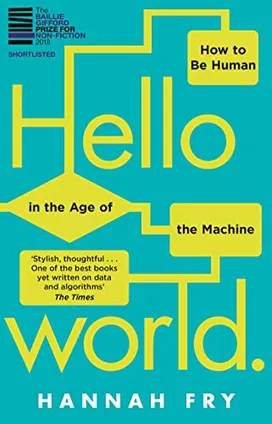
Hello World
by Hannah Fry
Started 15 March 2023 · 256 pages
A mathematician explains the algorithms now making decisions in justice, medicine, cars and art, and asks how humans and machines should work together.
About the book, from Open Library. Get the book.
8 highlights · page in the margin
- p. 3
GPS was invented to launch nuclear missiles and now helps deliver pizzas.
- p. 7
algorithm (noun): A step-by-step procedure for solving a problem or accomplishing some end especially by a computer.
- p. 12
Although AI has come on in leaps and bounds of late, it is still only ‘intelligent’ in the narrowest sense of the word. It would probably be more useful to think of what we’ve been through as a revolution in computational statistics than a revolution in intelligence.
- p. 15
given how much of our information we now get from algorithms like search engines, is how much agency people believed they had in their own opinions: ‘When people are unaware they are being manipulated, they tend to believe they have adopted their new thinking voluntarily,’ Epstein wrote in the original paper.
- p. 20
If there’s anything we can learn from this story, it’s that the human element does seem to be a critical part of the process: that having a person with the power of veto in a position to review the suggestions of an algorithm before a decision is made is the only sensible way to avoid mistakes.
- p. 21
Meehl systematically compared the performance of humans and algorithms on a whole variety of subjects – predicting everything from students’ grades to patients’ mental health outcomes – and concluded that mathematical algorithms, no matter how simple, will almost always make better predictions than people.
- p. 22
It’s like the saying among airline pilots that the best flying team has three components: a pilot, a computer and a dog. The computer is there to fly the plane, the pilot is there to feed the dog. And the dog is there to bite the human if it tries to touch the computer.
- p. 23
algorithm aversion. People are less tolerant of an algorithm’s mistakes than of their own – even if their own mistakes are bigger.