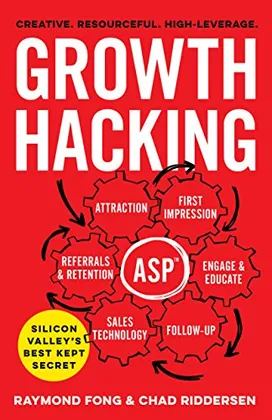
Growth Hacking
by Raymond Fong and Chad Riddersen
Started 13 July 2020 · 204 pages
A short introduction to growth hacking: using cheap, creative and data-driven experiments to find customers and grow a startup quickly.
About the book, from Open Library. Get the book.
152 highlights · Kindle location in the margin
- 38
They have deconstructed the Silicon Valley playbook and built a framework, the Automated Sales Process™ (ASP™), for any business to replicate and experience Silicon Valley-style growth.
- 41
Growth hackers thrive in resource-constrained environments where money is tight and time is of the essence.
- 48
the vast majority of companies died off or became zombies (dead, but still hobbling along).
- 49
What Chad recognized was an emerging pattern that differentiated the successful, rocket-growth companies from the crash-and-burn failures. That pattern was an emphasis on “growth hacking,” a term first coined by Sean Ellis in 2010
- 52
Distilled down to its core, the mind-set is a singular unrelenting focus on growth.
- 82
Dropbox, the cloud storage company mentioned previously that Sean Ellis was from, cleverly implemented a double-sided incentivized referral program. When you referred a friend, not only did you get more free storage, but your friend got free storage as well (this is called an “in-kind” referral program).
- 93
One key takeaway is that a creative and compelling referral program can not only fuel growth but also generate press.
- 121
You embrace change and are motivated by the pursuit of happiness and, ultimately, freedom. Your path to freedom is to learn how to hack growth; your path to learning how to hack growth is through the collective knowledge of those who have hacked growth before you;
- 138
As a savvy and self-aware business owner, accept that you will never have X extra money or free time. Your competitive advantage will come from your ability to intelligently reallocate your scarce resources to achieve breakthrough growth.
- 146
While it may appear on the outside that Silicon Valley’s fastest-growing companies achieve growth by having a “really good idea,” there are plenty of companies that have great ideas and fail. What differentiates the fastest-growing companies from their peers is that they’re not afraid to invest a massive amount of resources on growth.
- 149
We analyzed the ten tech companies worth over a billion dollars that went public in 2014 and 2015, and the average company spent a jaw-dropping $0.72 on sales and marketing for every $1.00 of sales during the three-year hypergrowth period before going public. As a matter of fact, one of the companies, Box, spent $1.59 for every $1.00 in sales!
- 170
what one thing, if done today, will make all other things easier or irrelevant?
- 203
The single, most limiting core belief we rewire for business owners is the false hope that “if I provide an excellent product and service to the market, everything else will take care of itself.”
- 208
In an environment with no competition, when there was only one business in town that did X, if you did X, customers had to come to you. But you are now operating in a hypercompetitive market with plenty of companies that provide competing solutions. In order to be found first, you need to market yourself.
- 212
What motivates you to grow your business? The surface-level motivator is likely financial, but money, by definition, is simply an instrument used to store value. We want you to go one level deeper and identify what you intend to exchange that store of value for.
- 221
The personal “why that makes you cry” is the subconscious fuel for your soul that is essential for your long-term success.
- 223
one of the best motivational growth hacks is to establish a “why that makes you cry” on a personal and professional level. You already established your personal motivation. On a professional level, how does the product or service you provide add value to the people you provide it for?
- 255
Think of an ASP™ as a digital replica of the perfect salesperson. The perfect salesperson will naturally attract prospects, set a polished first impression, keep prospects engaged as well as educate them, follow up with them at just the right time and handle any objections with expert salesmanship, skillfully close the sale while simultaneously looking for upsell opportunities, and get referrals while retaining them as customers for life.
- 267
Attraction is the means of getting attention for your products and services.
- 268
Each offline channel has an online parallel: TV = YouTube, print = website display ad, radio = online radio, word-of-mouth marketing = social media sharing.
- 271
The Attraction component works to eliminate marketing resource waste by quickly parsing through unqualified, cold-market prospects and pulling out prospects that are qualified for your product or service with targeted advertising.
- 274
In the chapter dedicated to Attraction, we will detail the unique benefits that online marketing possesses: analytics, attribution, and automation.
- 277
Once you’ve attracted your qualified prospects, you want to ensure that you make a good first impression by giving your prospects a consistent, personalized, and professional experience.
- 279
In an online world, your first impression is established when someone visits your website or stumbles upon your presence on social media.
- 280
The aim of the First Impression component is to turn your qualified prospects acquired via the Attraction component into brand-acquainted and intrigued prospects.
- 284
When you’ve made a favorable impression on your potential client, the next step of the ASP™ is to engage and educate that potential client about your product or service.
- 285
In the offline world, there are subtle psychological tricks that influence visitors to take specific actions. For example, a warmly lit and Wi-Fi enabled lounge area at your local coffee shop encourages you to stay until your stomach begins to grumble and you find yourself buying an overpriced muffin you passed on when you first purchased your latte.
- 287
In an online environment, there is an equal amount of subtle psychological tricks that will encourage your visitors to take certain sales-producing actions.
- 292
In even the most scientifically designed subconscious sales system, the vast majority of visitors will not purchase from you immediately. The path to real riches rests in the follow-up. In the offline world, follow-up activities range from phone calls to mailing lists, but these are often forgotten or neglected because they take a significant amount of time, money, and attention. The online follow-up environment has a set-it-and-forget-it quality that makes it sustainable and incredibly lucrative.
- 298
In the Follow-Up chapter you will discover a personalized, nonintrusive, and automated way of continuing a dialogue with your prospects that ensures that when they’re ready to buy, they think of you first.
- 300
When your prospect is ready to buy, it’s your role to move them through a frictionless sales experience that shepherds them smoothly to the point of purchase.
- 308
Once you have closed the sale, as you know, the sales process is not over. The final step is to ask for referrals and retain that customer for life.
- 310
In the online world, your business card can be replaced by a prepopulated social media post, and a gift can be credited instantaneously to your happy customer’s account the moment one of his or her friends becomes a customer. The reach and instant gratification that technology generates is unparalleled.
- 313
The Referrals & Retention component influences one-off customers into becoming happy, repeat, and referring customers.
- 323
You’ve read tip-of-the-day business articles proclaiming that “you need to start using negative keywords to optimize your AdWords spend.”
- 332
ASP™ is purposefully designed as a mental model to empower you to hack through all the tactic-filled noise and focus on implementing the strategic signal.
- 367
What differentiates attracting prospects online versus offline is the availability and abundance of data. Data creates a feedback loop for your marketing to help you continually fine-tune what you say, how you say it, and where you say it.
- 374
Not only can you serve the ad to someone who possesses the exact characteristics of your ideal buyer, but you can track the specific ad that person clicked on to go to your website, review the webpages he viewed, and determine whether or not he decided to purchase from you. This immediate attribution and feedback loop of online advertising empowers you to know which half of your advertising is wasted so you may eliminate the waste.
- 377
Another key data-enabled difference between online and offline advertising is the ability to start small and scale up. For a couple dollars per day, you can start running ads online with the freedom to cease any time you please.
- 380
When you identify an online ad that is producing buyers, you can quickly scale it up as the ad inventory is available on demand.
- 382
The opportunity to start small and scale quickly is one of the founding principles of the growth-hacking gospel and the reason why online advertising is such a uniquely powerful medium.
- 397
In an online advertising environment, maximizing exclusively for reach will get you into trouble. Online, you need to optimize for precision, identifying the exact audience you want to market to. This process starts with identifying your “avatar.”
- 410
Avatar Formation Questions What gender is your ideal buyer? How old is he or she? What’s his or her profession? What’s his or her annual income? Where does he or she live? Is he or she married? Does he or she have kids? What are his or her hobbies? What are his or her interests?
- 416
A popular Silicon Valley advertising mantra is that demographics don’t buy products; people do. Your avatar is the digital representation of that person that all marketing should cater to.
- 418
A free tool you can use to define your avatar is Facebook’s Audience Insights. You can input look-a-like audiences such as people who liked a competitor’s page, liked the page of a specific interest group, or demonstrated interests relevant to your offer. Facebook Audience Insights will then show you that specific audience’s shopping behavior, educational background, relationship status, and a number of intimate details that will help you develop a high-quality avatar.
- 421
Once you have established your avatar, the next step is to determine when, where, and how to reach those ideal buyers. The determination is as easy as putting yourself in your avatar’s shoes, but there are several slippery slopes and sand traps that you need to watch out for.
- 424
Regarding when, focus first on when your avatar is in a buying mood or most likely to take a buying action. One of the clearest indicators of buying action is the keywords the avatar uses when performing an online search. Continuing with the roofing contractor example, we didn’t advertise to everyone who was searching for “roofing” online, but we focused on people searching for terms such as “new roof,” “fix a roof leak,” “roofing contractor.” These terms signify that the person is in a position to spend money on hiring a roofing contractor.
- 428
Once we exhausted the ad inventory with purchase intent, we expanded to people considering investing in a solution but who need more information before deciding. For example, many people search for things like “What are the benefits of a composite roof?” Although their search doesn’t indicate immediate purchase intent, when exposed to the rest of the ASP™, we can lead them to a purchase decision.
- 431
Once we exhausted the ad inventory with education interest, we expanded to folks who are aware of their problem but may not be in a position to actively solve that problem. For example, we served display ads to homeowners on Facebook touting the benefits of having your roof inspected before the rainy season.
- 433
In summary, focus on purchase intent, then education-based interest, and then awareness-based interest when reaching out to your avatar.
- 434
Regarding where, focus on where your avatar spends time. Once you have clearly defined your avatar, this should be a much easier exercise.
- 441
Whether you determine where your avatar spends time by intuition or analysis, the where will feed into your determination of how to reach your avatar.
- 445
As a growth hacker, we recommend that you start with something simple, affordable, and quick to implement, such as text, in order to get an understanding of what works.
- 448
In summary, start simple and then embrace complexity.
- 456
Attraction from search platforms is when somebody finds you from a search engine.
- 457
Searches come in three varieties: searches for your brand, searches for a service you provide, and searches for information. There are two ways you can show up when people search: organically or by paid placement. You can improve your organic ranking through search engine optimization (SEO). You can get paid placement through pay-per-click (PPC) advertising. While SEO and PPC tactics come and go, the one thing you can count on is change.
- 462
Attraction from branding platforms is when somebody finds you on social media or other platforms where your company can be reviewed or talked about.
- 465
The common thread is that branding platforms are designed to facilitate conversation around your brand. You can choose to be proactive and control the conversation, or you can be reactive and respond to the conversation. Unfortunately, what you cannot do is ignore branding platforms, because the conversation about your brand will happen with or without your involvement. We advise being proactive on the branding platform that your avatar spends the most time on, as well as the one that is most likely to lead to a buying action. For all other platforms, we recommend being reactive, responding appropriately but not ignoring them.
- 469
Attraction from “other” sources is primarily traffic from news sites and partner sites. If you run any online ads outside search, the ads will get served on a variety of news publications and blogs.
- 476
one Shark Tank client has an article that is three years old that is still responsible for 5 percent of all monthly website visitors. What makes online so much easier to land than offline is that the cost to publish can be zero dollars, whereas offline methods have a massive cost structure. If you spoon-feed an online publication unique and original content, the likelihood of getting published is exceptionally high compared to giving the same information to an offline publication.
- 483
Take stock of where you are currently getting traffic from online. It’s more than likely that one category will be much smaller than the others. Once you have identified the soft spot, you can focus your energy on tactics that will strengthen that category. Prioritizing the activities that will strengthen an Attraction category weakness is a helpful way of identifying your highest return-on-investment (ROI) use of resources.
- 486
One of the frameworks we developed to identify high-ROI Attraction opportunities was the advertising arbitrage framework. The high-level concept is to seek advertising opportunities where advertising inventory supply outpaces advertiser demand. Fundamentally, this will occur when an advertising channel is growing extraordinarily fast (a supply increase), or when an advertising channel is quickly going out of favor (a demand decrease).
- 490
As of this writing, an example of a supply-increase advertising arbitrage opportunity is YouTube. More than a billion people visit YouTube every month, it has more reach than any cable network on earth, and the numbers continue to grow at an enormous rate. Most businesses are too lazy or don’t have the resources to create video ads, so advertising supply massively outpaces advertiser demand. Given that Google owns YouTube, there is an insane amount of ad targetability, and you can start getting your ad viewed by your ideal buyer for pennies.
- 499
One of the strategies we employ to create incredibly cost-efficient advertising opportunities is to connect content creation with commerce.
- 503
Brian has replicated this strategy multiple times by pairing Kim Kardashian with ShoeDazzle and Jessica Alba with Honest Company.
- 510
if you run a local roofing company, an endorsement from a local meteorologist could provide significant differentiation from your competitors at a modest price. When executing this strategy, focus on content creators whose audience overlaps with those you are trying to reach. Once you achieve high overlap, approach with a win-win proposition that is more than just a financial transaction. For example, mentioning where and how you intend to promote an endorsement gets folks excited, as that will help them expand their reach and fame (it’s “free” advertising for their personal brand).
- 514
As it relates to the financial structure of an endorsement, focus on aligning interest and protecting downside. Interest alignment includes things like revenue and equity share and will offset your out-of-pocket expenses. Downside protection is achieved by mitigating upfront costs and commitments.
- 544
Without spending a dollar more on marketing, how can you acquire the most customers in the least time?
- 547
Given that you are starting without the resource of money, you can reduce the scope of potential solutions to those that only consume the resource of time. As a growth hacker, your initial assessment is to look at how your organization is already spending time and identify opportunities where your time spent could benefit someone in a different industry, who then may be inclined to reciprocate. For example, if your sales force is already spending time talking to a customer about your product, is there a complementary product you could offer or refer your leads to?
- 568
The domino theory of growth hacking states that small wins beget progressively larger wins. Your job as a growth hacker is to identify the lead domino, the first tactic to implement, and line up the subsequent dominoes in ascending level of achievability on a path that leads you to your ultimate goal.
- 589
Despite Mr. Wonderful criticizing the product, there were still some people that purchased. These were the true fans and became the basis for our avatar.
- 590
Once we had a clearly defined avatar, we studied the ideal buyers’ every online behavior. We sought answers for a variety of questions such as “What did they search for?” “What websites did they frequent?” and “What forums did they contribute to?”
- 634
Online, your storefront or office is your website. Visitors draw conclusions based on a million little things, such as whether your website loads quickly, how polished your web design appears, and whether you own a .com domain.
- 661
When it comes to the preservation of resources, a fast-follow strategy is consistently superior to a first-mover strategy, particularly pertaining to your first impression. The trick is to figure out whom to follow.
- 670
As a general rule, a fast-follow technology adoption strategy mitigates the risk of losing money while maximizing the duration of enjoying a return on investment.
- 680
In the technology hotbed of Silicon Valley, the accrued liability caused by delaying innovation has its own term: “technical debt.”
- 709
Our client, expecting he was going to get direct phone calls from the TV ad, not web traffic, had neglected to fix his First Impression that hadn’t been touched for years and wasn’t even mobile-friendly. The dilapidated First Impression stopped the wealthy prospects in their tracks and prompted them to look elsewhere.
- 732
Engage and patiently educate your prospects so they have all the information they need to comfortably buy from you.
- 751
We focused the last remaining resources on a complete overhaul of their Engage & Educate component.
- 754
three ancient modes of persuasion that were famously first introduced by Aristotle more than 2,400 years ago.
- 758
Appeals to ethos are persuasive tactics that build your credibility—for example, a marquee client or an impressive press mention. Appeals to pathos are persuasive tactics that appeal to your audience’s emotion—for example, a stunning photo or a captivating client testimonial. Appeals to logos are persuasive tactics that are supported by logic—for example, facts and figures, and features and benefits.
- 763
Most businesses aimlessly communicate with no purpose or intention, hoping that eventually they will say something that resonates and results in a purchase. A growth hacker uses crystal-clear communication that is strategically designed to engage, educate, and ultimately sell. When all components of Engage & Educate are implemented, the persuasive effects will be so powerful that your growth rate will seem propelled by a magical force.
- 766
The heart and soul of your communication is rooted in Aristotle’s rhetorical framework.
- 777
Nine Modern Modalities of Engage & Educate Trust Building Branding Unique Selling Proposition Headline Feature-Benefits Copywriting Social Proof Frequently Asked Questions (FAQs) Call-to-Action
- 781
Before someone starts reading and engaging with your content, there is a three-second period of suspense where the aesthetics (ethos) and general feeling (pathos) of your site signal to your visitor whether or not to continue on. Passing the “three-second test” is a reflection of your ability to subconsciously convey that you are someone that can be trusted to provide what the visitor is looking for.
- 786
A few user tests or an examination of the bounce rate (the percentage of people that leave your site versus continue on to another page) and overall time spent on your site will give you a general sense for whether you are passing the three-second test.
- 793
Brand Basics Logo: vertical + horizontal + color + black on white + white on black + iconized Colors: a three- or five-color spectrum Typography: headline fonts as well as a reading-style font Voice: a set of rules for writing produced by the brand
- 797
As long as you establish the basics, and you use them consistently, you will be fine. The value of having a brand is that people will know it’s you before you tell them it’s you. For example, if someone sees your ad and then comes to your website, and the website has the same style as the ad, then he will immediately know he is in the right place.
- 800
Your unique selling proposition (USP), also referred to as your “unique selling point” and synonymous with your “unique value proposition” (UVP), is a succinct summation of how your company is different from your competitors.
- 805
Many companies are wary of advertising points of differentiation for fear of alienating an audience and missing out on a potential sale. However, in an attempt to be all things to all people, you end up being nothing to everybody. A clear and effective USP will convey credibility (ethos) and subconsciously tap into the emotional desire of your avatar (pathos).
- 814
Instant-Clarity Headline Formulas [What You Do] + [What Makes You Unique] + [Geographic Reach] Residential & Commercial Roofing Since 1929 Serving Los Angeles and Surrounding Area [End Result the Customer Wants] + [Specific Period of Time] + [Address the Objections] Example: Hot Fresh Pizza Delivered to Your Door in Thirty Minutes or It’s Free
- 831
To support the content conveyed in the headline and appeal to those that respond to logic, the crafting of clear “feature-benefits” is a core characteristic of the Engage & Educate component of the ASP™.
- 834
Feature-Benefits [What Something Is] + [What Something Does] Example (Apple’s iPod): 1GB of MP3s that puts 1,000s of Songs in Your Pocket
- 836
Given the gravity of importance associated with feature-benefits, it often is helpful to attach a visual icon to complement each…
- 839
Most individuals struggle tying features to tangible, emotion-inducing benefits. A simple trick to determine whether you’ve crafted a compelling feature-benefit is the “So what?” test. After every feature ask the question, “So what?”…
- 845
Copywriting is the art and skill of writing in a manner that persuades and seduces your reader toward an action, viewpoint, opinion, or sale. A person that is an excellent writer may not necessarily be an excellent copywriter. An excellent copywriter requires an intimate understanding of the reader, your avatar. By understanding your avatar’s wants, needs, and desires, you can connect with her pain and pleasure points. It’s less about appealing to your avatar on an intellectual level with technical…
- 852
Once you have a sense for the types of words, phrases, questions, and comments your customers have, your next step is to adopt a writing prose that feels direct and personal. When writing customer-centric copy, avoid “we,” “my,” “us,” and “our”; instead, use “you” and “your.” Imagine talking to a single prospective customer about your business; that is the conversational…
- 859
Social proof, referred to as “informational social influence” among psychologists, states that we mimic the actions of others when we are unsure what to do. We are psychologically hardwired to conform to the…
- 861
The reason a toddler is going to want the exact same toy as their playmate, despite there being dozens of other perfectly good toys laying around, is that the toddler wants the one that is credibly…
- 863
Here are some examples of social proof: Endorsements (experts, celebrities) Client mentions (logos, testimonials) Partner mentions (logos, quotes) Press mentions (logos, quotes) Reviews Ratings Awards Social media…
- 866
The more uncertainty, the more conformity. In other words, the more competitive your market is, the more influence social proof will have. Then, the more social proof you have, the more influence you will have. The multiple-source effect is that when multiple different sources…
- 873
Frequently asked questions (FAQs) are your digital opportunity to handle objections, and you can do so in a way that captures your salesperson’s most eloquent rebuttal. It may appear counterintuitive to prompt questions that may not even be on the mind of your prospective customers, but the questions can be framed in a way that positions the product or service in a favorable light. For example, as opposed to saying, “Does your window-cleaning service kill birds?” you can frame the question as “How does Mr. Clean Window Company help birds steer clear from my sparkling clean windows?”
- 881
Structurally, we advise tucking your FAQs toward the bottom of the page, followed by a repeat of the primary call-to-action. The next section will give you more clarity around what we mean by “primary call-to-action.”
- 884
The term “call-to-action” is a hyphenated way of saying, “Tell people what to do next.” While you want to give prospects a breadth of options, you can subtly shepherd visitors to take a preferred action. As such, it’s important for you to identify the primary, secondary, tertiary, and so on calls-to-action prioritized based on what fits best with your operation and industry. Here are some examples of different calls-to-action: Book an…
- 889
The quantity of calls-to-action often depends on the size of your operations and nature of your business. A small- or medium-sized business might only have a primary and secondary call-to-action. There are diminished returns and additional…
- 891
Once you have prioritized your preferred calls-to-action, there are several tactics for influencing behavior so that people take action without even thinking about it (pathos). The primary call-to-action should be visible “above the fold”…
- 895
Putting the primary call-to-action in a button will add the visual queue that…
- 898
Button Copy Lead with a familiar verb (e.g., Get, Grab, Download, Start, Apply). Be specific (avoid only using a generic phrase like “Click Here”). Be clear about what happens next (you can add copy below the button to add clarity; e.g., “Step 1 of 3”). Don’t be afraid of long button text; adding pronouns (e.g., “my”), articles (e.g., “the”), and prepositions (e.g., “for”) can make you sound more human and friendly. Add a benefit.…
- 903
Button Design Contrast the color so it’s different than the other colors on the page (don’t worry, there is no “magic” color; just make it different). Make it “feel” clickable (add mouse hover effects…
- 906
On pages with larger amounts of content where you have to do some scrolling, it’s best practice to repeat the key…
- 914
The question we are often asked is, “Do I need every component on every page?” And the answer depends. The homepage, landing pages (specific webpages that you send targeted traffic to), and, to some extent, product pages benefit from maximizing the engagement and educational value.
- 920
The principle that is worth applying is that the best analytics tool is the one you actually use. At present, Google Analytics is free, powerful, and a staple tool for most websites. As you improve the Engage & Educate component of your ASP™, you will typically see average time spent on your site increase, bounce rate decrease, average pages viewed per visitor increase, and, if it all comes together correctly, conversion rate (ability to convert a visitor into a prospect and a paying customer) increase. Analytics can get very complicated, so if you only have time to track one number, track the conversion rate.
- 943
The page concluded with a direct appeal to logic (logos) with a visual and text-based reference to the various credibility components (e.g., certifications) of the products. An appeal to logic was intentionally placed lower on the page because visitors that make emotion-based decisions were more likely to click through much earlier, whereas visitors that make logic-based decisions were more likely to scroll through the whole page. The page finished with a repeat of the key call-to-action, go to the shop, so that the next step is perfectly clear.
- 985
With even the most engaging and educating online sales experience, on average, ninety-seven out of one hundred prospects aren’t going to take an immediate purchase action.
- 992
For example, you can use an autoresponder to send a series of emails addressed with the prospect’s first name that changes the message sequence and timing based on whether the prospect opened the prior email or clicked on a certain link.
- 1000
The Advertising Rule of 7 states that it takes approximately seven touch points for someone to be able to recall your brand.
- 1002
Miller’s Law states that the number of objects the average person can hold in working memory is 7 ± 2.
- 1013
The framework we advise is to map your Follow-Up to your average sales cycle length. In general, the larger the dollar value of your product or service, the longer the sales cycle, particularly for business-to-consumer sales. If, for example, you’ve observed it takes an average of four weeks for someone to purchase your service, build your Follow-Up around a four-week period of time.
- 1022
The differences in the amount of information you ask for from a prospect can be broadly categorized as high-barrier versus low-friction requests. A high-barrier request for information will ask for many pieces of information in an attempt to produce more qualified leads; the more you know about a lead, the more qualified that lead is. The understanding here is that the more serious a prospect is about purchasing your good or service, the more inclined he will be to give you information. For companies that are plagued with low-quality lead flow and are concerned about conserving sales resources, asking for more information is a good approach.
- 1030
A hybrid information-capture approach is to collect information during the follow-up process. For example, you can start with a low-friction name and email request and collect more lead intelligence as a prospect engages with your material through subsequent questionnaires.
- 1038
If you sell something that does not have a research phase, you can incentivize individuals with a discount. Regardless of the incentive or information you provide, a database of qualified prospects has significant tangible value.
- 1047
Prior to designing the follow-up sequence, it’s important to have a clear articulation of the brand voice. The voice is a set of rules for the writing produced by your brand and is a function of having an intimate understanding of your target audience. One can further assume that the individuals inclined to sign up to receive more follow-up information are going to be more responsive to logos-based (logic) rhetoric than the cohort of clients that make more pathos-based (emotion) decisions and purchase without needing to do deeper diligence.
- 1053
The 4 E’s of Copywriting Engaging: Is the content compelling and of interest to the reader? Educational: Is the content teaching the reader something relevant to your product or service? Entertaining: Would the reader enjoy reading your content? Emotional: Would your content stir up emotions inside your reader?
- 1062
Follow-Up Framework Opt-In: Offer a desirable bribe (also called a “hook” or “lead magnet”) in exchange for an email address (at a minimum). Hook Delivery: Deliver what was promised for the prospect opting in. Digital delivery can range from digital reports to emails to audio or video content. The benefit of digital delivery is that you can provide immediate gratification to your prospect and it’s free to send. Sellucation: Sellucation is selling through education. Each Follow-Up installment is an opportunity to address common questions, handle objections, and amplify the problem while presenting your solution. It’s education with the implicit intent of driving sales. Social Proof: Reiterating the social proof you presented in the Engage & Educate phase with testimonials, reviews, awards, partner logos, and case studies will enhance your credibility and build trust. Promotions: Offering free consultations, discounts, and other incentives can motivate your prospect to take action. Communicating an expiration associated with the promotion can create a sense of urgency that further persuades prospects to move forward.
- 1073
Going back to our illustrative sample of one hundred website visitors, you may get three individuals to make a direct purchase and another three to opt in for your lead magnet and potentially purchase from you at a later date.
- 1076
there is a way for you to stay in front of all your website visitors, even if they didn’t give you their contact information. The way you stay in front of all your website visitors is with an advertising method called “retargeting” (also called “remarketing”).
- 1080
The way retargeting works is by identifying and remembering users, through their web browsers, who have visited your website and serving ads to those users as they browse other places on the web. Whether they’re perusing a social media site or reading their favorite blog, retargeting allows you to target your ads specifically to people that have previously visited your website. This is powerful because it allows you to market specifically to individuals who have shown interest in your specific product or service and your brand.
- 1085
Going back to the Advertising Rule of 7, retargeting ads are the key difference makers between someone remembering your brand and forgetting. The first brand impression may be a pay-per-click ad, the second brand impression would then be your website, and impressions three through seven would be from retargeting ads.
- 1090
Categorically, we make two main differentiations in retargeting ad units: brand-based and direct-response ad units. Intuitively, brand-based ad units convey your overall brand or company, and direct-response ad units focus on a specific product or service. Starting out, we advise launching brand-based ad units and retargeting visitors that visit any page of your website. If you only offer a singular product or service, then you may be able to experiment with direct-response style ads targeted to all visitors.
- 1166
For example, if a purchase requires an in-person consultation, there are online tools that sync to your calendar in real-time to enable prospects to book a consultation even if they’re perusing your site at 2:00 a.m. on a Saturday.
- 1169
If you are unable to provide an immediate estimate, there are tools for providing video-proposal walk-throughs that alert you when your prospect is engaging as well as tools for facilitating immediate digital-contract execution.
- 1187
For example, an inbound email from a new prospect can trigger an automatic entry into a spreadsheet that logs all your leads.
- 1201
But the Rolodex analogy hardly does the modern CRM justice, as CRMs do far more than just house client information. The modern CRM aggregates data across the multitude of client-acquisition tools and Sales Technology tools and brings the right information to light at the right time in ways that are often fully automated.
- 1266
The difference between an active referral system and a passive referral system is often the singular difference between a static company and a high-growth company.
- 1283
When LTV is greater than the customer acquisition cost (CAC), you can justify spending a lot of money on sales and marketing.
- 1286
For many of the businesses we work with, it’s a better use of resources to sell more goods and services to an existing customer than to go out and acquire a new customer.
- 1288
To use that same roofing company as an example, adding a simple maintenance program or adding a solar installation service can dramatically increase the lifetime customer value, which in turn allows the roofing business to justify spending more money on customer acquisition. This opens up new channels that their roofing-only competitors simply can’t afford since their LTV would be less than their CAC.
- 1291
Testimonials are a key piece of social proof that feeds the Engage & Educate and Follow-Up components of the ASP™. Given that testimonials can provide valuable insight into what is going well with your product or service, it is best practice to make testimonial requests a permanent part of your sales process. In certain industries where price is negotiable, you can make a practice of providing a “success story” discount in exchange for giving the testimonial. This implies that they will be a noteworthy success and primes them for providing a positive review.
- 1297
Testimonial Formula [Specific End Result or Benefit the Customer Received] + [Specific Period of Time] + [Accompanied Customer Emotion] + [Customer Name with Relevant Stats] Example: I was craving a Hawaiian style pizza at one in the morning and was stoked when it arrived just twenty minutes after I called! ~Chad R., Pasadena, CA
- 1304
Testimonial Questions What were you looking for when you found [COMPANY]? What compelled you to choose [COMPANY] over others? What results did you get from working with [COMPANY]? When [COMPANY] [COMPLETED SOLUTION], what did you like most about the experience? Who else would you recommend [COMPANY] to?
- 1309
To some extent you can attempt to preempt negative commentary through satisfaction surveys and other internal feedback forms, but it’s impossible to ward off all negativity.
- 1337
For industries that sell higher dollar-value discretionary purchases that have an element of luxury or leisure, you will often see special interest clubs and events used to foster a community and lifestyle around the brand.
- 1340
Self-contained forums have evolved into social media groups, and we are often asked what format we recommend. The first recommendation is that we advise selecting only one format because having multiple formats multiplies your work at the expense of the community quality. The second recommendation is to select a social platform where your audience is already spending time. If or when your selected social platform falls out of favor, we advise porting that community to a forum you control on your website, assuming you have developed a critical mass of followers, so you don’t have to keep porting your audience every time social-platform preferences change.
- 1346
Certain questions can be sales opportunities in disguise. For example, a question after a residential roofing project could be, “Were you aware of our discounted roofing maintenance programs that automatically extend the satisfaction guarantee on your new roof?”
- 1373
In general, an in-kind referral system is a superior choice, as your cost of providing the good or service is presumably less than the perceived value. This was the core takeaway from the Dropbox case study in the Introduction. One additional characteristic that Dropbox had that made it more effective was dualistic incentives, meaning that both the giver and the recipient derived a benefit. Both in-kind and financial incentive systems can employ this same dualistic tactic.
- 1378
In transactions with large organizations that have committee-based decisions or industries where financial incentives are restricted, a charitable donation provides an incentive at arm’s reach that can be a sufficient motivator to make a referral.
- 1380
One system that doesn’t fit in either the in-kind or financial incentive categories that can have a dramatic effect is referrals as a condition of doing business. In other words, there is no incentive besides the client getting the privilege of working with you. Referrals as a condition of doing business work well when you truly have a well-differentiated offering and are requested with absolute conviction.
- 1385
Refer unfit prospects to your competition. In many industries, there is a market dynamic where a significant amount of resources are spent on lead acquisition but a large percentage of those leads are not fit for your particular product or service. In such markets, the unfit leads represent a massive monetizable opportunity. For example, a client of ours builds multimillion-dollar custom homes in a specific set of neighborhoods in Los Angeles. When he gets leads that are looking to build a home less than one million dollars, he refers them to a quasi competitor who builds smaller custom homes in exchange for a commission pay. The referral fee he earns is essentially 100 percent margin and is effectively “free money.”
- 1392
Such a situation would have been a professional embarrassment for the founders who left senior positions
- 1404
Applying our nightclub knowledge to a boutique childcare facility resulted in an initial assessment of the moments of peak happiness. The two moments were right when the child is accepted into the program and a few months postenrollment when the child has developed his or her first tangible skill.
- 1406
The euphoria of the first moment was amplified by creating a stronger sense of acceptance scarcity and competition, just like the arbitrary line queue outside a nightclub. This set the stage for the second moment of peak happiness, which was accompanied by an automated email that went out asking if there were any other parents they knew of that would benefit from the same phenomenal experience their child was receiving.
- 1451
As the saying goes, begin with the end in mind. The end for you is a high-margin, sustainably growing business that is spitting out cash like a jackpot-winning slot machine in Las Vegas. This machine is built with your own hands, your own ingenuity, and it serves as a perpetually productive fountain of freedom.