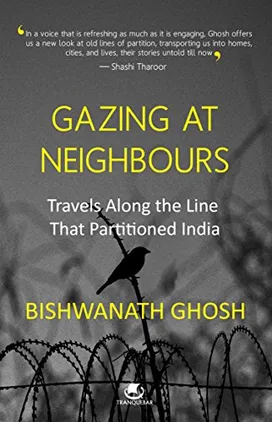
Gazing at Neighbours
by Bishwanath Ghosh
Started 21 December 2019 · 356 pages
A journey along the borders drawn at Partition, through towns in India that sit close to Pakistan and Bangladesh, and the lives and memories shaped by those lines.
About the book, from Open Library. Get the book.
27 highlights · Kindle location in the margin
- 814
I exited Jallianwala Bagh thinking people with guns often decide the destiny of people without guns, people with money often decide the destiny of people without money, and people having both, money and the best guns, often decide the destiny of an entire nation—even nations. Though once in a while, there comes a time when such people are put in their place by those who may not have the money or the best guns but who have something else: courage.
- 888
I couldn’t help but marvel at Sikhism: the most practical, pragmatic, and progressive of religions, built on selfless service and sacrifice. And yet, being a Sikh has never been easy.
- 1114
I have often wondered how Bhagat Singh, if he had lived, would have reacted to Partition: he would have been only forty at the time. What if he got to watch the events unfold from a gallery up in Heaven: to see India no longer fighting the British but a new nation carved out of it called Pakistan, and some of the pitched battles taking place on the very site of his cremation?
- 1143
It wouldn’t have evoked such curiosity in the year, say, 1931, when there was just one Punjab, a prosperous province in British India, its capital city being Lahore, the most progressive Indian city at the time, where Bhagat Singh and his two comrades were hanged in its central prison.
- 1211
For that matter, the next morning, when India celebrated its Independence Day, schools across the country would reverberate with Saare jahaan se achchha—composed by Muhammad Iqbal who, as the president of the Muslim League, had sowed the seed of Pakistan.
- 1278
Though after over two decades in journalism I have come to the conclusion that more often it is the cops who charm reporters into buying the stories they spin.
- 1315
This sort of a thing, it struck me, is quite common in the subcontinent: people going to the shrines of other religions in times of personal crisis—illness, unemployment, infertility. It need not necessarily mean that they have abandoned their own gods; it’s just that they are temporarily expanding their faith to include other gods as well, in the desperate hope that at least one god will listen.
- 1372
Guru Nanak was born in 1469 in a village called Rai Bhoi Ki Talvandi, 65 km southwest of Lahore. When he was in his late twenties, already married with two sons, he set out on a series of spiritual journeys through India, Arabia, and Tibet that lasted about thirty years. He preached that there was only one God, and that all human beings could have direct access to God with no need of rituals or priests, and that everyone was equal, regardless of caste or gender.
- 1452
‘India has already gone to the dogs. Look at Britain, where law is law, nobody can break it. But in India, the powerful people always manipulate laws, turning the truth into lies and lies into truth. Nice meeting you.’
- 1470
I handed back the binoculars to the elderly woman I had taken it from: she now had tears in her eyes and wanted to have one more look at the spot where Guru Nanak had died. For her it was a case of being so near and yet so far—the obstacle being the Radcliffe Line that ran between the gurdwara and the platform where we stood now.
- 1676
It is here in Wagah—where you get to compare India with Pakistan first hand on the basis of the appearance of their people—that you realize the diversity of India. People occupying the Indian galleries belonged to different races and religions, spoke different languages, wore different attires and yet were cohesively bound together by an identity called Indian. The Pakistani side, on the other hand, represented sameness.
- 1731
Now that’s something most spectators do not realize: that the Indians and Pakistanis actually spend hours practising together to look like enemies at sunset.
- 1777
The Ganga, on the other hand, reeks of superstition: people treat the river as a drain carrying all their sins. The Ganga stands for blind belief, the pool of nectar stands for blind devotion. There is a big difference between belief and devotion: belief can change, devotion doesn’t.
- 1995
Only when you find yourself in the midst of the countryside do you realize how small our cities are—and how small the minds of people living in it are. I had thought Bashar Sheikh was seeking a free ride back home, whereas he was actually doing me a great favour by coming along.
- 2153
Same people, same culture, same religion, same customs, same sources of joy and suffering—yet an imaginary line dividing them into two nations. How cruel and meaningless.
- 2171
I felt sad and angry. It is always the poor who are the worst sufferers of calamities—natural or manmade. At the same time, I found it heartening that the BSF usually turned a blind eye to such harmless violation of the Radcliffe Line: it was the victory of humanity over hostility.
- 2307
Tripura means the land of the Tripuri, a tribe that traces its origins to western China and today is distinguishable by the surnames Deb and Deb Barma, conferred to them by their king. The ruling family used the surname Deb Barman, also written as Dev Burman.
- 2679
Out of Sheer Rage,
- 2679
Geoff Dyer,
- 2715
Albert Camus’s The Outsider?’
- 2727
Had religion been such a strong adhesive, Bangladesh would have never separated from Pakistan. Culture is one’s truest identity, nationality a mere technicality—something that the people who were partitioned understand far better than those who weren’t.
- 2796
me: the son disapproved of those supporting Bangladesh, whereas the father loved Bangladesh; the son was born some forty years after Partition, whereas his father had been a direct victim of it.
- 3094
‘Smuggling happens in places where people on both sides of the border are of the same ethnicity.
- 3205
the celebrated Beat poet Allen Ginsberg, after visiting the refugee camps lining the road, wrote a lengthy, heart-rending poem titled September on Jessore Road,
- 3321
Jingoism, naturally, is a bigger crowd-puller.
- 3338
W.H. Auden’s 1966 poem Partition,
- 3715
India Wins Freedom (‘The Complete Version’) by Maulana Abul Kalam Azad,