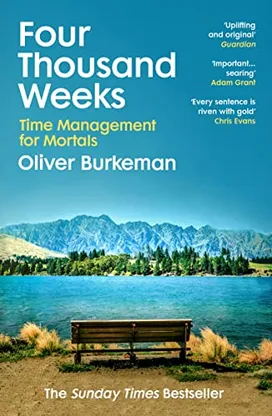
Four Thousand Weeks
by Oliver Burkeman
Started 3 December 2021 · 280 pages
Productivity advice turned around: an average life lasts about four thousand weeks, so the question is not how to get everything done but what to choose, what to neglect and how to accept our limits.
About the book, from Open Library. Get the book.
16 highlights · Kindle location in the margin
- 234
‘This space that has been granted to us rushes by so speedily and so swiftly that all save a very few find life at an end just when they are getting ready to live,’ lamented Seneca, the Roman philosopher, in a letter known today under the title On the Shortness of Life.
- 265
Take the daily battle against online distraction, and the alarming sense that our attention spans have shrivelled to such a degree that even those of us who were bookworms as children now struggle to make it through a paragraph without experiencing the urge to reach for our phones.
- 268
perhaps your problem isn’t being too busy but insufficiently busy, languishing in a dull job, or not employed at all. That’s still a situation made far more distressing by the shortness of life, because you’re using up your limited time in a way you’d rather not.
- 275
Then there are all those timeless human dilemmas like whom to marry, whether to have children, and what kind of work to pursue.
- 310
life accelerates, and everyone grows more impatient. It’s somehow vastly more aggravating to wait two minutes for the microwave than two hours for the oven – or ten seconds for a slow-loading web page versus three days to receive the same information by post.
- 321
In 1930, in a speech titled ‘Economic Possibilities for Our Grandchildren’, the economist John Maynard Keynes made a famous prediction: within a century, thanks to the growth of wealth and the advance of technology, no one would have to work more than about fifteen hours a week. The challenge would be how to fill all our new-found leisure time without going crazy. ‘For the first time since his creation,’ Keynes told his audience, ‘man will be faced with his real, his permanent problem – how to use his freedom from pressing economic cares.’
- 326
Keynes was wrong. It turns out that when people make enough money to meet their needs, they just find new things to need and new lifestyles to aspire to; they never quite manage to keep up with the Joneses, because whenever they’re in danger of getting close, they nominate new and better Joneses with whom to try to keep up.
- 329
for almost the whole of history, the entire point of being rich was not having to work so much.
- 350
the essayist Marilynne Robinson, who observes that many of us spend our lives ‘preparing ourselves and our children to be means to inscrutable ends that are utterly not our own’.
- 359
Productivity is a trap. Becoming more efficient just makes you more rushed, and trying to clear the decks simply makes them fill up again faster.
- 393
we’re like the proverbial fish who have no idea what water is, because it surrounds them completely.
- 410
There was no anxious pressure to ‘get everything done’, either, because a farmer’s work is infinite: there will always be another milking and another harvest, forever, so there’s no sense in racing towards some hypothetical moment of completion. Historians call this way of living ‘task orientation’, because the rhythms of life emerge organically from the tasks themselves, rather than from being lined up against an abstract timeline, the approach that has become second nature for us today.
- 450
The Industrial Revolution is usually attributed to the invention of the steam engine; but as Mumford shows in his 1934 magnum opus, Technics and Civilization, it also probably couldn’t have happened without the clock. By the late 1700s, rural peasants were streaming into English cities, taking jobs in mills and factories, each of which required the coordination of hundreds of people, working fixed hours, often six days a week, to keep the machines running.
- 467
Once time is a resource to be used, you start to feel pressure, whether from external forces or from yourself, to use it well, and to berate yourself when you feel you’ve wasted it.
- 491
The trouble with attempting to master your time, it turns out, is that time ends up mastering you.
- 510
I would never succeed in marshalling enough efficiency, self-discipline and effort to force my way through to the feeling that I was on top of everything, that I was fulfilling all my obligations and had no need to worry about the future. Ironically, the realisation that this had been a useless strategy for attaining peace of mind brought me some immediate peace of mind.