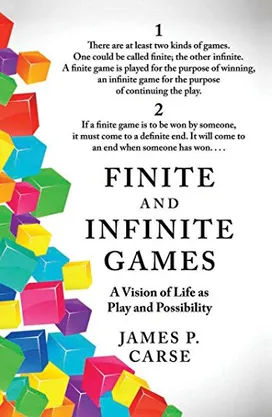
Finite and Infinite Games
by James P. Carse
Started 26 November 2020 · 152 pages
A philosophical meditation on two kinds of play: finite games, played to win, and infinite games, played to keep the game going, and what each means for how we live.
About the book, from Open Library. Get the book.
26 highlights · page in the margin
- p. 3
A finite game is played for the purpose of winning, an infinite game for the purpose of continuing the play.
- p. 3
We know that someone has won the game when all the players have agreed who among them is the winner. No other condition than the agreement of the players is absolutely required in determining who has won the game.
- p. 4
It is an invariable principle of all play, finite and infinite, that whoever plays, plays freely. Whoever must play, cannot play.
- p. 4
Just as it is essential for a finite game to have a definitive ending, it must also have a precise beginning. Therefore, we can speak of finite games as having temporal boundaries—to which, of course, all players must agree. But players must agree to the establishment of spatial and numerical boundaries as well. That is, the game must be played within a marked area, and with specified players.
- p. 5
Numerical boundaries take many forms but are always applied in finite games. Persons are selected for finite play. It is the case that we cannot play if we must play, but it is also the case that we cannot play alone. Thus, in every case, we must find an opponent, and in most cases teammates, who are willing to join in play with us.
- p. 6
Whenever persons may walk on or off the field of play as they wish, there is such a confusion of participants that none can emerge as a clear victor. Who, for example, won the French Revolution?
- p. 7
Only one person or team can win a finite game, but the other contestants may well be ranked at the conclusion of play.
- p. 7
There are many games we enter not expecting to win, but in which we nonetheless compete for the highest possible ranking.
- p. 7
In one respect, but only one, an infinite game is identical to a finite game: Of infinite players we can also say that if they play they play freely; if they must play, they cannot play.
- p. 7
Otherwise, infinite and finite play stand in the sharpest possible contrast.
- p. 8
There are no spatial or numerical boundaries to an infinite game. No world is marked with the barriers of infinite play, and there is no question of eligibility since anyone who wishes may play an infinite game.
- p. 8
While finite games are externally defined, infinite games are internally defined. The time of an infinite game is not world time, but time created within the play itself. Since each play of an infinite game eliminates boundaries, it opens to players a new horizon of time.
- p. 11
The rules of an infinite game must change in the course of play. The rules are changed when the players of an infinite game agree that the play is imperiled by a finite outcome—that is, by the victory of some players and the defeat of others.
- p. 11
The rules of an infinite game are changed to prevent anyone from winning the game and to bring as many persons as possible into the play.
- p. 12
Finite players play within boundaries; infinite players play with boundaries.
- p. 13
Although it may be evident enough in theory that whoever plays a finite game plays freely, it is often the case that finite players will be unaware of this absolute freedom and will come to think that whatever they do they must do.
- p. 13
It may appear that the prizes for winning are indispensable, that without them life is meaningless, perhaps even impossible. There are, to be sure, games in which the stakes seem to be life and death. In slavery, for example, or severe political oppression, the refusal to play the demanded role may be paid for with terrible suffering or death.
- p. 14
Unlike infinite play, finite play is limited from without; like infinite play, those limitations must be chosen by the player since no one is under any necessity to play a finite game. Fields of play simply do not impose themselves on us. Therefore, all the limitations of finite play are self-limitations.
- p. 15
Some self-veiling is present in all finite games. Players must intentionally forget the inherently voluntary nature of their play, else all competitive effort will desert them.
- p. 15
It is in the nature of acting, Shaw said, that we are not to see this woman as Ophelia, but Ophelia as this woman. If the actress is so skillful that we do see Ophelia as this woman, it follows that we do not see performed emotions and hear recited words, but a person’s true feelings and speech. To some extent the actress does not see herself performing but feels her performed emotion and actually says her memorized lines—and yet the very fact that they are performed means that the words and feelings belong to the role and not to the actress. In fact, it is one of the requirements of her craft that she keep her own person distinct from the role. What she feels as the person she is has nothing to do with Ophelia and must not enter into her playing of the part.
- p. 16
Only freely can one step into the role of mother. Persons who assume this role, however, must suspend their freedom with a proper seriousness in order to act as the role requires. A mother’s words, actions, and feelings belong to the role and not to the person—although some persons may veil themselves so assiduously that they make their performance believable even to themselves, overlooking any distinction between a mother’s feelings and their own.
- p. 16
The issue is whether we are ever willing to drop the veil and openly acknowledge, if only to ourselves, that we have freely chosen to face the world through a mask.
- p. 19
To be serious is to press for a specified conclusion. To be playful is to allow for possibility whatever the cost to oneself.
- p. 22
Surprise causes finite play to end; it is the reason for infinite play to continue.
- p. 23
To be prepared against surprise is to be trained. To be prepared for surprise is to be educated. Education discovers an
- p. 32
The joyfulness of infinite play, its laughter, lies in learning to start something we cannot finish.