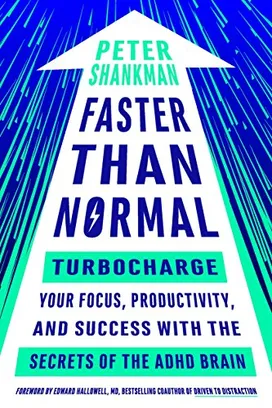
Faster Than Normal
by Peter Shankman and Edward Hallowell
Started 13 November 2025 · 239 pages
Shankman, who has ADHD, shares how he turned his restless brain into an advantage, with practical habits around exercise, diet, sleep and routines, and commentary from psychiatrist Edward Hallowell.
About the book, from Open Library. Get the book.
11 highlights · Kindle location in the margin
- 124
Like sitting in my dorm room at Boston University two days into my freshman year, asking myself why I simply couldn’t shut up every once in a while, because I’d just blurted out something that I thought was funny, but no one else in the room did, and I was sure I’d just blown the next four years of my social life.
- 126
perhaps the frequent trips to the principal’s office in grade school, where one of my parents would come collect me after school, and each meeting would start with “If he only applied himself . . .”
- 135
I get into the office super early and work before anyone else shows up, I’m so much more productive. The second the office fills with people, it’s like my brain shuts down and I start spacing out.
- 141
Here’s what matters more than anything: You’re not broken. You’re not damaged, you’re not defective, and you’re not destroyed. You’re not on the island of misfit toys, and your life isn’t “wrong” because you’ve been diagnosed with ADHD.
- 147
you’re never allowed to say “diagnosed with ADHD” again, because ADHD is not a negative. Say it with me: ADHD is not a negative! Quite the opposite. You’re gifted with a brain that’s faster than normal, and in this book, we’re going to learn how to operate it to its maximum potential. It’s going to be awesome.
- 157
Her complaints were also the same as those of every other woman I had dated: I wasn’t focused on her when we were together, but instead was doing a million different things. I was incredibly passionate about what I did for a living, but my passion for her came in spurts. While I loved doing out-of-the-blue things for her, my day-to-day actions left a lot to be desired. In her words, I was there, but I wasn’t there. Not in the sense that I wasn’t there for her if she needed me in a crisis (I had no problem with that sort of thing), but that I simply wasn’t entirely present even when I was sitting next to her on the couch. The worst part about hearing all of this, in my mind, was that it sounded like I didn’t love her at all, like she wasn’t important to me. But the opposite was true—she was the most important thing in the world to me. But I couldn’t show it on a day-to-day basis. As far as Joan could tell, I was more concerned about what I was doing on the Internet as I was sitting next to her than I was about her. And even though this couldn’t be further from the truth, and even though I worked so hard at trying to show it to her, she simply wasn’t seeing it.
- 166
In my head, I was figuring out what clothing I should buy for my new life as a multimillionaire, globetrotting playboy, despite being neither a multimillionaire nor a globetrotting playboy at the time.
- 172
Having ADHD makes life paradoxical. You can super-focus sometimes, but also space out when you least mean to. You can radiate confidence and also feel as insecure as a cat in a kennel. You can perform at the highest level, feeling incompetent as you do so. You can be loved by many, but feel as if no one really likes you. You can absolutely, totally intend to do something, then forget to do it. You can have the greatest ideas in the world, but feel as if you can’t accomplish a thing.
- 220
One of the biggest advantages and disadvantages to having ADHD is that your brain doesn’t play by the same rules as everyone else’s. You can decide to do something, and five minutes later, you’re doing it. You don’t think, “Well, what if it fails,” you simply do it. That’s both good and bad. We’re going to discuss this a lot over the course of the book, and I’m going to teach you how I’ve hacked this trait to be a lot more “good,” and a lot less “bad.”
- 256
it simply means that my body doesn’t naturally produce enough of three major “focus and happy” chemicals on its own. These chemicals are dopamine, serotonin, and adrenaline, and they’re the chemicals that make it easy for humans to concentrate and stay focused.
- 297
I’ve learned to do two things: teach my body to make more “focus and happy” chemicals on demand, and also live my life in such a way that I don’t need to constantly rely on my body making more, as “normal” people do. In other words, I’ve learned how to fill up my gas tank, but also learned how to drive so efficiently that I get the best gas mileage in the universe, by far.