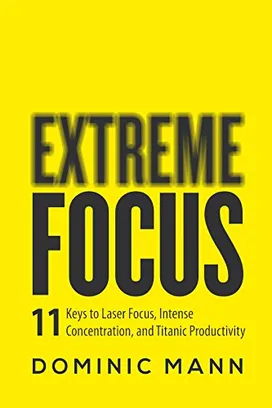
Extreme Focus
by Dominic Mann
Started 16 November 2020
A short practical guide to improving concentration and productivity through habits, environment and mental techniques.
About the book, from Open Library. Get the book.
65 highlights · page in the margin
- p. 8
He who spreads himself too thin will inevitably struggle to succeed. Concentrate all your forces on but a single target and dominate it completely.
- p. 12
Identify the 20 percent of your work that yields all the results. Focus on it. Amplify it. Likewise, eliminate (or at least minimize) the other 80 percent that’s getting you nowhere. This will not only save you time, but it will allow you to multiply the results you achieve.
- p. 16
short breaks dramatically improve our ability to focus on a task for prolonged periods.
- p. 18
"We propose that deactivating and reactivating your goals allows you to stay focused. From a practical standpoint, our research suggests that, when faced with long tasks (such as studying before a final exam or doing your taxes), it is best to impose brief breaks on yourself. Brief mental breaks will actually help you stay focused on your task!"
- p. 19
each pomodoro has to be completely uninterrupted work. If you get distracted and start doing something else, that pomodoro does not count and you have to start again.
- p. 22
When people think that they are multitasking, what they are actually doing is “task-switching.” They switch between tasks. They are not doing multiple things at once. They are doing things in quick succession.
- p. 24
To combat this, they suggest the three F’s: Focusing, Filtering, and Forgetting. Focusing means doing one thing at a time. Filtering means delegating to avoid taking on too many tasks and overloading yourself with information. Forgetting means doing things like exercising, taking breaks, and clearing your head.
- p. 25
Extreme focus requires proactivity. This means working toward a definite objective and not just being pushed around and acted upon by external forces.
- p. 26
the first step to getting focused is to ask yourself, “Do I have a single objective?” Write the objective down. Name it. Choose just ONE objective.
- p. 27
Next, tasks are not just one thing. Completing anything takes more than just one action — no matter how big or small. So the second step is to find a smaller task or action to get your started. Ask yourself, “Do I have a related small task to focus on right now?” Determine the answer and write it down.
- p. 27
Finally, the third step to getting focused is to be committed to the attainment of your objective. It’s difficult to reap the rewards of extreme focus if you’re not committed to what you’re doing. At the very least, be committed to focusing on the task at hand — even if you care not for the task itself.
- p. 28
When you lose focus, small steps are far less intimidating than considering the entire goal. Little actions allow you to quickly refocus.
- p. 33
Tony Schwartz perfectly encapsulates the secret to fully utilizing your day: “Manage your energy, not your time.”
- p. 35
The way to do this is to simply arrange our day so that it starts with the most difficult, important, cognitively demanding tasks and finishes with the easiest, least cognitively demanding tasks.
- p. 39
In his bestselling book, “The 10X Rule,” Grant Cardone
- p. 39
makes an analogy between success and having a baby. Cardone notes that we do anything and everything to keep our children alive and well — even waking up in the middle of the night countless times. He then suggests that we treat our own success in exactly the same way — as our duty.
- p. 40
Focus must be treated in the exact same way. Focus, extreme focus, must be treated as your duty. Performing at your absolute peak must be your moral obligation. And failing to live up to your potential, failing to focus, failing to perform at your peak, must be seen as a terrible sin.
- p. 42
By exercising each morning, eating healthy, sticking to work related activities, and completing tasks sequentially, you can boost your productivity by… wait for it… 98 percent.
- p. 43
And if you try some of those other things, like reducing the number of times you check email, chucking on some headphones to deter unwanted interruptions, and maybe even putting your phone on airplane mode for set blocks of time, there’s no reason you can’t triple or even quadruple your productivity.
- p. 51
The key to finding (some) enjoyment in work we otherwise hate is to focus on the positive aspects, especially the aspects that appeal to us in particular.
- p. 51
So let’s say you have to write some lame article or press release for your company. You hate it. It’s boring. You don’t want to do it.
- p. 51
Instead of saying, “Poor me, I have to write this crap. Hurry up 5pm!” you can instead focus on mastery. Write in the best possible prose ever. Try as hard as you can to master it. Make it a little masterpiece. Focus on writing beautiful, flowing prose that you just want to read over and over again. Look forward to it!
- p. 53
“Of all the virtues we can learn no trait is more useful, more essential for survival, and more likely to improve the quality of life than the ability to transform adversity into an enjoyable challenge.”
- p. 54
The key to extreme focus, whether or not you like the task itself, is to become obsessed with the process, not the result. Master small aspects of the process. Focus on components of the process, not the actual task itself.
- p. 54
Mihaly Csikszentmihalyi wrote in his bestselling book Flow: “Most enjoyable activities are not natural; they demand an effort that initially one is reluctant to make. But once the interaction starts to provide feedback to the person's skills, it usually begins to be intrinsically rewarding.”
- p. 56
“Physical fitness is not only one of the most important keys to a healthy body, it is the basis of dynamic and creative intellectual activity.” — John F. Kennedy
- p. 56
There are three main components to physical health: Exercise, diet, and sleep.
- p. 57
The average Western diet is incredibly high-carb. Cereal for breakfast, a bagel for lunch, and pasta for dinner. The only problem with such a high-carb diet is that carbs are very quickly digested. This means that the brain doesn’t have a stable source of energy throughout the day, but is instead subjected to rapid spikes and crashes in energy.
- p. 58
Most people consume lots of carbs, moderate protein, and low fat.
- p. 59
There are two ways to get off the “brain fog” diet and skyrocket your productivity with just food alone.
- p. 59
The first option is to eat low-GI (low glycemic index) foods. These foods are still high in carbs, but they take longer for the body to break down. This reduces the sudden spikes and crashes in blood sugar and provides you with a more steady source of energy throughout the day. Endurance athletes such as long-distance runners often eat low-GI foods as they provide sustained energy.
- p. 60
The second option, and my personal choice, is to virtually flip the “brain fog” diet upside down. Rather than eating high-carb, moderate protein, and low-fat, this means eating high-fat, moderate protein, and low-carb.
- p. 60
The basic mechanics behind carb-restricted diets is that the body starts burning fat for energy rather than glucose (glucose is derived from carbs and sugar). The process of the body burning fat for energy rather than carbs is known as nutritional ketosis.
- p. 64
If you want to find out more about LCHF diets — such as the ketogenic diet, paleo diet, and Bulletproof diet — I would advise you to do some research and/or consult a nutritionist.
- p. 65
the author of the bestselling book Grain Brain, neurologist Dr. David Perlmutter,
- p. 65
He actually recommends a diet of 50 percent fat — specifically “good” fats such as that found in coconut oil, nuts, avocados, olive oil, eggs, wild salmon, and grass-fed meats.
- p. 65
Bad fats are predominantly trans fats, most commonly found in vegetable oils such as canola oil, sunflower oil, safflower oil, and so on. These bad fats cause inflammation in the brain due to their high Omega-6 fatty acid content.
- p. 65
the World Health Organization emphasizes dark chocolate (such as Lindt’s 90%), nuts, seeds, and fish as brain powering foods — the best for productivity.
- p. 67
Studies consistently show that sedentary people who start doing regular exercise experience a dramatic increase in their energy levels. This effect is so pronounced, in fact, that the average effect was found to be greater than the effect of stimulant medications such as those used for ADHD and narcolepsy.
- p. 70
Finally, yet another benefit of exercise is that it increases sleep quality.
- p. 72
Flow — also known as being in “the zone” — is a mental state described by Csikszentmihalyi
- p. 72
As he writes in the book: “Enjoyment appears at the boundary between boredom and anxiety, when the challenges are just balanced with the person's capacity to act.”
- p. 73
Another component to flow is having a clear goal and receiving immediate feedback. Combined, these two aspects of flow enable one to adjust their performance. Examples of this would include violin players, composers, surfers, skiers, and so on.
- p. 73
In 2013, Owen Schaffer refined all the components of flow into seven conditions: 1. Knowing what to do 2. Knowing how to do it 3. Knowing how well you are doing (i.e. instant feedback) 4. Knowing where to go (if navigation is involved) 5. High perceived challenges 6. High perceived skills 7. Freedom from distractions
- p. 82
Other studies have also found that cluttered, messy, “disorderly” environments lead to decreased willpower and increased likelihood of making unhealthy food choices.
- p. 84
In his timeless classic, As a Man Thinketh, James Allen says the following: “Men do not attract that which they want, but that which they are.”
- p. 85
If you want to achieve success in whatever field you desire, you must become the type of person who would achieve the success you seek.
- p. 85
A fat person can’t lose weight by simply wanting to lose weight. They must become the kind of person who is slim and fit. If they are a person who lives an active lifestyle and eats healthy food, they don’t need to worry about their weight. They don’t need to worry about wanting to lose weight. You don’t attract that which you want, but that which you are.
- p. 86
"We are what we repeatedly do. Excellence, then, is not an act, but a habit." — Aristotle
- p. 86
Benjamin Franklin said: “Your net worth to the world is usually determined by what remains after your bad habits are subtracted from your good ones.”
- p. 101
It is also worth noting that, as articles like “How Many Silicon Valley Startup Executives Are Hopped Up On Provigil?” by TechCrunch and “Cognitive Enhancement: All on the Mind” by The Economist report, a growing number top executives and academics use so-called “smart drugs” (also known as nootropics) for cognitive enhancement. Many of these drugs are FDA-approved and available over the counter (or in some cases, prescription).
- p. 101
One of the most popular smart drugs is modafinil (known by its brand name “Provigil” in the US), which is known for leading to intense focus, increased alertness, and clearer thinking.
- p. 105
while research from UC Riverside shows that a 60–90 minute nap can have the same effect as an eight-hour night of sleep in terms of improving memory test results.
- p. 105
Change of Environment Our brains come to associate certain environments with certain activities. That’s why you hear medical experts advising people to not do anything in your bedroom other than sleep — no television, iPads, or laptops. Otherwise our brain will associate bed with being alert and doing work. This is also why the newly self-employed often struggle to get anything done. Their brain associates home with relaxation and unwinding, not work and productivity.
- p. 106
This is also why the newly self-employed often struggle to get anything done. Their brain associates home with relaxation and unwinding, not work and productivity.
- p. 106
To avoid the same pitfalls, try changing environments. If you struggle to get work done at home, try going to a library (or getting to work earlier and/or staying later). You’ll find extreme focus…
- p. 106
Parkinson’s Law "Work expands so as to fill the time available for its…
- p. 107
In an article titled Parkinson’s Law, The Economist wrote the following: “Thus, an elderly lady of leisure can spend the entire day in writing and despatching a postcard to her niece at Bognor Regis. An hour will be spent in finding the postcard, another in hunting for spectacles, half-an-hour in a search for the address, an hour and a quarter in composition, and twenty minutes in deciding whether or not to take an umbrella when…
- p. 107
You can apply Parkinson’s law to your own work, too. Instead of doing the leisurely half hour morning email check, force yourself to do it in five minutes. Heck, you could even try reduce…
- p. 108
You can also make a to-do list and write next to each task how long you think it should take. Then give yourself half that time and work through it all like a maniac. You’ll be shocked by how much stuff you used to do…
- p. 108
The Pomodoro technique can also be a great way to do things more efficiently by applying artificial limitations to your work. Simply assign a certain task to…
- p. 108
Create a Distraction…
- p. 108
you don’t need to eliminate distraction! Instead, simply make a distraction to-do list. Suddenly find yourself faced with the overwhelming urge to “quickly” browse your favorite subreddit? Simply write it down on a notepad next to you and get straight back to work.…
- p. 109
Not only will a distraction to-do list allow you to get important tasks done (without suddenly realizing halfway through the workday that you’ve just spent two hours mindlessly browsing the web), but studies have found that if you postpone a certain urge (i.e. desire to check out a distraction),…
- p. 110
Once we get distracted, it takes an average of 25 minutes to get back to…