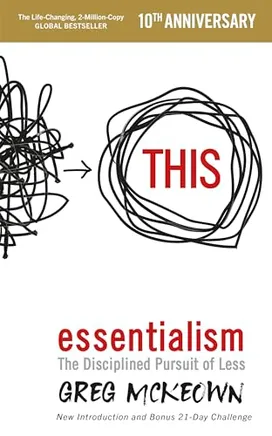
Essentialism
by Greg McKeown
Started 4 July 2021 · 266 pages
A case for doing less but better: identify what is truly essential, say no to the rest, and build systems that make execution effortless.
About the book, from Open Library. Get the book.
13 highlights · Kindle location in the margin
- 251
Now when a request would come in he would pause and evaluate the request against a tougher criteria: “Is this the very most important thing I should be doing with my time and resources right now?” If he couldn’t answer a definitive yes, then he would refuse the request.
- 257
He stopped attending conference calls that he only had a couple of minutes of interest in. He stopped sitting in on the weekly update call because he didn’t need the information. He stopped attending meetings on his calendar if he didn’t have a direct contribution to make.
- 260
by being selective he bought himself space, and in that space he found creative freedom. He could concentrate his efforts on one project at a time. He could plan thoroughly. He could anticipate roadblocks and start to remove obstacles. Instead of spinning his wheels trying to get everything done, he could get the right things done. His newfound commitment to doing only the things that were truly important – and eliminating everything else – restored the quality of his work. Instead of making just a millimetre of progress in a million directions he began to generate tremendous momentum towards accomplishing the things that were truly vital.
- 270
In this example is the basic value proposition of Essentialism: only once you give yourself permission to stop trying to do it all, to stop saying yes to everyone, can you make your highest contribution towards the things that really matter.
- 286
Less but better. A more fitting definition of Essentialism would be hard to come by.
- 287
The way of the Essentialist is the relentless pursuit of less but better. It doesn’t mean occasionally giving a nod to the principle. It means pursuing it in a disciplined way.
- 288
The way of the Essentialist isn’t about setting New Year’s resolutions to say “no” more, or about pruning your inbox, or about mastering some new strategy in time management. It is about pausing constantly to ask, “Am I investing in the right activities?” There are far more activities and opportunities in the world than we have time and resources to invest in. And although many of them may be good, or even very good, the fact is that most are trivial and few are vital. The way of the Essentialist involves learning to tell the difference – learning to filter through all those options and selecting only those that are truly essential.
- 293
Essentialism is not about how to get more things done; it’s about how to get the right things done. It doesn’t mean just doing less for the sake of less either. It is about making the wisest possible investment of your time and energy in order to operate at your highest point of contribution by doing only what is essential.
- 304
Essentialism is a disciplined, systematic approach for determining where our highest point of contribution lies, then making execution of those things almost effortless.
- 349
If you don’t prioritise your life, someone else will.
- 350
That experience gave me renewed interest – read, inexhaustible obsession – in understanding why otherwise intelligent people make the choices they make in their personal and professional lives.
- 360
And I have worked tirelessly to understand why so many bright, smart, capable individuals remain snared in the death grip of the non-essential.
- 381
the pursuit of success can be a catalyst for failure. Put another way, success can distract us from focusing on the essential things that produce success in the first place.